The sirens in São Paulo do not sound like music. They are jagged, metallic cries that slice through the humidity of a Tuesday night, signaling a shift in the air that everyone feels and nobody knows how to fix. For years, the uniform was a boundary. It meant a badge pinned to a chest, a heavy pair of combat boots hitting the asphalt, and a sworn duty to stand between the citizen and the abyss. But the asphalt has changed. The streets have grown teeth.
And the men who carry the shields have decided that a badge is no longer enough. They want a microphone. They want a gavel. They want a seat under the grand, domed ceilings of Brasília.
Across Brazil, a quiet, seismic political realignment is taking place. Police officers, military police, and retired security commanders are shedding their tactical gear for sharply pressed suits, trading the precinct for the campaign trail. They are running for Congress in unprecedented numbers, and their platform is built from the raw materials of modern anxiety. Fear is a powerful currency. In an era where urban violence feels like an uninvited guest in every living room, the men who promise to lock the door are finding eager buyers.
To understand why this wave is cresting now, you have to walk down a narrow avenue in Rio de Janeiro just as the sun dips below the favelas, turning the sky the color of bruised plums.
Imagine a veteran patrol officer—let us call him Marcelo, though his face is stitched together from a thousand men I have spoken with over twenty years of reporting. Marcelo has spent twenty-four years in the line of fire. He has seen the rusted barrels of unregistered pistols pointed at his windshield. He has attended the funerals of rookies whose boots were still shiny. He knows the weight of a bulletproof vest that smells of old sweat and rain.
When Marcelo talks about the state of the nation, he does not speak in the clinical jargon of political scientists. He speaks of a deep, creeping exhaustion. He tells you about patrolling neighborhoods where the state’s writ runs out at the corner grocery store. He tells you about feeling abandoned by the very politicians who write the laws governing his safety.
"We are told to hold the line," Marcelo once told me over a cup of bitter, black coffee that tasted like charcoal. "But the people writing the rules have never had a stone thrown at their head. They sit in air-conditioned rooms in Brasília while we bleed in the gutters. If we want protection for our families, and for the people we swore to protect, we have to go there ourselves."
That sentiment is the beating heart of this movement. It is an insurgent political wave born of disillusionment. For decades, traditional politicians treated public security as an afterthought—a budget line to be slashed or a problem to be solved with tired rhetoric. But as crime rates fluctuated and public trust in conventional institutions eroded, a vacuum opened.
Enter the men of law and order.
They bring with them a distinct brand of authority. In a fractured political landscape, the uniform represents a visceral kind of competence. To a tired voter staring at inflation figures and headlines about armed robberies, a candidate who has actually worn body armor looks less like a smooth-talking career politician and more like a savior. They promise order. They promise swift justice. They promise to bring the discipline of the precinct to the chaos of the legislature.
Yet, this shift carries a profound, complicated tension that goes to the very marrow of Brazilian democracy.
When active-duty or retired security forces enter the political arena en masse, the line between civilian governance and armed authority begins to blur. Historically, Latin America has a fragile relationship with militarism. The ghosts of past dictatorships still rattle chains in the national memory. Every time an officer steps up to a podium adorned with the national flag to denounce political corruption and promise an iron-fisted restoration of order, a familiar anxiety stirs in the hearts of those who remember what happens when the men with guns also write the laws.
Is it a defense of society, or is it the militarization of politics?
The truth, as it usually is, lives in the gray shadows between those two absolutes.
The officers running for Congress are not monolithic. Some are genuine reformers who want to overhaul a broken penal system, improve training for rank-and-file officers, and secure better mental health resources for a police force suffering from staggering rates of PTSD and suicide. They have lived through the systemic failures of the system from the inside. They know that throwing more boots on the street without fixing the root causes of crime is like putting a band-aid on a severed artery.
Others, however, ride a more dangerous wave. They lean into populist demagoguery, leveraging the public's legitimate fear of crime to push policies that erode civil liberties, expand extrajudicial police powers, and brand any dissent as an ally of criminality. For these candidates, the uniform is a prop, and the campaign trail is a march toward unyielding control.
This is the invisible stake in the upcoming elections. Voters are not just choosing between left and right, or between economic plans. They are voting on the soul of the state's monopoly on legitimate force.
Consider what happens when the enforcers become the lawmakers. When the person writing the statute on police accountability is a former commander who believes the badge can do no wrong. When the legislature begins to mirror the hierarchy of the barracks. The checks and balances that keep a democracy breathing depend entirely on the separation of powers. When that separation is colonized by corporate interests, activist groups, or, in this case, the military and police apparatus, the equilibrium shifts in ways that can be difficult to reverse.
And yet, you cannot simply dismiss the anger that fuels this movement. To tell a mother living in a neighborhood dominated by armed factions that she should worry about democratic theory while her teenage son dodges crossfire on his way to school is an insult to her reality. The traditional political class failed these communities first. The rise of the police candidate is a symptom of that failure, a loud, undeniable referendum on decades of institutional neglect.
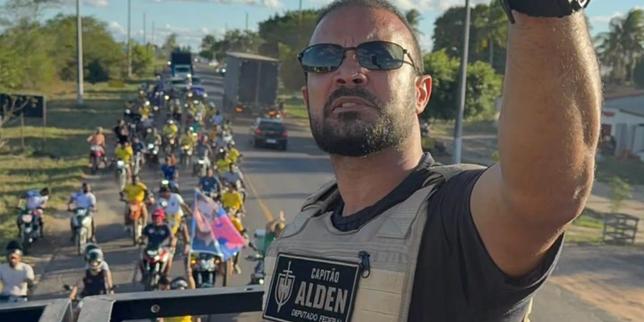
The campaign rallies of these security candidates have a different energy than standard political events. They are orderly. The crowds do not wave banners with lighthearted slogans; they carry flags, wear green and yellow, and nod with solemn agreement as speakers thunder against lawlessness. There is a palpable hunger for certainty. In a world where the future feels terrifyingly unscripted, the promise of a firm hand is intoxicating.
We are watching a fundamental re-definition of who gets to speak for the nation.
As these candidates fan out across the country, knocking on doors in middle-class suburbs and speaking at packed community centers in working-class districts, they carry with them the weight of Brazil's deepest contradictions. They are the symbols of state protection and, to many marginalized communities, the symbols of state terror. They are the ultimate insiders of the security apparatus and the ultimate outsiders in the polished halls of institutional politics.
The siren outside continues to wail, cutting through the heavy night air. Somewhere out there, a patrol car is moving through the dark, its blue lights painting the cracked pavement in flickering shades of neon. Inside that car, an officer grips the steering wheel, wondering if his future lies on the next shift, or on a ballot paper that could change the destiny of a continent.