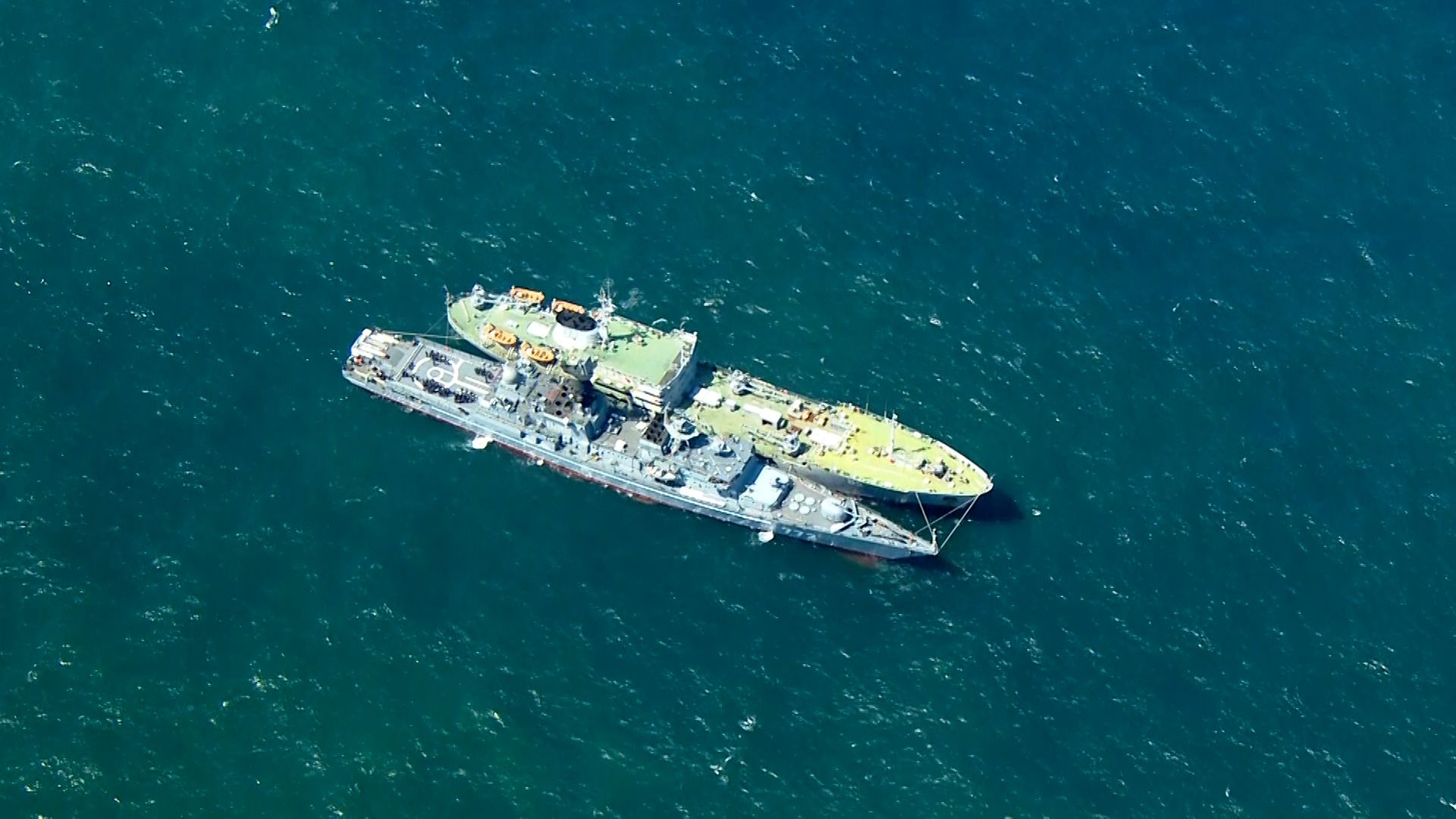
The Water Is Cold, the Radar Is Hot
Forty-six miles off the jagged coastline of northern Scotland, the North Sea does not care about diplomacy. It is a vast, slate-grey expanse of churning saltwater where wind cuts through heavy canvas coats and the horizon bleeds continuously into low-hanging clouds.
For the crew of a commercial trawler out in those grey swells, a typical morning smells of diesel, salt, and wet gut-lined scales. But on a Tuesday morning, the air changes. The hum of the vessel's radar flickers. A silhouette emerges through the salt spray—a steel wedge, dark and jagged, carving through the swell without a radio signature.
Then comes the thump.
It is not a explosion you hear first; it is a physical displacement of air that hits your chest like a dropped sack of sand. Seconds later, a plume of sea spray shoots sixty feet into the freezing sky. A Russian frigate, heavily armed and operating just outside British territorial waters, has begun live-fire artillery drills.
The Ministry of Defence in London registers the event with calculated, sterile language: routine monitoring, international waters, no immediate breach. But out on the deck of a trawler, or in the combat operations room of a shadowing Royal Navy frigate, there is nothing routine about twelve tons of floating steel testing its deck guns within eyeshot of the coast.
The Chessboard Without a Board
To understand what happened forty-six miles off the UK coast, you have to forget maps drawn on paper. Mapmakers draw neat blue lines twelve nautical miles from shore to mark sovereign territory. To a military tactician, those lines are faint pencil marks drawn across an open field.
Consider a hypothetical Royal Navy watch officer standing on the bridge of HMS Somerset. Let us call him Lieutenant Miller. Miller does not see the sea as water; he sees it as acoustic layers, thermal boundaries, and weapon engagement zones. When a Russian vessel like the Admiral Gorshkov class moves into the English Channel or the North Sea, Miller’s entire world narrows down to a glowing green screen and the steady ticking of a stopwatch.
International maritime law permits warships to sail through international waters—and forty-six miles out is indisputably international space. They can steam through. They can even conduct maneuvers.
So why perform live-fire drills so close to another nation's front door?
It is the naval equivalent of standing on a public sidewalk, staring directly into a neighbor's living room window, and loudly racking the slide of a hunting rifle. It breaks no municipal code, yet it changes the temperature of the entire street.
The Cold Logic of Provocation
Nations do not burn expensive fuel and fire million-dollar shells into the ocean just for target practice. Every maneuver is a sentence in a silent, dead-serious conversation between military intelligence apparatuses.
When a foreign warship fires its weapons within sight of a coast, it achieves three specific goals.
First, it measures response times. The moment that hull flashes on radar, NATO monitoring stations light up. Signals intelligence aircraft launch from nearby airbases. Royal Navy escorts scramble from port. By firing a shell into the sea, the foreign ship triggers a cascade of electronic signatures. Russian sensors onboard record every radar frequency, every radio transmission, and every deployment timeline the defending military uses to respond.
Second, it tests nerve. In times of heightened global tension, fatigue is a weapon. Forcing defense forces to maintain high-alert status day after day drains crews, burns through maintenance schedules, and creates operational friction.
Third, it sends a message home and abroad. It demonstrates reach. It tells adversary populations that the ocean is not a shield.
What It Feels Like on the Front Line
It is easy to analyze geopolitical strategy from a dry room with carpeted floors. It is entirely different to experience it where the salt freezes on your eyebrows.
Imagine standing on the deck of a monitoring ship. The wind is fifty knots. The sea is rolling twenty-foot troughs that make the deck drop out from under your boots every eight seconds. Your fingers are numb inside heavy leather gloves, but you cannot take your eyes off the optic target tracker.
You know the rules of engagement. You know that one misread signal, one tracking radar locked on for three seconds too long, or one panicked reaction from a green sailor could turn a tense standoff into an international crisis.
The noise of a live-fire exercise is deafening. The main gun of a modern frigate releases a high-pitched, metallic crack that tears through the roar of the ocean. The shockwave ripples across the surface of the sea, killing small fish and sending shockwaves through the hulls of nearby civilian ships.
The civilian fishermen reel in their lines. They pull back toward port, leaving the steel predators to their dance.
The Invisible Stakes
We live in an age where most threats arrive via fiber-optic cables or satellite feeds. We forget that the world’s true supply lines remain stubborn, physical things laid across cold oceans.
Underneath the exact patch of grey water where those artillery shells splashed down lie critical infrastructure: subsea communication cables carrying trillions of dollars in daily financial transactions, natural gas pipelines feeding energy to millions of homes, and commercial shipping lanes that keep supermarket shelves stocked.
A warship firing guns near these corridors is not just flexing military muscle; it is hovering over the jugular of modern civilization.
Navies call this grey-zone warfare. It operates in the space between peace and war—a space where rules are stretched until they fray, but never quite snapped. It relies on the knowledge that the other side wants to avoid escalation just as much as you do, creating a dangerous game of maritime chicken.
A Shadow That Lingers
Eventually, the gun barrels cool. The smoke clears, dissolved by the biting Atlantic wind. The foreign vessel turns its bow back toward the open ocean, slipping into the fog as quietly as it arrived.
On shore, the news cycle moves on within twenty-four hours. Reports are filed, press secretaries issue carefully calibrated statements, and the public resumes its daily routine.
But out on the water, the water does not forget.
The Royal Navy escort continues its slow, rhythmic patrol, tracing the edge of the territorial limit. Lieutenant Miller stares out into the darkening twilight, watching the blank horizon where the shadow was just hours before.
The guns have gone quiet, but the silence that follows them feels heavy, fragile, and temporary.