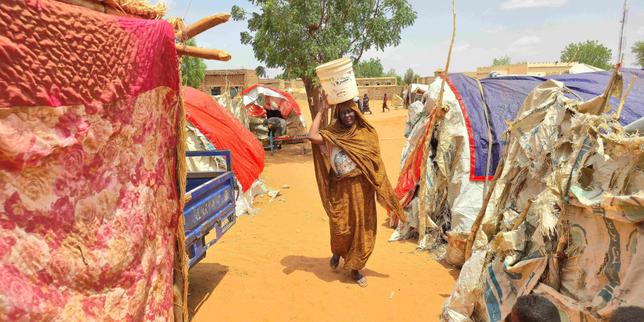
The sound of a plastic jerrycan dragging against dust has become the metronome of survival. It is a dull, scraping noise, repeated thousands of times before the sun even clears the horizon. In El-Obeid, the strategic capital of North Kordofan, mornings do not begin with the smell of coffee or the bustle of a thriving market anymore. They begin with the desperate calculation of thirst.
For months, the paramilitary Rapid Support Forces have tightly encircled this city. They hold the crossroads. They control the highways. Most critically, they control the access points to the outside world, effectively turning a bustling hub of hundreds of thousands of people into an open-air pressure cooker.
To understand what is happening here, one must look past the sterile maps deployed by international analysts. On those maps, El-Obeid is a dot at a geopolitical intersection. On the ground, it is a mother named Hawa waiting six hours under a blistering sky just to fill a single container with brackish water from a makeshift well.
The Geography of Thirst
Water is the first weapon of a modern siege. When the power lines are cut and the pumping stations lack fuel, the taps go dry. The city’s main water reservoirs, located outside the defensive perimeter, fell early under the influence of the surrounding forces. What remains inside is a dwindling, contaminated supply.
Consider the simple physics of survival. A human being needs a minimum of a few liters of water a day just to function in the Sudanese heat, where temperatures routinely climb past forty degrees. When a city of over half a million people is cut off, traditional logistics collapse entirely. Donkey carts, once a modest fixture of local commerce, have become the primary distributors of life. But even the donkeys must eat, and fodder prices have skyrocketed along with everything else.
The price of a single barrel of water has multiplied exponentially. For a family that has lost its income because businesses have shut down and public salaries have vanished, buying water means choosing to go without food. It is a slow, grinding mathematical trap.
The Market of Scarcity
Walk through the central market of El-Obeid today and the change is stark. This was once the proud heart of the global gum Arabic trade, a place where merchants exchanged goods from across the continent. Now, the stalls are mostly empty planks of wood.
Food does not arrive by miracle. It arrives via trucks that must navigate a labyrinth of checkpoints, extortions, and active combat zones. Every kilometer of road held by armed groups adds a premium of fear and cash to the price of flour, oil, and sugar. When a shipment does make it through the blockade, the prices are completely detached from the reality of what local residents can afford.
Looting is a constant shadow. Warehouses have been systematically emptied over the course of the conflict. What little remains is hoarded or guarded with desperate intensity. The economy has devolved into something primitive and brutal: bartering what few valuables are left for a handful of grain.
Inside the Wards of Dust
If the markets are quiet, the hospitals are deafeningly loud, even in their silence. The healthcare system here is not just failing; it is being starved to death.
Medical professionals who chose to stay behind face a nightmare of shortages. Imagine trying to perform surgery by the flickering light of a smartphone because the hospital generator ran out of diesel hours ago. Imagine telling a diabetic patient that there is no insulin left because the cold-chain storage broke down when the power grid failed.
Kidney dialysis patients face what amounts to a deferred death sentence. Without the specific chemical solutions and a steady supply of clean water required to run the machines, treatments are cut from three times a week to once, then to nothing at all. The doctors know the math. The patients know it too. They sit in the waiting rooms, watching each other grow weaker, waiting for a shipment of medical supplies that everyone knows is stuck at a checkpoint hundreds of miles away.
The Terror of the Quiet Hours
But the physical deprivation is only half the burden. The psychological weight of encirclement is a heavy, invisible fog. In El-Obeid, people live in fear of a sudden breakthrough. They look toward the cities of Darfur to the west, where similar sieges ended in catastrophic tribal violence, mass displacement, and slaughter. The memory of those atrocities hangs over every conversation.
Every loud noise triggers a sudden freeze. A car backfiring, a distant thunderclap, the rumble of a heavy vehicle—all of them sound like the beginning of the final assault. Shelling is sporadic but lethal. An artillery round drops blindly into a residential neighborhood, shatters a home, kills a child, and then the silence returns. It is the unpredictability that breaks people.
The internet and phone networks are highly unreliable, frequently cut off for days at a time. This digital isolation is a deliberate tactic. When the lines go dead, rumors fill the void. Are the paramilitaries at the gates? Has the defensive line collapsed? Is anyone coming to help? Without reliable information, panic becomes an infectious disease. Families pack small bags with their remaining documents and clothes, sitting on their floors, waiting to decide whether to flee into the desert or hide under their beds.
The Roads to Nowhere
Fleeing is not a simple choice. The roads out of El-Obeid are gauntlets. Leaving means risking everything at the checkpoints that ring the city limits. Travelers report being stripped of their savings, their phones, and their dignity. For young men, crossing these lines carries the immense risk of arbitrary detention or forced conscription.
The desert itself is unforgiving. Those who attempt to bypass the main roads must walk for days through arid terrain without adequate water, exposed to banditry and the elements. Many simply do not make it to the safer regions of the north or east.
This leaves the population trapped in a terrible stasis. They cannot stay comfortably, and they cannot leave safely. They are stuck in the middle of a conflict they did not ask for, pawns in a broader struggle for control of the nation’s soul and resources.
The Fading Collective Voice
The international community speaks of Sudan in broad, sweeping generalities. It tracks the macro-movements of armies and the fluctuating percentages of food insecurity. But these metrics fail to capture the granular reality of a society being disassembled piece by piece.
The local emergency response rooms—run by young volunteers, neighbors, and local activists—are the only thin barrier preventing total societal collapse. These makeshift groups organize communal kitchens, manage the distribution of what little water can be found, and try to maintain a semblance of order. They do this at immense personal risk. Volunteers have been targeted, arrested, and killed by both sides of the conflict, viewed with suspicion simply because they refuse to stop helping their communities.
As the weeks turn into months, even these networks are fraying. Resources are completely exhausted. The volunteers are as hungry and tired as the people they are trying to save.
The sun begins to set over El-Obeid, painting the sky in deep shades of orange and dust. The scraping sound of the plastic jerrycans fades for a few hours as darkness takes over. The city grows dark, save for the occasional candle or flashlight. The residents retreat indoors, locking their doors against the night, listening closely to the horizon, wondering if tomorrow will bring relief or the violence they have spent months trying to outrun.


