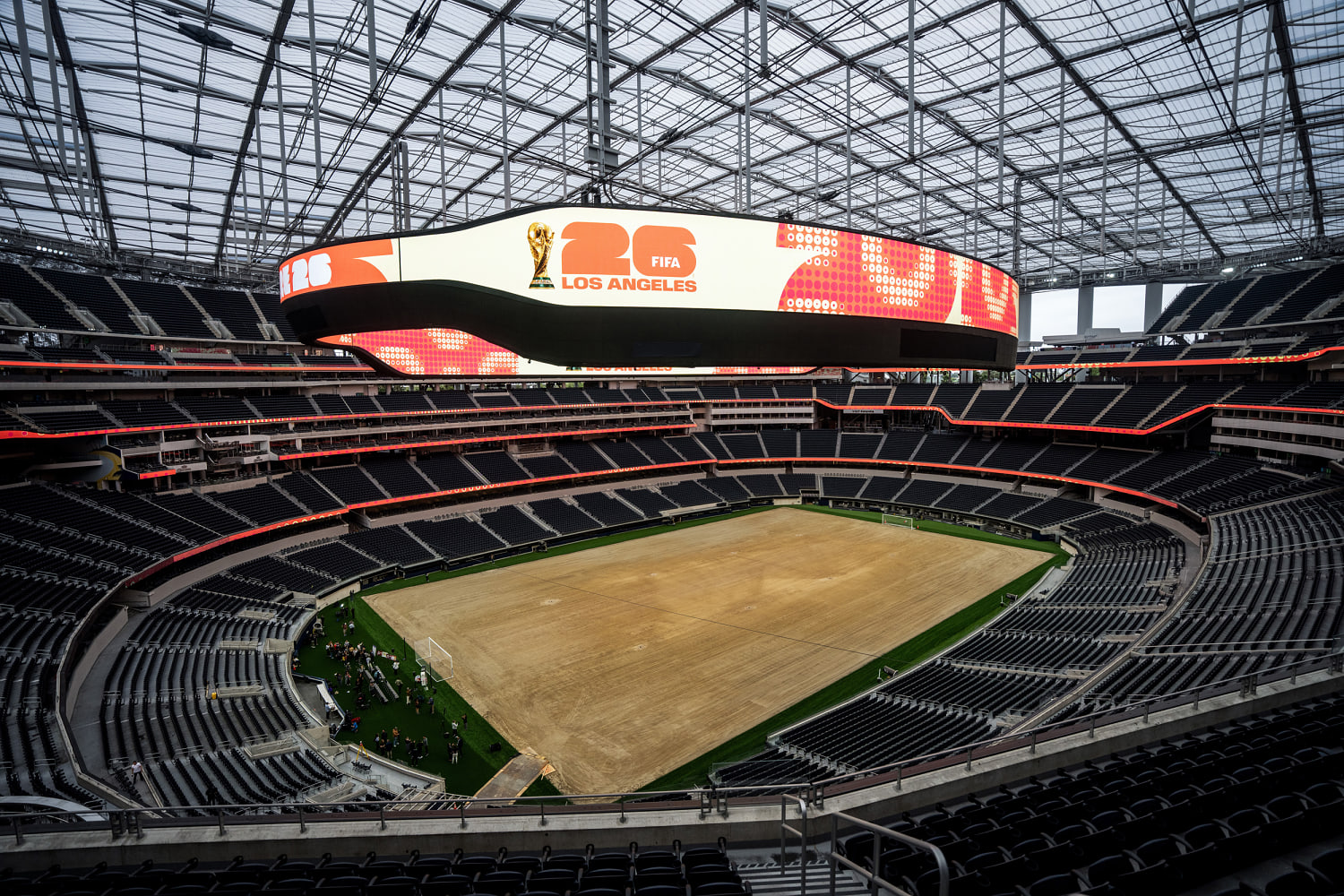
The roar of 70,000 voices is a physical weight. It presses against your chest, vibrating through the concrete of the stadium floor and into the soles of your shoes. This is the 2026 World Cup. On the pitch, the world’s most gifted athletes are chasing a ball with a precision that borders on the supernatural. In the stands, a father named Mateo—a name we will use to represent thousands in his position—is holding his daughter’s hand so tightly his knuckles are white.
He isn't just worried about a missed penalty kick.
Mateo has lived in the United States for fifteen years. He pays taxes. He coaches youth soccer on weekends. But he lacks the specific set of papers that the government deems necessary for a "legal" existence. For Mateo, the World Cup coming to North America was supposed to be a dream. Instead, it feels like a beautifully manicured trap.
The Invisible Presence at the Gate
The news began to circulate quietly at first, then with the force of a gale. Immigration and Customs Enforcement (ICE) and Customs and Border Protection (CBP) will have a presence at World Cup venues. To the casual fan, this sounds like a standard security measure—just more uniforms in a sea of high-visibility vests. To others, those uniforms change the chemistry of the air itself.
Official government statements frame this as a matter of "inter-agency cooperation" and "national security." They point to the sheer scale of the event, the millions of international visitors, and the logistical nightmare of policing sixteen different host cities. From a bird’s-eye view, the logic is sterile and unassailable. Why wouldn't the nation's primary border and immigration agencies be present at the largest international gathering on earth?
But the view from the ground is different. When you inject deportation officers into a space defined by celebration, you create a friction point that heat-maps the fractures in American society.
Consider the mechanics of a modern stadium. It is a masterpiece of surveillance. High-definition cameras with facial recognition software sweep the crowds. Biometric scanners are becoming the norm for entry. In this environment, "security" is a sliding scale. For a tech executive from Palo Alto, it’s a convenience. For Mateo, it’s a digital dragnet.
The Policy of Presence
The Department of Homeland Security (DHS) has designated the World Cup as a SEAR 1 event—the highest level of Special Event Assessment Rating. This puts it on par with the Super Bowl or a Presidential Inauguration. This designation triggers a massive influx of federal resources. It’s a literal army of coordination.
Under this umbrella, ICE and CBP aren't just there to check passports at the airport. Their jurisdiction extends deep into the interior, especially within the "100-mile border zone" where their authorities are significantly expanded. Many of the host stadiums, from Los Angeles to Miami, fall squarely within this zone.
The official line is that these agents are there to combat human trafficking, counterfeit merchandise, and "bad actors." These are noble goals. No one wants a World Cup fueled by forced labor or marred by violence. However, the presence of these agencies creates a psychological "chilling effect." This isn't a legal term; it's a human one. It describes the moment a person decides to stay home, to hide, to miss their child’s milestone because the risk of a routine encounter is too high.
Imagine the conversation at Mateo’s kitchen table. His daughter, born in Chicago, wearing a jersey with a name she can barely pronounce, begs to see the game. Mateo looks at the ticket prices—high, but manageable for a once-in-a-lifetime memory—and then he looks at the news. He sees the acronyms. He sees the black tactical vests. He decides the price of a memory might be his entire life in this country.
The Geometry of Fear
The tension lies in the overlap of two very different Americas. One America views the police and federal agents as a shield. The other views them as a sword.
Critics of the DHS presence argue that using a sporting event to facilitate immigration enforcement undermines the spirit of the "Global Game." They argue it turns a theater of dreams into a theater of dossiers. If an undocumented fan is involved in a minor scuffle or even witnesses a crime, will they report it? Or will the fear of the person in the green or navy uniform keep them silent?
Safety is a collective endeavor. When a significant portion of the crowd is terrified of the "safety" providers, the entire system becomes more fragile.
The federal government insists that they are not conducting "sweeps" or "raids" at the matches. They claim the focus is on high-level threats. Yet, the history of immigration enforcement in the United States is a history of mission creep. A focused search for a smuggler can easily turn into a "collateral" arrest of a bystander whose only crime is being in the wrong zip code without a visa.
The Economics of Exclusion
There is a cold, hard business reality here too. FIFA, the governing body of world soccer, prides itself on inclusivity. Their marketing is a rainbow of nations, a symphony of "oneness." But the reality of a World Cup held in a country with a deeply polarized immigration policy is anything but unified.
Host cities have spent billions to lure these matches. They expect a return on investment that goes beyond ticket sales—they want the world to see them as vibrant, welcoming global hubs. When the headlines shift from "Hat-trick in Houston" to "Arrests in the Parking Lot," the brand takes a hit.
The invisible stakes are the billions of dollars in "dark labor" that actually built the infrastructure for this tournament. The hotels were cleaned, the grass was sodded, and the roads were paved by hands that the government now says aren't supposed to be here. There is a profound irony in a stadium built by undocumented labor being a place where those same workers are too afraid to sit.
A Tale of Two Gates
To understand the stakes, you have to look at the gate.
At Gate A, a tourist from London walks through. He’s had a few beers. He’s loud. He loses his ticket. An officer helps him find his way, laughs off his rowdiness, and sends him on his way. The system worked.
At Gate B, someone like Mateo walks up. He is quiet. He is following every rule. But his heart is hammering against his ribs. He sees the K-9 unit, the tactical gear, and the badge. To him, that badge isn't a symbol of order. It's a symbol of a shattered family. He isn't worried about the game; he’s calculating the nearest exit, the quickest route to his car, the phone call he’ll have to make if things go wrong.
The World Cup is supposed to be the one time the world speaks the same language. We use the vocabulary of goals, fouls, and overtime. It is a brief, shining window where the borders on a map matter less than the lines on the grass.
But as the 2026 tournament approaches, that window is being fitted with bars. The presence of federal immigration agents at the matches is more than a security detail. It is a reminder that even in our most joyous, most global moments, we cannot outrun the shadows of our own policies.
The whistle blows. The ball is kicked. The crowd erupts. And somewhere in the upper deck, a man looks over his shoulder, wondering if the person standing behind him is there to watch the game or to take him away from it.
The lights of the stadium are bright enough to be seen from space, but they still cast long, dark shadows on the ground.