The air inside the clinic smelled of wet cement, dried sweat, and the sharp, chemical tang of chlorine. It was three in the morning in the heart of the equatorial forest. Outside, the cicadas hummed a frantic, unbroken static that drowned out the distant rustle of canopy leaves. Inside, a nurse whose eyes held the exhaustion of three consecutive night shifts stared at a clipboard, her pen hovering over a blank line.
She did not want to write the next name.
Writing the name meant acknowledging the math. The math was terrifying.
For decades, the invisible predator of the rainforest had played by a predictable set of rules. It struck, it burned through a village, and it burned itself out. The distances between settlements acted as moats. The jungle, hostile and dense, slowed down the march. But biology is not static. It mutates. It learns. And beneath the humid canopy of Central Africa, Jean-Jacques Muyembe watched the old rules shatter into dust.
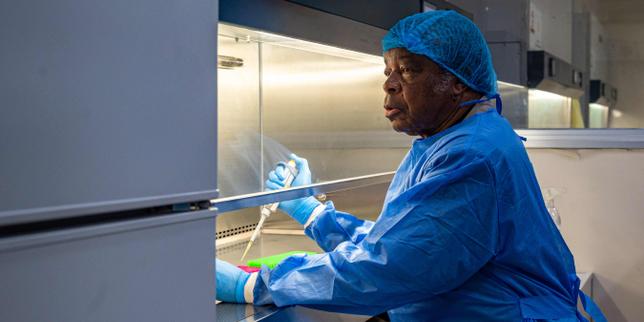
Listen to him speak of it, and you hear the quiet dread of a man who has stared into the abyss for half a century. Muyembe was there at the very beginning. Back in 1976, when a strange hemorrhagic fever first bled from the mission station of Yambuku, he was among the young scientists sent to untangle the mystery. He walked through the wards where people were dying in the dark, touching the tragedy with his own hands, drawing blood samples with trembling fingers. He mapped the footprint of the beast before the world even had a name for it.
He thought he knew its habits. He thought it was a slow-moving giant.
He was wrong.
Ebola is no longer walking. It is sprinting.
Consider what happens when a virus encounters modern momentum. The old outbreaks were isolated by geography, contained by the natural friction of rural life where footpaths connected mud-brick homes and motorized vehicles were rare. Today, those same footpaths have paved over into bustling trade routes. Dust roads are highways. Isolated hamlets are now densely packed peri-urban sprawls where thousands of people share a single water pump and cross provincial borders before dawn.
When the virus jumps into a mobile population, the physics of transmission change entirely. In a hypothetical scenario that epidemiologists model with cold sweat, a single asymptomatic carrier boards a crowded minibus in a forest clearing at sunrise. By noon, that carrier has passed through three transit hubs, shaking hands, sharing food, and coughing into the recycled air of an air-conditioned cabin. By nightfall, they have arrived in a city of two million souls.
The virus does not need wings. It catches a ride on human connection.
This is the core realization that haunts the laboratories in Kinshasa. The speed of the spread has outpaced the speed of traditional containment. Contact tracing, once a reliable shield, is like trying to catch smoke with bare hands when hundreds of anonymous contacts disperse into a labyrinth of alleyways every single hour.
Fear is an accomplice. It always has been. When a disease arrives with the brutality of hemorrhagic fever, stripping away dignity and life in a matter of days, reason retreats. People hide their sick loved ones under corrugated iron roofs. They whisper secret burials in the dead of night to escape the quarantine teams in their eerie white hazmat suits. You cannot blame them. Panic is a deeply human response to an inhuman horror. If your child is burning with a fever and men in plastic masks arrive to take them away to a place of no return, instinct screams at you to run, to hide, to deny.
Yet, denial is fuel for the fire.
Muyembe spent his life fighting not just the microbe, but the heavy curtain of mistrust that falls between rural communities and centralized authorities. Science without empathy is just arithmetic. He understood early on that you cannot conquer a virus in a laboratory while ignoring the human heart that pumps it through the population. You have to sit with elders. You have to drink bitter coffee on wooden porches and listen to the rumors, the grief, and the anger. You have to earn the right to be heard over the deafening roar of superstition and institutional abandonment.
Progress has been hard-won. The decades following Yambuku were marked by frustrating blind spots where doctors could only offer palliative care, holding hands as patients slipped away. But science is stubborn. Through sheer grit, researchers built an arsenal. Experimental vaccines emerged from the crucible of trial and error. Monoclonal antibody treatments, once a distant fantasy, began to pull people back from the very edge of the grave.
Yet, an arsenal is only as good as the soldiers carrying it and the supply lines feeding the front lines.
When the virus accelerates, the supply lines fracture. Vaccines require ultra-cold storage chains that fail when diesel generators sputter out in the midday heat. Trained medical personnel are a scarce resource, stretched so thin across vast geographic expanses that a single outbreak in the east can drain the capacity of an entire nation. The health workers themselves become casualties, falling at their posts like exhausted sentries.
We look at global health security through the lens of stock market indices and geopolitical summits, but the reality is microscopic and visceral. It is a wet palm gripping a bed rail. It is a vial of blood spinning in a hand-cranked centrifuge. It is the hollow echo of an empty chair at a dinner table in a village where half the family is gone.
The warning issued by the veteran virologist is not a routine bureaucratic bulletin. It is a klaxon sounding in the dark.
The speed of the current transmission curves tells us that the safety margins we once relied upon have evaporated. The buffer zones are gone. What happens in a remote clearing in the equatorial basin no longer stays there. It ripples outward with the speed of global commerce and human migration.
We stand at an intersection of vulnerability and capability. We possess the tools to stop the march, but only if we deploy them with a urgency that matches the enemy. Hesitation is fatal. Complacency is an invitation.
The cicadas outside keep up their frantic static, indifferent to the fragile architecture of human survival. Inside the clinic, the nurse finishes writing the name. She looks down at the page, takes a slow, deep breath, and looks up toward the door, waiting for the next footsteps in the dark.