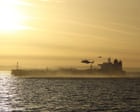
British Royal Marines commandos sliding down fast-ropes onto the deck of the oil tanker Smyrtos 25 miles south of the Isle of Wight marked the end of Western patience with Russia's maritime evasion tactics. The high-stakes, six-hour military operation executed on June 14, 2026, was not a mere customs inspection. It was the first time the United Kingdom deployed full kinetic military capabilities to physically board and seize a piece of the Kremlin's prized shadow fleet in international waters, dealing a direct blow to the illicit logistics network funding the war in Ukraine.
While Western allies have relied heavily on financial blockades and paper designations, this physical intervention changes the geometry of maritime enforcement. The 244-meter crude carrier, loaded with roughly 600,000 barrels of Russian oil from Ust-Luga, was intercepted under the authority of international law regarding stateless vessels. British officials openly acknowledge that the Kremlin will strike back. Shipping corridors worldwide are bracing for asymmetric retaliation, ranging from electronic warfare to tit-for-tat vessel seizures.
The Strategy Behind the Boarding
For two years, the Western strategy against Russian oil relied on a price cap framework that assumed Moscow would obey global banking and insurance rules. Instead, Russia built a parallel maritime ecosystem. They assembled an estimated 600 to 700 elderly, poorly maintained tankers operating entirely outside G7 corporate oversight.
The Smyrtos is the textbook definition of this ghost armada. Formerly known as the Myrtos, the vessel systematically cycled through ownership structures, shell companies, and regulatory registries to obscure its true operators. It was already blacklisted by the UK, European Union, Canada, and Switzerland. Yet, it continued to haul crude from Baltic ports toward Mediterranean and Asian hubs with impunity.
The legal vulnerability that British authorities exploited was the ship's flag. By claiming registration under the flag of Cameroon while carrying fraudulent documentation, the vessel effectively operated as a stateless entity in international waters. Under Article 110 of the United Nations Convention on the Law of the Sea, warships possess a right of visit to verify a vessel's nationality if there are reasonable grounds to suspect it is flying a false flag. Once Royal Marines and National Crime Agency officers established that the Cameroonian registry was fraudulent, the ship lost its sovereign protections. It became an international outlaw, subject to domestic British seizure laws.
The operation required a massive mobilization of force. A Type 23 frigate, HMS Sutherland, tracked the tanker for days before the assault. The final strike utilized a multi-service task group: Merlin, Wildcat, and Chinook helicopters from the Maritime Air Group provided air cover and insertion capabilities, supported by an RAF P-8A Poseidon maritime patrol aircraft, while the mine warfare vessel HMS Ledbury assisted in securing the perimeter. This level of military commitment signals that European nations are no longer willing to let paperwork do the job of warships.
Expecting the Russian Blowback
The Kremlin view of these operations is straightforward: they classify them as state-sponsored piracy. Security officials in London and Paris have spent the days following the raid calculating how, not if, Moscow will respond.
Potential Flashpoints for Russian Retaliation
├── Asymmetric Sabotage: GPS jamming and AIS spoofing in chokepoints like the English Channel and Danish Straits.
├── Proxy Legal Seizures: Detaining Western-flagged commercial vessels in the Persian Gulf or Russian-controlled waters using invented regulatory infractions.
└── Direct Naval Harassment: Deploying Russian surface combatants to aggressively shadow and intimidate Western merchant shipping.
The signs of friction are already appearing. Just forty-eight hours after the Smyrtos was boarded, a Russian frigate, the Admiral Grigorovich, fired warning shots near a British pleasure yacht in the English Channel. While the Ministry of Defence downplayed the incident as an act of nervous overreaction rather than direct retaliation, it highlights the razor-thin margin for error currently existing in European waters.
Naval intelligence sources indicate that any deliberate Russian response is unlikely to happen immediately or in the English Channel, where NATO land-based air power is absolute. Instead, the retaliation will likely be asymmetric and global. The most vulnerable targets are British-flagged or Western-owned commercial vessels transiting international chokepoints where Russia holds local naval leverage, such as the eastern Mediterranean, the Red Sea, or the Arctic routes.
Historical precedents suggest Russia may borrow tactics from its allies. In 2019, when British Royal Marines detained the Iranian tanker Grace 1 off Gibraltar for violating Syrian sanctions, Iran's Islamic Revolutionary Guard Corps waited several weeks before launching a heliborne assault to seize the British-flagged Stena Impero in the Strait of Hormuz. Moscow possesses the exact same capabilities and significantly deeper global reach.
The Fragmented Enforcement Net
While the seizure of the Smyrtos is a tactical victory, it highlights a fractured European enforcement landscape that relies on physical interventions rather than a unified legal framework. Denmark, Sweden, Finland, and France have all executed individual detentions over the first half of 2026, yet these actions remain fragmented.
The French navy led the seizure of the tanker Tagor off the coast of Brittany earlier in June, working in close intelligence coordination with the British. This demonstrates an emerging European coalition of the willing, determined to turn the English Channel and the North Sea into a hostile environment for Russian oil logistics.
However, physical interdictions are incredibly resource-intensive. The operation to seize one single tanker required multiple capital ships, specialized commando units, and continuous long-range aerial surveillance over a six-hour window. Replicating this model across a fleet of several hundred ghost ships is logistically impossible for European navies already stretched thin by commitments in the North Atlantic and the Mediterranean.
Shadow Fleet Profile vs. Standard Fleet Profile
====================================================================
Characteristic       Shadow Fleet Tanker       Standard Merchant Vessel
--------------------------------------------------------------------
Average Age          15–20+ Years              Under 10 Years
Insurance            Unregulated / Sovereign   P&I Club (Western Backed)
Flag Protection      Flags of Convenience      Verified National Registry
Tracking Integrity   Frequent AIS Blackouts    Continuous Broadcasting
====================================================================
The real impact of the Smyrtos operation is commercial rather than material. By proving that a false flag or a shell company structure will no longer prevent physical military intervention, the UK and France have dramatically altered the risk calculus for the maritime industry. The shadow fleet relies on merchant captains, international crews, and technical managers who are willing to operate in a gray zone for high premium payouts.
When the Indian captain of the Smyrtos was escorted off his ship in handcuffs and charged with criminal sanctions violations under UK domestic law, the personal risk for every mariner operating within the Russian network skyrocketed. Insurance underwriters operating outside the Western system must now factor in the total loss of hull and cargo to military seizure, a risk that no sovereign guarantee can fully mitigate.
The Long War for the Seaways
The escalation off the Isle of Wight moves the sanctions confrontation out of the courtrooms and onto the high seas. For two years, Western policy treated Russian oil evasion as a financial puzzle to be solved with secondary banking sanctions and corporate registry audits. The deployment of 42 Commando shatters that illusion.
By physically taking control of the Smyrtos, the United Kingdom accepted the reality that economic warfare cannot be sustained without the credible threat of physical force. The vessel remains anchored off Portland Bill, under the guard of HMS Ledbury, serving as a highly visible warning to the ghost ships scheduled to depart Baltic ports in the coming weeks.
This aggressive stance forces a choice upon Moscow. The Kremlin must either accept higher shipping friction and escalating insurance costs, or deploy its own naval assets to escort civilian tankers through European waters. Russian warships escorting unflagged, uninsured oil tankers through the English Channel would bring the maritime forces of NATO and the Russian Federation into direct, daily contact along the world's busiest shipping lanes.
The Royal Marines didn't just seize an oil tanker; they dismantled the assumption that the shadow fleet could operate without physical consequences. The international shipping industry is left to wait for the inevitable response from a Kremlin that cannot afford to let its primary economic lifeline be cut by commandos in the middle of the night.