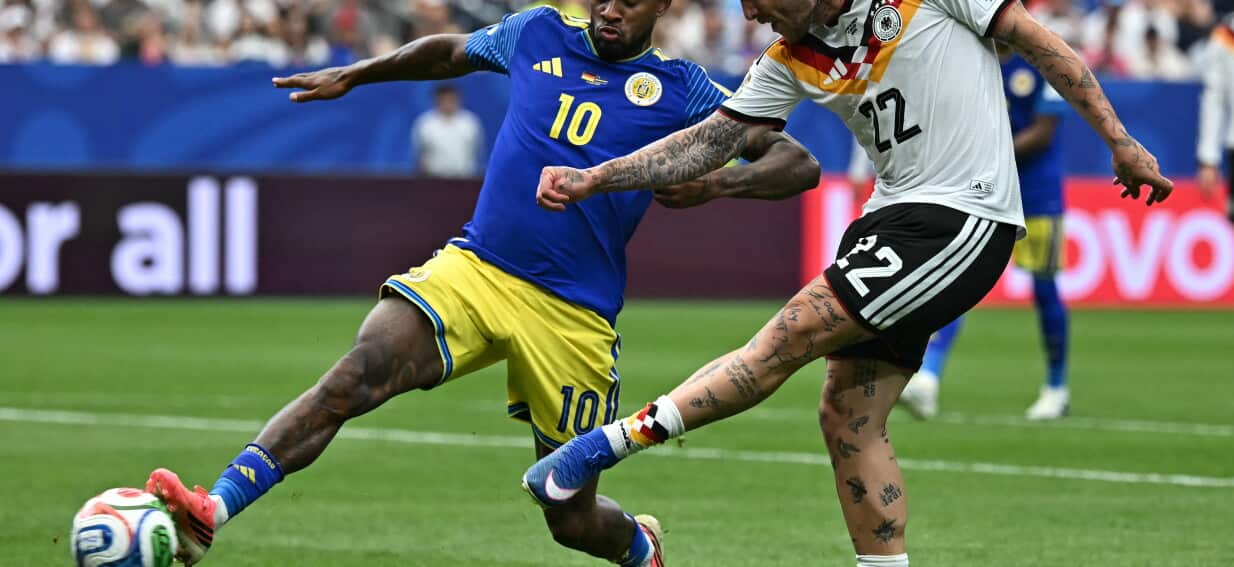
The rain in the stadium doesn't care about dreams. It falls just as hard on the multi-million-dollar boots of a European powerhouse as it does on the soaked jerseys of a Caribbean island making its debut on the world's biggest stage.
When the whistle blew to start the match between Germany and Curacao, the scoreboard read 0-0. For ninety seconds, everything felt possible. But football, at this level, is a machine. It is a calculated, rhythmic, and ruthless exhibition of spatial awareness and physical dominance. In similar updates, read about: Why Japan Just Ruined Ronald Koeman World Cup Masterplan.
By the time the ninety minutes expired, the scoreboard told a brutal story. 7-0.
To the casual observer scrolling through a sports app, it was a routine blowout. A predictable Tuesday statistic. Another powerhouse ticking a box on their way to the knockout rounds. But if you only look at the numbers, you miss the entire point of the game. You miss the sweat, the shattered illusions, and the quiet dignity that exists inside a crushing defeat. Yahoo Sports has provided coverage on this critical topic in great detail.
The Choreography of a Modern Juggernaut
Germany did not just win; they disassembled the opposition.
Watching the German midfield operate is less like watching a sport and more like observing a high-end Swiss watch factory. Every movement is synchronized. When the left-winger cuts inside, the fullback is already sprinting into the vacated space. It happens in milliseconds. Instinct masquerading as mathematics.
Consider the opening goal. It was not a moment of individual magic. It was the result of a suffocating press that forced a hurried, anxious clearance from the Curacao defense. Three passes later, the ball was in the back of the net. Simple. Clinical.
The goals kept coming. Two before the twenty-minute mark. Four by halftime.
For the German squad, this match was about establishing a rhythm for the tournament. It was about proving to their critics back home that the preseason stumbles were merely anomalies. They played with a terrifying seriousness. Even up by five goals, the German manager stood on the touchline, barking orders, demanding perfection, gesturing wildly at a fullback who had misplaced a pass by a mere six inches.
This is the hidden burden of excellence. When you are expected to win the entire tournament, a five-goal victory is not enough. You must hunting for the sixth. Then the seventh. The pressure to maintain absolute dominance can be suffocating, leaving no room for complacency or joy until the trophy is lifted.
The Invisible Stakes of the Underdog
Now look across the pitch.
To understand Curacao is to understand a population smaller than the capacity of some European stadiums. Their roster is a patchwork quilt of domestic league players, lower-division journeymen, and a few notable names who chose to represent their heritage over the comfort of more prominent national setups.
For these players, walking out of the tunnel meant looking up into a sea of flashing cameras and realizing that their families, their neighbors, and an entire island nation were watching through television screens thousands of miles away.
Imagine the sheer psychological weight of that moment.
Every mistake is magnified. Every lost duel feels like a personal failure. After the third goal went in, you could see the visible deflation in the body language of the Curacao center-back. His shoulders slumped. He stared at the grass. It is a lonely feeling, standing in the penalty box while a stadium roars for the other team, knowing there are still sixty minutes left to endure.
But the real story of this match was not the collapsing defense. It was what happened after the fifth goal.
Instead of retreating into a defensive shell to prevent a double-digit humiliation, Curacao started playing with a reckless, beautiful freedom. They began to press higher. The goalkeeper made a double-save that defied gravity, leaping to his left to parry a rocket of a shot, then scrambling to his feet to block the rebound with his chest. He didn't celebrate. He just yelled at his defenders to wake up.
That is the essence of competition. True character is not revealed when you are winning; it is forged when the cause is already lost, yet you refuse to stop running.
The Disconnect of the Scoreboard
We live in a culture obsessed with data. We analyze possession percentages, expected goals, heat maps, and distance covered. We reduce human drama to a series of green and red charts.
The statistics will say Germany dominated eighty percent of the possession. They will show thirty shots on target compared to Curacao’s two. They will tell you it was a lopsided, uncompetitive fixture that perhaps raises questions about the expansion of the tournament format.
But statistics cannot measure the sound of the Curacao fans who traveled across the world, still singing in the eighty-fifth minute, drowning out the local crowd with drums and brass instruments. Statistics cannot capture the post-match jersey exchange, where a young Caribbean midfielder stood in the tunnel, clutching a German midfielder's shirt like it was made of solid gold, a physical manifestation of a dream realized despite the scoreline.
The tournament moves on. Germany will face stiffer tests, tactical battles that will push their clinical system to its absolute limits. Curacao will analyze the film, pack their bags, and prepare for their next group match, knowing their mountain just got steeper.
The stadium eventually emptied, leaving only the discarded plastic cups, the damp flags, and the fading echoes of a seven-goal barrage. The scoreboard was finally switched off, plunging the numbers into darkness, leaving only the raw, human memories of a night where one side demonstrated the perfection of power, and the other discovered the true cost of belonging on the world stage.