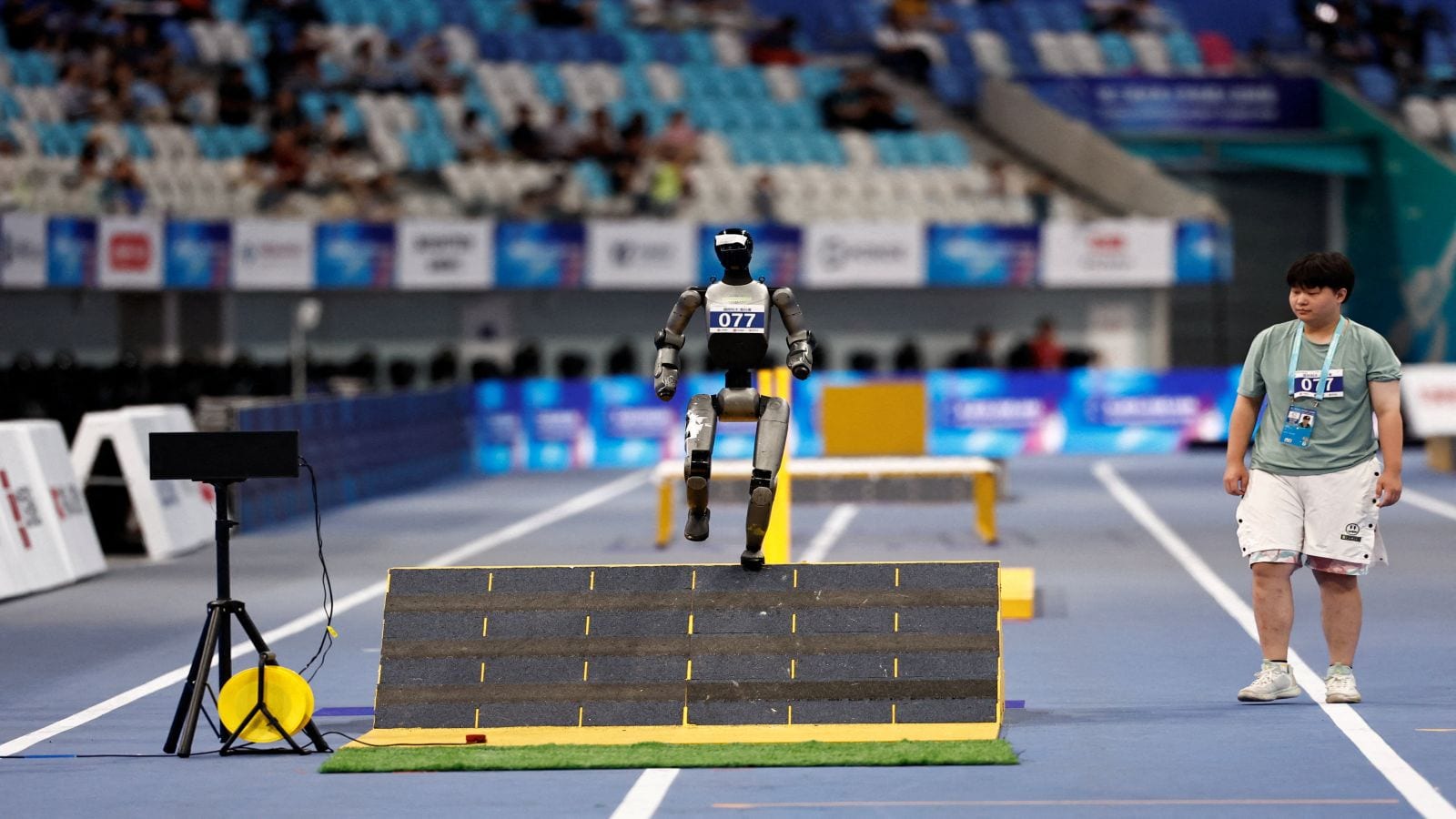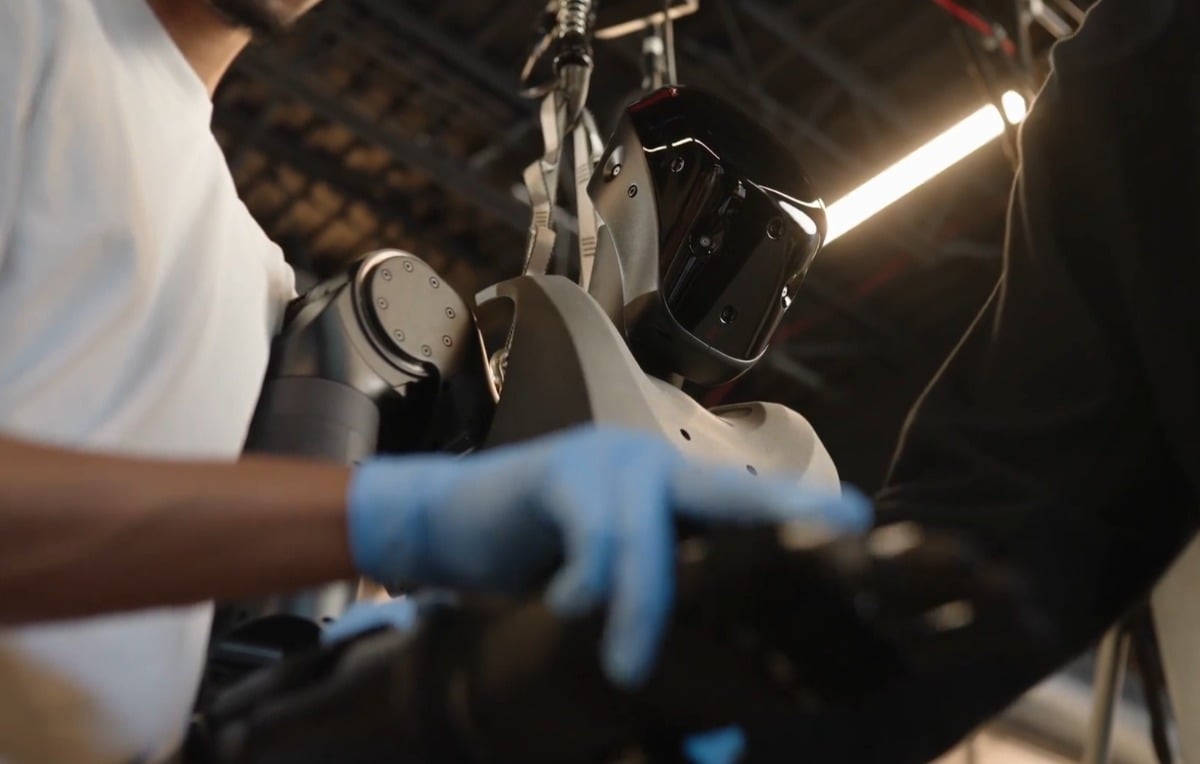
Science fiction lied to us about the timing, but it nailed the execution. For decades, movies promised that bipedal metal soldiers would march across dystopian landscapes in the far future. Instead, it is happening right now in Eastern Europe.
The defense tech accelerator Brave1 announced a new grant program explicitly focused on developing humanoid robots for the Ukrainian Armed Forces. The goal is brutal in its clarity: replace human lungs and blood on the zero line with gears and lithium-battery packs.
This isn't a theoretical thought experiment for a tech conference. In February 2026, two Phantom MK-1 humanoid machines built by American startup Foundation Future Industries arrived in Ukraine for active frontline evaluation. The testing marked the first time bipedal, human-shaped machines operated in an active combat zone. While Silicon Valley tech executives keep hyperventilating over chatbots, the real, messy evolution of artificial intelligence is walking on two legs through the mud of the Donbas.
The Brutal Math Driving the Autonomous Infantry
Military analysts love to focus on the flashy side of weapons tech, but the push for humanoid platforms comes down to cold, hard attrition. Ukraine faces a massive adversary with a seemingly endless supply of manpower. Software and steel are the only realistic ways to balance those scales.
Before the Phantom arrived, Ukraine already scaled up its use of unmanned ground vehicles (UGVs). The Ministry of Defense reported that ground robotic platforms carried out over 50,000 logistics and medical evacuation missions in early 2026 alone. Monthly robotic missions grew from 7,500 in January to more than 14,000 by May. The number of military units operating ground robots doubled in a matter of months.
Ground Robot Adoption Tracker (2026)
Jan: 7,500 monthly missions | 117 active units
May: 14,000+ monthly missions | 230 active units
But those existing platforms are mostly boxes on wheels or tracks. They carry ammunition, lay mines, and drag wounded soldiers out of artillery fire. They do great work, but they are fundamentally limited by geometry.
The world we built is designed for humans. Trenches are dug for humans. Doorways, ladders, vehicles, and stairs are all sized for a bipedal frame. A tracked box gets stuck in a narrow, zigzagging trench system or panics at a flight of concrete stairs inside a ruined apartment building. A humanoid shape can, theoretically, climb over debris, turn doorknobs, and pick up a standard rifle dropped by a fallen soldier without requiring a completely redesigned logistics chain.
Reality Check on the Phantom MK-1
The initial field tests of the Phantom MK-1 in Ukraine quickly separated tech-bro marketing from raw battlefield reality. On paper, Foundation Future Industries built a six-foot-tall, 80-kilogram machine that looks like a tactical Star Wars battle droid.
In the real world, the MK-1 proved highly limited. Field reports indicate the machines were mostly restricted to basic logistics in highly controlled, albeit dangerous, areas.
- The weight and cost profile: At $150,000 per unit, losing a humanoid robot hurts the wallet far more than losing a cheap FPV drone.
- The power drain: The MK-1 battery lasted under an hour in field conditions. A soldier cannot rely on an asset that dies before it even reaches the objective.
- The mechanical fragility: The robot relies on roughly 20 individual motors to move. If a single actuator takes shrapnel or gets jammed with thick Ukrainian clay, the entire unit loses balance and collapses.
- Environmental vulnerability: The initial MK-1 units weren't fully waterproof or dustproof.
Foundation is already spinning up the Phantom 2, promising a six-hour battery life and double the payload capacity. But the lesson from the front line is obvious: building a robot that survives a clean laboratory floor is easy; building one that survives frozen mud, constant electronic warfare jamming, and rain is a nightmare.
The Nightmare of Handing the Kill Chain to Code
The biggest hurdle for humanoid deployment isn't the mechanical joints. It's the brain.
Right now, these systems are "human-in-the-loop." Operators control them remotely, and a human must sign off before the machine executes an action. But anyone who understands modern electronic warfare knows that remote control is a luxury that vanishes the moment a heavy jamming unit turns on. If the signal cuts out, a remote-controlled robot becomes an expensive lawn ornament.
The inevitable push is toward autonomy—giving the robot the right to make its own decisions when the connection drops. That is where things get incredibly dangerous.
AI models suffer from behavioral drift and hallucinations. A vision model might mistake a civilian holding a broom for an insurgent holding an RPG. Furthermore, captured systems are a goldmine for enemy intelligence. If Russian forces capture a functional Phantom, they don't just get the hardware; they get the onboard data storage, the encrypted communication protocols, and the underlying software architecture.
Despite the risks, the Brave1 initiative shows that the pressure to innovate overrides the hesitation. Ukraine is transforming into a live-fire laboratory for the future of mechanized conflict because it simply has no other choice.
What Happens Next on the Line of Contact
If you want to understand where this tech goes next, ignore the flashy marketing videos of robots doing backflips. Watch the small engineering firms. The immediate future of military humanoids will not look like an elite robot commando kicking down doors. It will look like a slow, iterative rollout of simpler, uglier systems designed for single, exhausting tasks.
Engineers are moving away from general-purpose droids toward modular platforms. Expect to see units with swappable limbs—treads for moving across open fields, which then swap out for legs when entering an urban ruin. The immediate focus for the Brave1 grants will likely target static defensive holding patterns, where a robot can be tethered to a power source inside a bunker to fire a mounted weapon, keeping human soldiers deep underground.
The transition to robotic warfare is accelerating out of absolute necessity, and the tactical insights gathered in the coming months will dictate how global superpowers structure their armies for the next fifty years.
Inside the Factory Making Ground Robots for Ukraine
This video offers an inside look at how small factories are rapidly scaling production of unmanned ground vehicles for the Ukrainian front lines, illustrating the immediate manufacturing ecosystem supporting this technology.