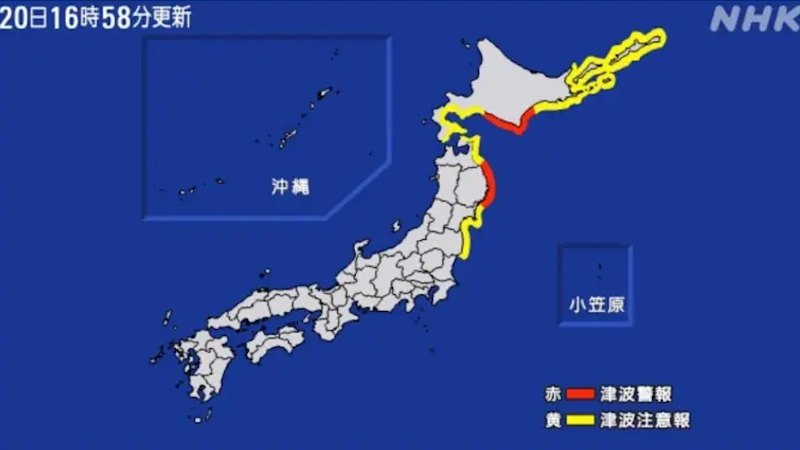
The occurrence of a magnitude 7.5 earthquake off the coast of Japan is not a random geological event but a predictable manifestation of the complex tectonic stress accumulation within the Amurian Plate and the Okhotsk Plate boundary. Standard news reporting focuses on the immediate chaos; however, a strategic analysis reveals that the true impact of such an event is determined by the intersection of bathymetric profile, urban structural resilience, and the latency of automated early warning systems. The primary threat in the Sea of Japan is not merely the ground shaking but the rapid-onset tsunami waves characterized by short arrival times due to the proximity of the epicenter to the coastline.
The Mechanics of Crustal Deformation and Energy Release
A magnitude 7.5 event represents a significant release of elastic strain energy. On the moment magnitude scale ($M_w$), every whole-integer increase corresponds to a 32-fold increase in energy release. The specific mechanics of this quake involve a shallow crustal thrust faulting, where one block of the Earth's crust is forced upward over another.
The shallowness of the hypocenter—often less than 20 kilometers—is the critical variable. Deep earthquakes allow the surrounding lithosphere to dissipate seismic waves before they reach the surface; shallow events concentrate that energy directly into the seabed. This vertical displacement of the water column is the fundamental trigger for tsunami generation. Unlike mid-ocean ridges where tsunamis may take hours to reach land, the geography of the Sea of Japan creates a "closed basin" effect, where wave reflections and resonance can lead to prolonged periods of sea-level instability.
The Tsunami Propagation Function
The velocity of a tsunami in the open ocean is governed by the depth of the water, calculated as $v = \sqrt{g \cdot d}$, where $g$ is the acceleration due to gravity and $d$ is the water depth. In deep water, these waves travel at speeds exceeding 700 kilometers per hour. As the wave approaches the shallow waters of the Japanese coastline, a process known as "shoaling" occurs.
Variables of Coastal Impact
- Wave Amplitude Amplification: As the depth decreases, the velocity drops but the energy flux remains constant, forcing the wave height to increase significantly.
- Bathymetric Focusing: Underwater ridges and canyons act as lenses, refracting wave energy toward specific coastal points, often resulting in localized surge heights that far exceed regional averages.
- The Drawback Phenomenon: If the leading edge of the tsunami is a trough, the sea will appear to recede, exposing the seafloor. This is a high-risk period where psychological bias often leads individuals to investigate the shoreline rather than seeking elevation.
Infrastructure Resilience and the Japanese Building Standard Act
The survival of Japanese urban centers during a 7.5-magnitude event is the result of iterative engineering rather than luck. The Building Standard Act, specifically the Shin-Taishin (New Earthquake Resistance Standard) implemented in 1981 and revised after the 1995 Kobe earthquake, dictates two levels of performance:
- Life Safety: Buildings must withstand moderate earthquakes with zero structural damage to ensure the continued functionality of the internal systems.
- Collapse Prevention: During extreme events (Level 2 shaking), the structure may sustain permanent damage but must not collapse, allowing for safe egress of occupants.
The use of Base Isolation Systems (BIS) and Tuned Mass Dampers (TMD) transforms a building from a rigid, brittle object into a flexible system capable of dissipating kinetic energy. BIS involves placing the structure on lead-rubber bearings that decouple the building from the ground's lateral movement. In a magnitude 7.5 event, a base-isolated building may experience only 20% of the ground's peak acceleration.
Limitations of Automated Early Warning Systems (EEW)
The Japan Meteorological Agency (JMA) operates the most sophisticated EEW network globally, utilizing the speed differential between P-waves (primary, faster, less destructive) and S-waves (secondary, slower, highly destructive). However, the system faces a "blind zone" near the epicenter.
The time available for automated shutdown of high-speed rail (Shinkansen), gas lines, and nuclear reactors is calculated in seconds. For a 7.5-magnitude quake, the S-wave travels at approximately 3.5 to 4.5 kilometers per second. If a city is within 30 kilometers of the epicenter, the lead time provided by an EEW might be less than five seconds. This creates a technical bottleneck where the latency of digital communication (the time it takes to process the sensor data and push a notification to a smartphone) may exceed the time it takes for the destructive waves to arrive.
The Nuclear Safety Redundancy Protocol
Following the 2011 Tōhoku event, Japanese nuclear facilities transitioned to a "Defense in Depth" strategy. This involves the installation of high-level seawalls and the placement of emergency power supplies (diesel generators and batteries) at higher elevations or in watertight bunkers.
In the event of a 7.5-magnitude quake, reactors automatically trigger a "Scram," inserting control rods to halt the fission process. However, decay heat—the energy produced by the radioactive decay of fission products—remains a threat for days. The failure point in such a system is rarely the reactor vessel itself but the cooling pumps. The strategic necessity is the maintenance of a continuous heat sink. Any disruption in the supply of cooling water, whether through pipe fracture or pump inundation, initiates a countdown to core damage.
Logistics and Supply Chain Fragmentation
The immediate aftermath of a major seismic event triggers a "logistical freeze." This is not caused by a lack of supplies, but by the physical destruction of "Last Mile" infrastructure.
- Liquefaction: Saturated, loose soil behaves like a liquid during intense shaking, causing roads to buckle and port facilities to tilt.
- Intermodal Failure: The simultaneous loss of rail, road, and sea access prevents the distribution of emergency resources.
- The Just-in-Time Vulnerability: Modern Japanese cities operate on thin inventory margins. A 48-hour disruption in road access leads to immediate shortages in fuel and perishable food, necessitating air-bridge operations that have significantly lower throughput than traditional ground transport.
Psychosocial Response and "Normalcy Bias"
A critical failure in disaster mitigation is the human tendency to underestimate the probability of a "Black Swan" event. Despite the ubiquity of tsunami drills, "Normalcy Bias" causes individuals to interpret the initial earthquake as a routine event rather than a precursor to a tsunami.
Data from previous events show that the time taken to decide to evacuate is the most significant predictor of mortality. Structured evacuation requires moving to "Tsunami Evacuation Towers"—purpose-built vertical structures—within 10 to 15 minutes of the initial shaking. The delay caused by checking social media or attempting to secure property often consumes the survival window.
Quantitative Comparison of Risk Profiles
| Factor | Standard News Narrative | Structural Analytical Reality |
|---|---|---|
| Primary Threat | Ground shaking and fire | Tsunami arrival within <20 minutes |
| System Reliability | "The system warned people" | Blind zones render EEW ineffective at the epicenter |
| Building Safety | "Buildings are strong" | Non-structural damage (broken glass, falling ceilings) causes 40% of injuries |
| Nuclear Risk | "Radiation leaks" | Loss of Offsite Power (LOOP) is the primary risk driver |
| Recovery Time | Focus on immediate rescue | Economic recovery hindered by permanent subsidence of port land |
The Strategic Path Forward
To mitigate the effects of a magnitude 7.5 event and its subsequent tsunami, the focus must shift from reactive emergency management to proactive structural hardening and data-driven evacuation.
Municipalities must prioritize the "Hardening of the Last Mile." This involves replacing aging water and gas infrastructure with earthquake-resistant ductile iron pipes and seismic isolation valves. Digital twins of coastal cities should be used to simulate tsunami inundation in real-time, feeding live data into individual navigation systems to route people away from predicted surge paths rather than relying on static evacuation signs.
The ultimate defense against seismic risk is the reduction of "Response Latency." Every second saved in the transition from P-wave detection to individual action correlates to a measurable decrease in mortality. This requires the integration of seismic sensors directly into the firmware of consumer electronics, bypassing the delays of central server processing.
Infrastructure must be viewed as a dynamic system. Bridge sensors that detect structural integrity in real-time can immediately close damaged routes to prevent accidents and keep clear paths for emergency services. This move toward a "Self-Diagnosing City" is the only viable strategy for long-term urban survival in high-seismicity zones.