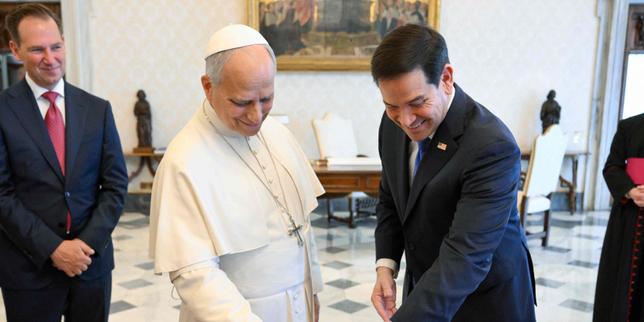
The recent summit between Pope Leo XIV and U.S. Secretary of State Marco Rubio was publicly framed as a standard exchange of diplomatic pleasantries. Official communiqués spoke of a shared commitment to global stability and the protection of religious freedom. However, behind the closed doors of the Apostolic Palace, the dialogue shifted toward a far more granular and high-stakes negotiation regarding the shifting tectonic plates of Western influence. This was not a meeting of abstract ideals. It was a cold-eyed assessment of how two of the world's oldest and most influential institutions intend to manage the fractures appearing in the international order.
For the Vatican, the stakes involve the survival and relevance of its moral authority in a world increasingly dominated by secular regional blocs. For Rubio, the meeting served as a vital bridge to the Global South, where the Catholic Church maintains a structural reach that the U.S. State Department often struggles to replicate through traditional diplomacy. If you found value in this article, you should check out: this related article.
The Strategy of Neutrality Under Fire
Historically, the Holy See operates on a principle of "active neutrality." This is often misunderstood as passive observation. In reality, it is a sophisticated diplomatic maneuver that allows the Pope to talk to every side of a conflict when no one else can. Under Leo XIV, this neutrality has taken on a more assertive edge. The Pope is acutely aware that the traditional post-Cold War consensus is dying. He isn't interested in simply echoing Washington's talking points, nor is he willing to cede moral ground to the rising powers in the East.
Marco Rubio represents a specific strain of American foreign policy that views the world through the lens of competition. His presence at the Vatican signifies a recognition that the U.S. needs the Church to help stabilize regions like Latin America and Sub-Saharan Africa. In these areas, the local parish often has more credibility than the local government or the American embassy. The discussion moved past the rhetoric of peace and into the logistics of influence. They discussed how to handle the vacuum left by retreating international organizations and the increasing footprint of private military contractors in conflict zones. For another look on this event, see the latest update from Reuters.
Latin America as the Primary Chessboard
Nowhere is the alignment between the Holy See and the Rubio doctrine more apparent than in Latin America. Rubio, a son of the Cuban diaspora, views the region through the prism of democratic survival. The Pope, the first from the Southern Hemisphere, sees it as the demographic future of the Church. They share an interest in preventing the total collapse of civic order in nations like Venezuela and Nicaragua, though their methods differ.
While Rubio leans on economic pressure and political isolation, the Vatican maintains a network of bishops who serve as the only remaining conduits for humanitarian aid and political mediation. During their talks, they explored a "double-track" approach. The U.S. provides the external pressure, while the Church maintains the internal social fabric to prevent a complete descent into anarchy. This is a dangerous game. If the Church is seen as too close to American interests, it loses its status as an honest broker. If the U.S. ignores the Church's ground-level data, its policies remain blunt instruments that often harm the very people they intend to save.
The China Question and the Silent Rift
The most significant point of friction remains the Vatican’s relationship with Beijing. Rubio has been a vocal critic of the Holy See’s provisional agreement with China regarding the appointment of bishops. He views it as a compromise that weakens the West's stance on human rights. The Vatican, however, views it as a necessary survival tactic. To the Pope, a Church that is completely cut off from its billion-plus population in China is a Church that has failed its mission.
During the meeting, the Pope reportedly defended this long-term view. He sees centuries where politicians see election cycles. The Holy See is betting that by maintaining a presence in China now, it can exert influence decades down the line. Rubio’s challenge was to convince the Pontiff that the immediate costs to religious liberty are too high to ignore. This isn't just a theological debate; it's a disagreement over the timeline of power. The U.S. wants results now. The Vatican is willing to wait for the next era.
Reforming Global Financial Ethics
Beyond the geopolitical maneuvers, a significant portion of the dialogue focused on the restructuring of global debt. Leo XIV has been increasingly vocal about the "invisible tyranny" of a financial system that prioritizes debt servicing over human survival. This is a point where the Pope finds himself in an unlikely alignment with certain populist elements of the American right that Rubio represents.
There is a growing realization that the current debt models in the developing world are unsustainable and provide an opening for predatory lending from rival superpowers. By advocating for debt relief or restructuring based on ethical "human-centric" metrics, the Vatican provides a moral cover for the U.S. to propose new financial frameworks that counter the influence of foreign state-backed loans. They are looking for a way to rewrite the rules of the global economy without triggering a total systemic collapse.
The Weaponization of Information
The two leaders also addressed the erosion of truth in the digital sphere. For the Church, the spread of misinformation isn't just a political problem; it's a spiritual crisis that destroys the foundation of community. Rubio, who has spent years on the Senate Intelligence Committee, views it as a national security threat.
They discussed the potential for a joint effort to promote "intellectual hygiene." This involves using the Church's global educational infrastructure to teach critical thinking and media literacy. It’s an admission that hardware and software cannot win the information war alone. You need a human-centric defense. This represents a shift away from technological solutions and back toward the grassroots level of education and local leadership.
Managing the Migrant Crisis at the Source
The movement of people across borders is the most volatile issue in modern politics. For Rubio, it is a matter of border security and the rule of law. For the Pope, it is a humanitarian imperative. However, their conversation moved toward the "right not to migrate." This is the idea that people should not be forced to leave their homes due to violence or economic despair.
By focusing on the "right not to migrate," Rubio and the Pope found common ground. They looked at specific investment projects in the Northern Triangle of Central America that would be managed by local religious and civic organizations rather than corrupt government channels. This bypasses the traditional bottlenecks of foreign aid. It is a pragmatic attempt to solve the problem at the source, moving beyond the polarized debate of walls versus open borders.
The New Face of the Catholic Vote
Rubio’s visit wasn't just about foreign policy. It was also about domestic perception. The American Catholic vote is no longer a monolith. It is fractured between traditionalists and social justice advocates. By engaging with Leo XIV, Rubio signals to the Catholic constituency that his brand of conservatism is grounded in a broader moral framework.
The Pope, in turn, uses these meetings to remind the American political establishment that the Church remains a power player. He isn't a figurehead to be wheeled out for ceremonies. He is a head of state with the world’s most extensive intelligence network. The information he receives from a priest in a remote village in the Congo or a bishop in an underground church in Asia is often more accurate than what a satellite can provide.
The Cost of the Alliance
Every alliance has a price. For Rubio, the risk is being seen as too deferential to a foreign religious leader. For Leo XIV, the risk is the politicization of the faith. The meeting proved that the "necessity of working for peace" is not a platitude. It is a grueling, often messy process of horse-trading between two entities that know they are stronger together than they are apart.
They didn't leave the room with a signed peace treaty for the world's conflicts. Instead, they left with a clearer understanding of the leverage each holds. The U.S. has the military and economic might. The Vatican has the moral high ground and the social infrastructure. In a world that is rapidly de-globalizing, this combination is the only thing that might prevent a total descent into regional feudalism.
The success of this diplomacy will not be measured by the warmth of the photos taken in the library of the Apostolic Palace. It will be measured in the coming months by how the U.S. adjusts its stance on debt relief and how the Vatican handles its next round of negotiations with Beijing. The true work of peace is found in these technical, often boring details of governance and trade. It is found in the quiet shifts of policy that happen long after the cameras have been turned off and the Secretary of State's plane has left Italian airspace.
Power in the modern era is not just about who has the most missiles. It is about who can define the narrative of human dignity in a way that people actually believe. Rubio and Leo XIV both know that the old stories are failing. They are trying to write a new one before the world decides to move on without them.


