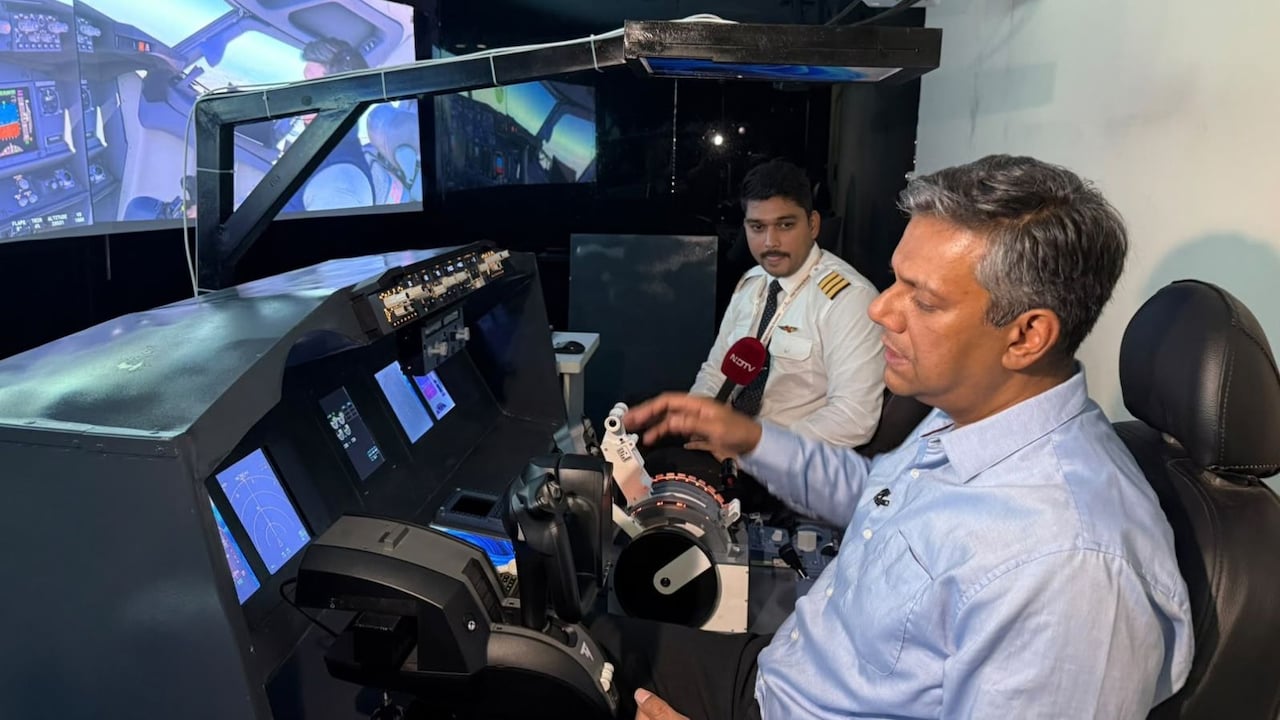
The cabin is completely dark except for the eerie, synthetic twilight cast by the primary flight display. Outside wrap-around screens, a digital rendition of night approaches the runway. Rain streaks down the simulated glass, rendered with mathematical precision. But inside this multi-million-dollar box of hydraulic actuators and computing power, the sweat is entirely real.
Consider what happens when the ground drops away and reality blurs into terror.
Years ago, reporters from NDTV stepped inside a Boeing 737 flight simulator to retrace the final, frantic seconds experienced during the flydubai disaster. They did not just sit in passenger seats scrolling through news feeds. They sat in the left seat, hands resting on the yoke, watching the flight deck fill with amber warning lights and a relentless cascade of acoustic alerts.
Silence is heavy in a cockpit. Until it is shattered.
The Anatomy of Disorientation
Spatial disorientation does not announce itself with dramatic cymbals. It creeps in through the inner ear, whispering lies to a pilot's brain. When visibility drops to zero, up feels down, level feels steep, and the human senses become utterly untrustworthy instruments.
Imagine pushing forward on a control column when your entire body screams that you are falling backward. That is the precise trap of nocturnal aviation.
The flydubai crew faced a wall of darkness over Rostov-on-Don. Wind shear clawed at the aircraft's belly. The weather was a beast refusing to be tamed. In the cold light of day, accident reports reduce these moments to sterile columns of telemetry, altitude losses, and control inputs. They talk about pitch angles and thrust levers. But telemetry data cannot capture the visceral grip of panic when the altimeter spins like a roulette wheel.
Inside the simulator, engineers dial in those exact meteorological ghosts. The hydraulic legs groan, pitching the cabin violently. The visual displays spin into a vertigo-inducing vortex of grey clouds and ground lights.
When Instruments Fail the Human Mind
Training captains watch pilots closely during these scenarios. They look for the micro-hesitations. That split-second delay where the brain refuses to accept what the flight director is telling it.
We tend to trust our guts. Evolution built us to rely on our immediate physical feedback loops. If your stomach floats, you are climbing. If your inner ear tilts, you are banking. But inside a jetliner hurtling through cloud cover at five hundred miles per hour, your inner ear is an active saboteur.
To survive, a pilot must wage a civil war against their own biology. They must look past the screaming alarms, ignore the phantom feelings of acceleration or deceleration, and trust the glowing green numbers on the primary flight display.
When the NDTV crew took the controls in the simulator, they experienced this cognitive dissonance firsthand. Instructors induced a sudden go-around scenario—a routine maneuver made lethal by fatigue, poor visibility, and cognitive overload. The nose pitches up sharply. The engines roar to life, shoving you back into your seat. If you pull back too hard on the yoke while distracted by a flurry of system checks, the aircraft stalls. If you push too soon, you chase the asphalt.
There is no margin for error. There is only the centerline.
The Weight of Routine
Most passengers look at commercial aviation as an administrative hurdle. You take off your shoes, slide your laptop into a bin, squeeze into a middle seat, and zone out to a downloaded podcast. The marvel of modern flight has become aggressively mundane.
We forget that we are hurling heavy tubes of aluminum and composite materials through the troposphere, sustained only by thin air and relentless human vigilance.
The simulator exposes this fragile contract. Every emergency procedure practiced in those dark boxes is bought with blood. The checklist in front of the captain is a tombstone ledger, written by the ghosts of flights that did not make it home. Every bold-face item—memory items executed without looking at a manual—represents an exhausted crew frantically trying to solve a complex puzzle while gravity keeps score.
When the simulator motion platform finally locks back into its resting position, the heavy hydraulics bleed their pressure with a long, mechanical sigh. The artificial rain stops dripping down the wrap-around screens. The digital lights of Rostov-on-Don vanish, replaced by the mundane, fluorescent glow of a training facility warehouse.
You step out of the left seat. Your legs are slightly weak. Your shirt is damp at the collar. Outside the simulator door, life continues as normal, oblivious to the invisible abyss that just opened and closed in the dark.
And somewhere tonight, thousands of feet above the earth, another crew is staring quietly into the amber glow of the flight deck, watching the instruments, trusting the math, and holding the night at bay.