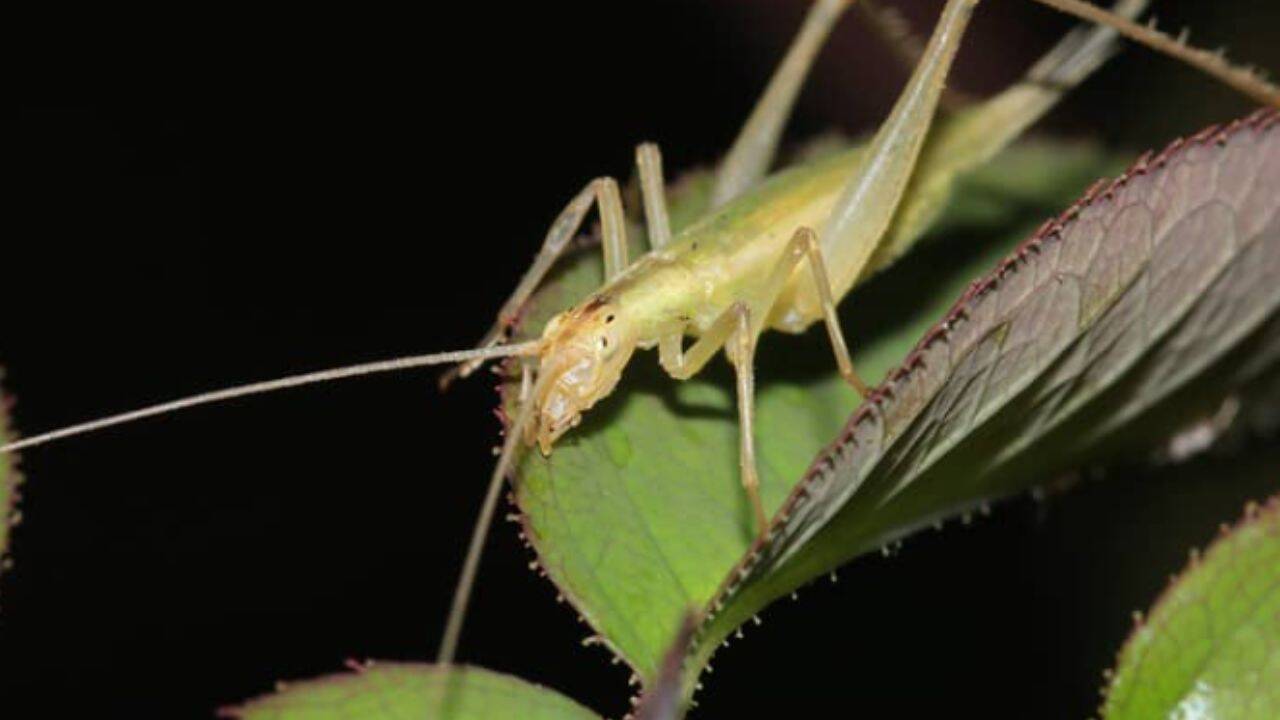
Imagine standing in a dense, humid fern forest one hundred and fifty million years ago. The air hums. It vibrates with a deafening, alien chorus. You cannot see the musicians, but you can feel them in your chest. They aren't dinosaurs roaring in the distance. They are tiny, armored insects singing for mates high in the canopy of the Mesozoic world.
For decades, we assumed the sounds of the Jurassic were lost forever. Fossils preserve anatomy, not audio. Bones turn to stone, chitin compresses into thin carbon films, and the ancient soundscapes fade into permanent silence.
Until now.
Paleontologists and computer scientists paired up recently to reverse-engineer the acoustic world of the Jurassic using modern audio synthesis and machine learning. They didn't just guess what ancient bugs sounded like. They extracted physical parameters from exceptionally preserved fossils, ran mathematical models of sound production, and recreated acoustic signals that haven't echoed through Earth's atmosphere since the Cretaceous extinction event.
Some of these resurrected calls are so high-pitched that normal human ears cannot even detect them. We are talking about ultrasonic frequencies operating far beyond our biological limits.
Let's look at how this works, why it matters, and what it tells us about deep-time evolution.
The Physics of Stone and Song
Sound is just mechanical vibration traveling through a medium like air or water. When an insect stridulates—rubbing body parts together like modern crickets or katydids—it leaves microscopic structural clues on its exoskeleton.
If you look at a fossilized wing or a specialized sound-producing scraper under an electron microscope, you see ridges, teeth, and resonators. These aren't random accidental patterns. They are precision instruments shaped by natural selection.
Think of a modern guitar string. If you know the length, tension, and mass of the string, you can calculate the exact note it will produce when plucked. Fossilized insect sound organs work the exact same way.
Researchers measured the microscopic teeth on the stridulatory files of ancient orthopterans—the group containing modern grasshoppers, crickets, and katydids. They fed these physical measurements into neural networks trained on the acoustic physics of living insects.
The algorithm bridges the gap between static stone and dynamic motion. It simulates how fast the scraper moves across the file, how the surrounding wing membrane flexes, and how the resulting sound wave propagates through ancient air.
You get a synthesized audio file of a bug that died before mammals even figured out how to walk upright.
Frequencies Beyond Human Hearing
One of the most shocking discoveries from this computational audio work involves frequency range.
We tend to think of prehistoric animal sounds as heavy, low-frequency rumbles. Think of cinematic T-Rex roars vibrating the mud. But the insect world operates on a totally different scale.
Many of the reconstructed Jurassic insect calls fall squarely into the ultrasonic range, often exceeding twenty kilohertz. Some signals spike much higher.
Why would an insect evolve a song humans can't hear?
Predation pressure.
In the Jurassic, early mammals and small predatory reptiles were starting to diversify. Many of these nocturnal hunters listened for the mating calls of large insects. If your mating song is too loud or sits right in the audible hearing range of a hungry predator, you become dinner before you find a partner.
Shifting calls into the ultrasonic spectrum is an evolutionary defense mechanism. It creates a private communication channel. The intended mate hears it loud and clear, but the eavesdropping predators remain completely deaf to the broadcast.
It is an ancient arms race fought in the frequencies of sound waves.
Overcoming the Preservation Bias
Reconstructing prehistoric soundscapes is deeply difficult. The fossil record is notoriously patchy. Soft-bodied insects rarely fossilize at all, and when they do, delicate sound-producing structures are often crushed flat.
Researchers rely on Konservat-Lagerstätten. These are rare geological sites with extraordinary preservation conditions, such as fine-grained Jurassic limestone deposits in China and Germany.
Even with great fossils, you face a major interpretive hurdle. You have to ensure the physical deformation of fossilization hasn't warped the microscopic teeth spacing. If a fossilized file is stretched by tectonic pressure over millions of years, the calculated frequency will be entirely wrong.
Scientists cross-check their digital models against living phylogenetic relatives. If a fossilized bushcricket has a modern descendant with a specific femur-to-wing ratio, the baseline physics provide a strict calibration constraint.
This keeps the AI from hallucinating sounds that violate the laws of biomechanics.
What This Tells Us About Ancient Ecosystems
Sound is an invisible layer of ecology. When you walk through a modern forest, acoustic niche partitioning is everywhere. Different species sing at different frequencies, different times of day, and different micro-habitats so they don't drown each other out.
Recreating Jurassic insect calls lets us test whether acoustic partitioning existed one hundred and fifty million years ago.
The data shows it did.
The soundscape was crowded. Different families of prehistoric insects occupied distinct audio bands. Some broadcasted low, rhythmic pulses that traveled far through dense vegetation. Others blasted high-frequency chirps suited for short-range signaling in open clearings.
We are moving past static dioramas of green ferns and grey dinosaurs. We are building immersive, multi-sensory windows into a functioning biosphere.
Practical Takeaways for Science and Tech
This crossover between machine learning and paleontology isn't just an academic curiosity for museum exhibits. It teaches us how to extract hidden signals from noisy, degraded data sets.
If an algorithm can reverse-engineer a sound wave from a squashed, mineralized wing fragment that is millions of years old, you can apply similar signal-processing logic to modern engineering problems.
Here is how this methodology translates into other fields:
- Bioacoustics monitoring: Conservationists use similar algorithms to track endangered insect and bird species in dense rainforests by parsing complex, overlapping background noise.
- Structural health diagnostics: The math used to analyze microscopic teeth on a fossilized wing is identical to the math used to detect micro-fractures in high-stress aerospace turbine blades.
- Non-destructive testing: Translating surface geometry into functional mechanical output helps engineers predict how a manufactured part will behave without destroying it during quality control.
Next time you hear a cricket outside your window on a warm summer evening, pause for a second. You aren't just listening to a backyard pest. You are tuning into an acoustic tradition that predates human civilization by hundreds of millions of years.
The song hasn't changed much. The singers just got smaller.