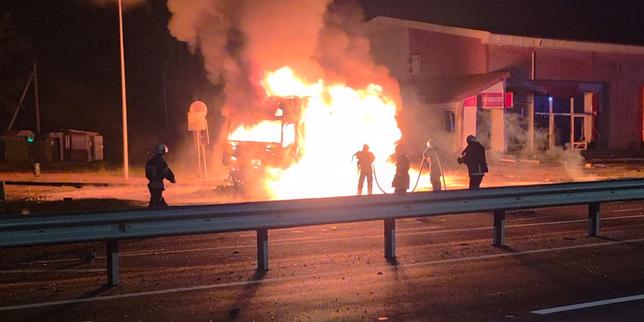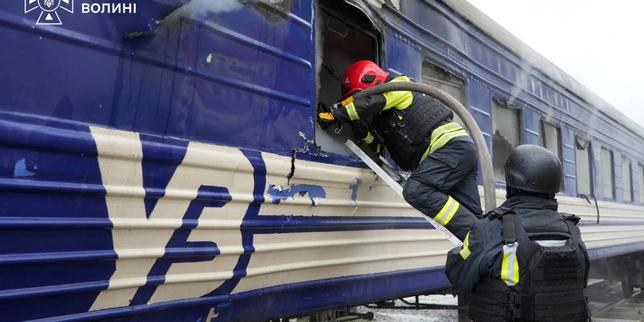
The warning sirens wailed across Volyn as a Russian drone locked onto its target just two kilometers from the European Union frontier. This wasn't a remote supply depot or an empty cargo yard deep in the eastern front. It was a locomotive hauling a civilian passenger train bound straight for Warsaw.
When the unmanned aerial vehicle slammed into the train infrastructure near the Yahodyn-Dorohusk border crossing, it shattered whatever lingering illusions remained about the safety of Ukraine's transit corridors. Ukrzaliznytsia, the national railway operator, didn't mince words. They called it a systematic campaign designed to choke the country's final arteries.
Trains are Ukraine's lifeline. When the airspace closed on the first day of the full-scale invasion, the tracks became the nation's blood supply. Millions of refugees escaped via these carriages. Foreign leaders, diplomats, and humanitarian aid rolled in on these exact steel paths. Now, Moscow has shifted its sights directly onto the rolling stock and the people operating it.
What makes the Volyn attack particularly chilling is the timing and proximity. Shortly before the explosion, a diplomatic train had cleared the very same station. On board were high-profile international figures, including former British Prime Minister Boris Johnson and former CIA Director David Petraeus, who had just wrapped up consultations in Kyiv. Whether the proximity was a calculated message or a grim coincidence, the political shockwaves instantly crossed the border into NATO territory.
Polish authorities treated the incident with immediate alarm. Polish Interior Minister Marcin Kierwiński confirmed that the strike landed dangerously close to sovereign EU soil, igniting fierce debates in Warsaw and Brussels. Ukrainian Foreign Minister Andrii Sybiha put it bluntly to western allies: Russian terror is no longer knocking on the door—it's rattling the handle.
Yet, the physical strike on the Warsaw-bound train is only part of a broader, quieter strangulation strategy.
The War on Locomotives and Logistics
Destroying tracks is easy. Steel rails can be welded back together within hours of a blast. Locomotives, however, are an entirely different logistical nightmare.
Since the invasion began, Russian strikes have damaged or completely destroyed over five hundred Ukrainian locomotives. More than half of those losses happened in a single year. Finding replacements is nearly impossible through standard procurement. Ukraine operates on a 1520-millimeter broad gauge track standard, meaning standard European rolling stock cannot simply cross the border and take over.
Compounding the hardware crisis is a severe human toll. Railway workers operate under constant threat of kinetic strikes, often receiving only minutes of warning before a drone or missile hits their route. The national rail operator faces a massive labor deficit. Train drivers and maintenance crews cannot be trained overnight, and the attrition rate among essential transport personnel continues to mount.
When a passenger train is struck or delayed by hours, travelers feel the immediate pain. But the hidden casualty is the economy. Freight transit—grain, industrial exports, and vital imports—slows to a crawl every time the network goes into lockdown.
What This Means for European Security
Moscow's intent goes beyond disrupting local timetables. By targeting transit routes that interface directly with Poland, the Kremlin is testing the limits of western deterrence.
The strategy aims to achieve multiple objectives at once:
- Intimidate international partners who rely on rail travel to visit Kyiv.
- Create economic bottlenecks that drain Ukrainian resources.
- Sow psychological panic among civilians who view the railway as their last safe corridor.
As winter approaches, these infrastructure attacks enter a harsher phase. New operational rules permit trains to keep moving under lower-level air alerts, but major strikes force shutdowns that paralyze hundreds of miles of track simultaneously.
The attack on the Warsaw train proves that no route is entirely out of range. If western capitals want to keep Ukraine's transit infrastructure alive, defense strategies must evolve to shield the skies directly above the tracks. Otherwise, the economic and logistical squeeze will tighten until the system reaches its absolute breaking point.