Paper crackles differently behind closed doors.
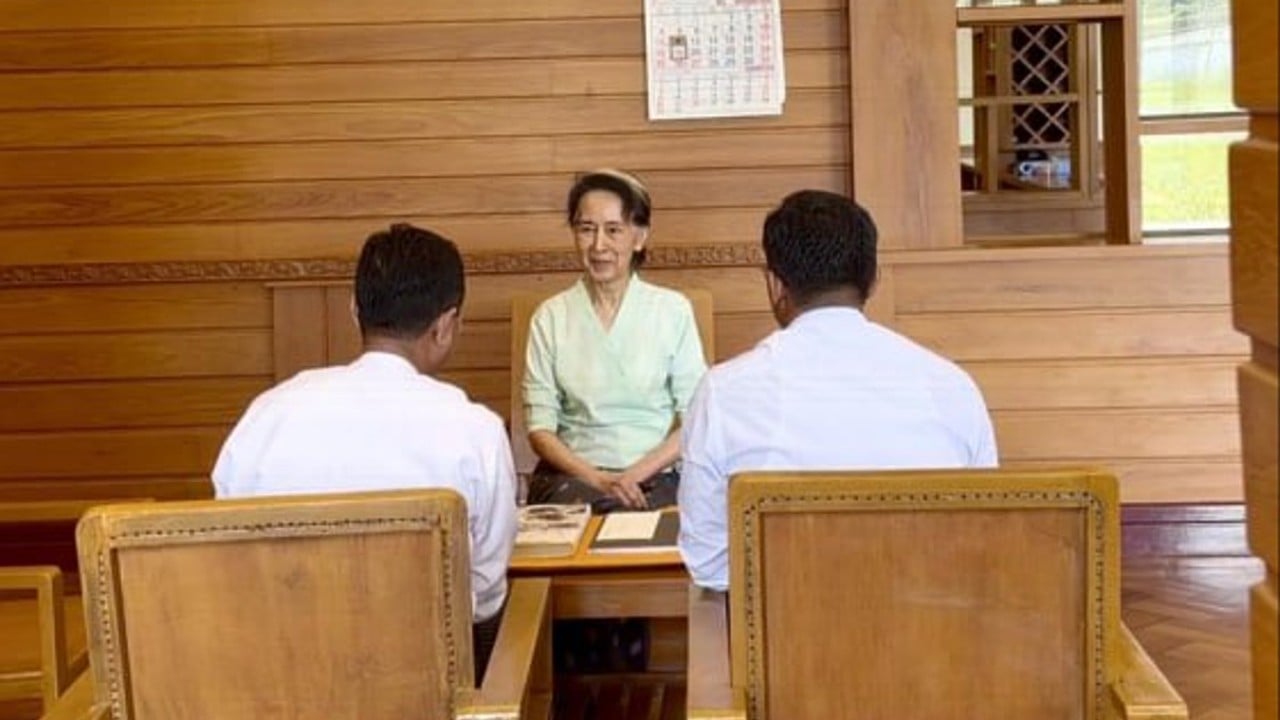
In a quiet room where calendars rarely move and visitors are counted like contraband, a parcel arriving from thousands of miles away carries a weight that has nothing to do with postage. According to announcements from Myanmar's military authorities, detained former leader Aung San Suu Kyi has received a royal package sent by Britain's King Charles. On paper, that sentence is a dispatch. A wire-service blurb. A tiny knot of diplomatic trivia tied up in twelve words.
Yet anyone who has watched political captivity unfold knows that small objects inside locked spaces rarely stay small. They become mirrors. They become arguments. They become Rorschach tests for power, memory, and legitimacy.
I have sat across from families in exile who spent years turning every scrap of news out of Yangon and Naypyidaw into a lifeline, reading between lines the way sailors read swell patterns on a dark sea. You learn quickly how hungry information makes people. When a figure who once defined a nation's democratic hopes is held out of public view, even a parcel—its existence confirmed by the very authorities holding her—triggers a storm of questions. Why now? Who touched it? What does a crown in London have to do with a detained woman in Southeast Asia?
None of those questions have neat, comforting answers. I will admit right here that trying to read the motives behind backchannel gestures in Myanmar's conflict is dizzying and often unsettling. Anyone claiming total certainty about every move made by generals, diplomats, or royal households is selling confidence they do not actually possess. Still, we can trace what is known, separate verified facts from speculation, and examine why a royal gift inside a detention setting hits so hard emotionally and politically.
The Weight of a Parcel in Isolation
To understand why a package matters so much, think about isolation not as a single locked door, but as a slow thinning of air.
When someone is detained and largely cut off from ordinary life, routine becomes a battleground. What you eat, who speaks to you, what arrives at the threshold—every detail is filtered through custodianship. When Myanmar's government states that Aung San Suu Kyi received a royal package from King Charles, the announcement itself is a deliberate act. Detaining authorities do not broadcast details about a prisoner by accident. Every word released by a state media apparatus or official spokesperson is chosen with care, meant to project control, composure, or a specific message to domestic and international audiences.
Let's be clear about what is verified and what remains opaque. The core reported fact is that Myanmar's government stated detained leader Aung San Suu Kyi received a royal package from King Charles of the United Kingdom. What has not been publicly laid bare—as is common in tightly controlled detentions—is the full granular ledger of every item inside, the exact circumstances of handover, or the private thoughts of the woman at the center of it all.
To grasp the psychological dynamics at play, consider a hypothetical scenario—purely a thought experiment, not a report of what occurred. Imagine a writer kept in a quiet compound for months, allowed only sparse contact with the outside world. One afternoon, a box arrives bearing the seal of a distant institution. Even if the contents are modest—perhaps a letter, a book, a personal item, or seasonal provisions—the box forces a collision between two worlds: the narrow, regulated present of the room and a wider world that still remembers your name. For the person inside, it might feel like a sudden breeze through a crack in the frame. For observers outside, it can feel like a riddle wrapped in velvet.
That tension is the real story beneath the headline. A package is a physical object, yet it operates like a signal flare.
Symbols, Crowns, and Complicated Histories
Why would a British monarch send a royal package to Aung San Suu Kyi?
History is never a clean slate in places shaped by empire, independence, and decades of civil strife. Britain has deep historical ties to Myanmar—formerly Burma—stretching back through colonial rule, the path to independence in 1948, and generations of diplomatic engagement and friction. In modern British constitutional practice, the monarch acts as head of state on advice and within conventions set by the government, while also maintaining personal and institutional threads across Commonwealth and international affairs.
When a royal gesture intersects with a detained political figure, people immediately look for meaning. Some see a humanitarian or personal nod—an acknowledgment of health, dignity, or enduring public relevance despite imprisonment. Others look with sharper skepticism, asking whether symbolic gestures from abroad can shift realities on the ground when armed conflict, displacement, and political deadlock grip the country.
Use a metaphor here: a chess piece moved quietly across a board where several other games are being played at once. A move on one corner of the board does not automatically checkmate the king in the center, yet it changes the lines of sight. Players watch how opponents react. Allies wonder what strategy sits behind the move. Bystanders try to figure out whether the piece was meant to advance, defend, or simply remind everyone it is still in play.
In politics, symbols are rarely neutral. A crown carries centuries of ceremony and soft power. Detention carries stark authority. When the two meet in a brief official statement from Myanmar's authorities, every observer brings their own lens to the scene.
What People Actually Want to Know
Whenever a headline like this breaks, readers rush past the first paragraph looking for straight answers to practical questions. Strip away the diplomatic phrasing, and most people are asking four things: Who is involved, why does a royal package matter, what does Myanmar's government gain by confirming it, and does this change Aung San Suu Kyi's legal or physical reality?
First, the cast is unmistakable. Aung San Suu Kyi, the Nobel laureate and former State Counsellor who has spent years in and out of detention across decades of Myanmar's modern history, remains a focal point of intense debate both inside the country and abroad. King Charles, Britain's sovereign, represents an institution steeped in protocol and international visibility. And Myanmar's government—the military authorities exercising state power—controls access, narrative, and confinement.
Second, a royal package matters because visibility is scarce in detention. When someone is held out of sight, silence breeds rumor and forgetting. Even a filtered report that she received a package from King Charles keeps her name anchored in global news cycles and reminds audiences that outside actors still pay attention to her fate.
Third, consider the strategic calculus of the authorities announcing it. When a government confirms that a prominent detainee received a gesture from a foreign royal figure, it can project a veneer of routine administration or selective openness, even while keeping strict control over her liberty and communication. At the same time, it signals to domestic supporters and critics alike that she remains under state custody—a reminder of who holds the keys.
Fourth, we have to be honest about limits. A package is not a release order. Symbolic contact or humanitarian consideration—if that is what animates it—does not automatically overturn court convictions, end fighting, or alter the daily mechanics of custody. Hope and reality often stand in different rooms; confusing a gesture with a breakthrough is an easy trap to fall into.
The Human Cost Behind Every Headline
I have spoken with people who left Myanmar carrying nothing but a plastic bag and a memory of sirens, as well as people inside who tried to keep ordinary routines alive while prices climbed and fear settled into the walls. When you have seen how fragile normal life can become, distant diplomatic headlines feel strangely intimate. You find yourself picturing real hands opening real paper.
Imagine another hypothetical scenario to feel the human scale of what distance does to families and followers. Picture a young woman living in a cramped apartment thousands of miles from home, checking her phone before dawn because time zones twist sleep out of shape. She reads that a detained leader back home has received a package from King Charles. She does not have a seat in a foreign ministry or a pass to a press briefing. She has a memory of marching in daylight, a cousin whose messages suddenly stopped, and a fierce ache to know whether anyone who cares still has strength left. For her, the story isn't an abstract column in a newspaper. It is a thread connecting her grief to the wider world.
That is why cold, bare-bones reporting often leaves readers feeling oddly detached despite the gravity of the subject. A wire report gives you the skeleton—names, titles, an action—but leaves out the pulse. It tells you a package arrived, without helping you feel what it means to live in a place where even a delivery becomes news.
At the same time, fairness demands restraint. Empathy should never slide into invention. We don't know what was said behind closed doors, nor can we turn a brief official statement into a grand movie script. Good storytelling respects the boundary between what is confirmed and what is imagined, labeling the imagination clearly so the truth stays intact.
Reading Between the Lines Without Losing Your Ground
When news comes out of a high-stakes conflict zone, two habits ruin clear thinking: cynicism that dismisses everything as mere propaganda, and wishfulness that turns every small detail into a turning point.
Both habits are understandable. Cynicism protects you from disappointment; wishfulness keeps despair at bay. Yet both can blind you. If you assume every statement from Myanmar's government is purely a trick, you might miss subtle shifts in tone or diplomatic maneuvering. If you treat a royal package as proof of imminent political change, you set yourself up for letdown when the gates stay shut.
A steadier approach starts with simple questions. What is verified? Myanmar's government stated that detained Aung San Suu Kyi received a royal package from King Charles. What is plausible? That international figures and institutions continue to register concern or goodwill in ways calibrated to protocol and access, while authorities manage what reaches the public. What remains uncertain? Almost everything beyond the basic fact of receipt—the exact contents, the timing of any broader diplomatic push, and what life looks like inside her detention day to day.
Uncertainty is uncomfortable. Nobody likes sitting with an incomplete picture when real lives are on the line. Still, admitting what we do not know is a form of honesty that builds trust far faster than fake certainty.
What Lingers After the Dispatch Fades
News cycles move fast. By next week, another crisis will crowd the screen, another statement will be parsed, and today's headline will sink toward the archive.
For the person behind a locked door, time does not move like a news cycle. It moves slowly, measured by light shifting across a floor, footsteps outside a wall, and the rare, sudden arrival of something from far away.
A royal parcel cannot unlock a door on its own, yet a box carrying a name from across the ocean still breaks the silence of a room—and leaves the rest of us wondering what travels farther than a package: a gift, or the memory of someone still waiting to be free.