Three.
That is the number that appears in the morning dispatches, sandwiched between weather forecasts and currency exchange rates. Three dead in Kyiv. Two bridges damaged. A barrage of Russian missiles and drones slicing through the pre-dawn dark, met by the desperate, roaring mathematics of air defense, leaving behind twisted steel over the Dnipro River and three empty chairs at kitchen tables that will never be filled again.
When you read a headline like that from thousands of miles away, your brain performs a quiet, protective magic trick. It turns human beings into arithmetic. Three deaths become a small figure compared to the staggering totals of a multi-year war. Two damaged bridges become a minor logistical headache, a red line on a traffic app, a detour of twenty minutes on a Tuesday morning.
If you have ever stood on the bank of the Dnipro at 5:00 AM, smelling the wet concrete and the metallic tang of ozone after an interception, you know that arithmetic is a lie.
To understand what happened in Kyiv, you have to stop looking at the map as a collection of strategic targets and start seeing it as a living body. And if Kyiv is a body, the Dnipro is its spine, and the bridges are the nerves that allow the left hand to know what the right hand is doing.
The Anatomy of a Crossing
Consider a hypothetical commuter—let’s call her Olena, a pediatric nurse who lives on the Left Bank in Darnytsia and works at a clinic on the Right Bank near Lukianivka. There are hundreds of thousands of Olenas in Kyiv. Their entire existence depends on a simple daily miracle: crossing a massive, slow-moving river that splits one of Europe’s largest cities in two.
On a normal morning, Olena steps onto the metro or boards a marshrutka, her eyes half-closed, nursing a paper cup of bitter coffee. Beneath her tires or train tracks lies a span of reinforced concrete and tensioned steel. She does not think about the engineering required to hold up thirty thousand tons of rush-hour traffic against a freezing current. Why would she? Infrastructure is designed to be invisible. You only notice a bridge when it isn't there.
When Russian ballistic missiles and Shahed drones target Kyiv’s crossings, the objective isn't merely to stop tanks. Tanks rarely use commuter overpasses in the heart of a capital city three hundred miles from the front lines. The true target is the rhythm of survival.
Think of a city under sustained aerial bombardment like a human heart operating under extreme shock. The air defenses—Patriot batteries, IRIS-T systems, mobile machine-gun teams scanning the black sky with thermal scopes—are the immune system fighting off a lethal infection. They intercept the vast majority of incoming threats. Yet even a successful interception carries a price. Falling debris, shattered warheads, and the occasional missile that slips through the net act like blood clots in the city’s arteries.
When two bridges take hits in a single night, the shockwave doesn't stay at the water’s edge. It ripples outward into every apartment block on the Left Bank. Suddenly, Olena cannot reach her clinic. The ambulance carrying a stroke patient from Troieshchyna is rerouted into a gridlocked bottleneck stretching four miles back from the remaining intact crossings. Delivery trucks carrying insulin, fresh bread, and diesel for hospital generators sit idling, burning fuel they cannot afford to waste.
The Sound Before the Silence
Anyone who has lived through a ballistic strike in Kyiv will tell you that the worst part isn't the explosion. It is the three seconds of absolute, vacuum-sealed silence right before the blast wave hits your windows.
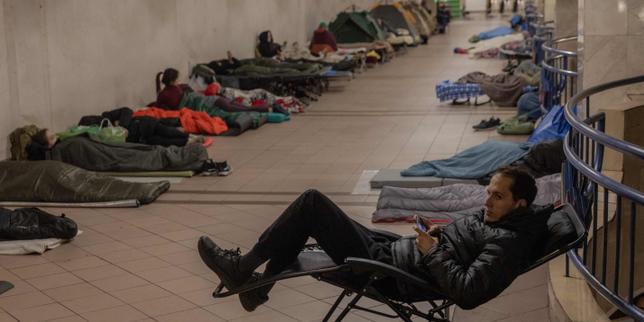
First comes the air raid alert—not just the wail of municipal sirens echoing off Soviet-era apartment blocks, but the jarring, metallic shriek of the mobile app on millions of bedside tables. People do not panic anymore; panic requires too much energy, and energy is a finite resource when you haven't slept a full night since February 2022. Instead, a practiced choreography takes over. Parents scoop sleeping children into corridor bathrooms, placing them behind two load-bearing walls to avoid flying glass. Dogs tremble in bathtubs.
Then, if the incoming weapon is ballistic, the physics change. Cruise missiles and drones take hours to cross the country, giving air defense crews time to track, calculate, and engage. Ballistic missiles drop from the upper atmosphere at hypersonic speeds. Often, the boom of the impact arrives before the warning has even finished registering on the radar screens.
Imagine standing in your kitchen, reaching for a kettle, when the air pressure suddenly drops so fast your ears pop. A flash of blinding orange light turns the night outside into noon for a fraction of a second. Then comes the sound—not a Hollywood boom, but a jagged, tearing roar that vibrates in your teeth and rattles the fillings in your jaw.
Somewhere across the city, steel screams as it bends past its breaking point. Concrete pulverizes into gray dust that hangs over the river like winter fog. And in three separate locations, three lives end instantly.
We rarely learn their names in the initial wire reports. Wire reports are built for speed, not grief. They give us the cold architecture of the event: Russian forces launched a combined strike overnight; air defenses downed dozens of targets; debris and direct hits killed three civilians and damaged two river crossings.
Behind those words are three distinct universes collapsing. One might be a security guard walking his perimeter near an industrial zone, holding a flashlight that is still switched on beneath a pile of rubble. Another might be an elderly woman who couldn't make it down four flights of stairs to the basement shelter because her knees gave out years ago. The third might be a young man stepping onto his balcony for a cigarette, thinking the worst of the barrage had already passed.
To reduce them to a statistic is convenient for headlines, yet it obscures the profound violence of what is happening. Every single death in a city of three million people is an act of deliberate erasure.
Why Bridges Always Come First in Modern War
If you look back through the history of twentieth- and twenty-first-century warfare, from the spans over the Rhine in 1945 to the bridges of Belgrade in 1999, you see the same obsessive fixation on crossings. Military theorists call them choke points. Civil engineers call them critical nodes. Ordinary people simply call them the way home.
There is a cruel psychological logic to striking bridges in a city like Kyiv. When you bomb an electrical substation, the lights go out, and people feel cold and isolated. When you bomb a bridge, you physically sever a community from itself. Families split between the Left and Right banks suddenly find themselves separated by a geographic barrier that feels as wide as an ocean.
During the first weeks of the full-scale invasion in 2022, Ukrainian engineers blew up their own bridges on the northern approaches to Kyiv—over the Irpin River—to stop Russian armored columns from rolling into the capital. That was a sacrifice born of desperation, a deliberate amputation to save the patient. People accepted the muddy detours and makeshift pontoon crossings because they knew the alternative was occupation.
Years later, the dynamic has shifted into a grueling war of attrition. Russia is no longer trying to drive tanks across Kyiv’s bridges; it is trying to make life inside the city so exhausting, so friction-heavy, and so terrifying that the population’s will to resist fractures under the weight of daily inconvenience and grief.
Consider what happens next when two bridges are damaged.
First, municipal repair crews arrive before the smoke has even cleared. These men and women are the unsung infantry of urban survival. Wearing high-visibility vests over heavy winter coats, they work directly beneath open skies—fully aware that Russian forces frequently employ "double-tap" strikes, firing a second missile at the exact same coordinates twenty minutes later to kill first responders and engineers.
They inspect the load-bearing pillars. They test the tension cables. They sweep away shrapnel and shattered asphalt while air raid sirens wail a second, third, and fourth time. Within hours, if the structural integrity holds, they open a single lane. Traffic crawls across at ten miles an hour, drivers staring silently through windshields at scorched guardrails and fresh craters filled with gravel.
The Architecture of Resilience
From the outside, it is easy to wonder how anyone endures this without losing their mind. Honestly, if you ask people living in Kyiv how they cope, many will admit they don't entirely know. Fear doesn't disappear; it just gets compressed into a tight, cold knot at the base of the stomach, carried around like a heavy stone in a coat pocket.
You develop strange new instincts. You learn to tell the difference between the dull thud of outgoing air defense and the sharp crack of an incoming warhead. You never park your car under large trees or next to glass-fronted office buildings. You keep a go-bag by the front door containing your passport, a power bank, a bottle of water, and a tourniquet, even if you haven't touched it in six months.
And yet, by 9:00 AM on the very morning those two bridges are damaged, something remarkable happens.
The coffee shops along Khreshchatyk open their doors. Baristas grind beans using backup generators humming quietly on the sidewalks. Tram drivers navigate around police tape. Olena, our hypothetical nurse, eventually makes it across the river—two hours late, exhausted, her boots caked in gray slush, stepping into the clinic to take over the shift from a colleague who stayed overnight so the ward wouldn't be left unattended.
This is the part that cold military calculations consistently fail to measure. Planners in distant command bunkers look at maps, calculate explosive yields, and predict civilian panic based on formulas from mid-century textbooks. They see two damaged bridges and assume paralysis.
They forget that a city is not made of concrete and steel. Concrete cracks. Steel melts. Bridges buckle under the impact of half a ton of high explosives.
A city is made of the stubborn, irrational refusal of millions of ordinary people to let someone else dictate where they belong.
The Weight of the Morning After
Still, we must be careful not to romanticize resilience to the point where we ignore its cost. Resilience is not a renewable resource; it is burned like fuel, leaving behind scar tissue and exhaustion.
Every time a barrage hits Kyiv, the city’s invisible margin of safety shrinks a little further. Air defense interceptors are finite and staggeringly expensive, costing millions of dollars per shot to knock down drones built from lawnmower engines and carbon fiber. Repair crews can patch asphalt and weld steel plates over shrapnel holes, yet metal fatigue and structural stress accumulate over time, just like trauma accumulates in the human nervous system.
When international headlines move on after twenty-four hours—because three dead and two damaged bridges no longer feel like breaking news—the people of Kyiv remain standing on the riverbank, staring at the scaffolding.
They are left with the quiet terror of the next night’s forecast. They are left with the funerals of three neighbors whose only crime was sleeping in their own beds or walking to work before dawn. They are left navigating a wounded city where every crossing over the water is a reminder of how thin the line is between ordinary life and sudden annihilation.
Late that evening, long after the rush-hour bottlenecks have finally cleared, a solitary municipal worker stands near the edge of one of the damaged spans. Beneath his boots, the river moves black and indifferent toward the sea, carrying reflections of amber streetlights across its surface. He shines his beam onto a freshly welded steel plate bolted over a jagged tear in the guardrail, checks his clipboard, and walks back toward his truck as the first faint hum of a distant siren begins to rise again in the dark.


