The silt smells different when the water dies.
Ask anyone who has spent forty years living within sight of the Danube. They will tell you that the great river has a voice, a low, rhythmic breathing that changes pitch depending on whether the snows are melting in the Alps or the summer sun is baking the Hungarian plains. You learn to sleep to it. You learn to measure your life by its floods and its shrinks. But nobody teaches you how to listen to a river when it simply stops breathing.
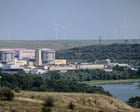
By late summer, the mud flats near Cernavodă stopped looking like a riverbed and started looking like a scar.
(Note: The following scenes use hypothetical characters to ground verified meteorological data and grid reports into a human scale, illustrating how falling water levels force operational halts at nuclear facilities.)
Ion wiped a grease-stained forearm across his forehead, squinting against the glare bouncing off the concrete apron of the plant. Inside the containment buildings of Romania’s sole nuclear power station, machinery hummed with the indifferent, terrifying efficiency of a mechanical heart. Outside, the coolant intake channels were gasping.
"Look at the telemetry," Ion muttered, tapping a heavy finger against a glowing monitor.
Beside him, Elena didn’t need to look. She had spent the morning walking the perimeter, watching the waterline retreat centimeter by centimeter from the intake pumps. The Danube was hitting record lows. Not just low for August, but low for history. The river, starved of rain and baked by weeks of relentless heatwaves stretching across Central Europe, could no longer provide the volume of cold water required to condense steam back into liquid within the secondary loop.
Physics does not negotiate. If you cannot pull enough water from the earth to bleed off the heat, you have two choices. You throttle the reactor, or you trip the breakers.
Power dropped. Megawatts vanished from the national grid, not because of a blown transformer or a cyberattack, but because a river forgot how to run deep.
We tend to think of our technological grid as something floating above nature. We draw lines on maps, erect steel towers, pour foundations of reinforced concrete, and convince ourselves we have built a sanctuary against the whims of the sky. We imagine electricity as an abstraction that lives behind a wall switch.
It is not.
Electricity is physical. It is heavy. It requires millions of tons of matter moving, heating, cooling, and reacting every single second. And above all, it requires water. More water, by a massive margin, than most people ever realize. Nuclear plants, coal plants, natural gas turbines—they are all, at their core, extraordinarily complicated machines designed to boil water and catch the steam. When the water vanishes, the civilization built on top of it stutters.
Consider what happens when the Danube drops below critical thresholds. It is not merely a matter of navigation barges running aground or farmers watching corn stalks curl into ash. It is the silent, cascading vulnerability of baseload power.
Romania relies on the Cernavodă Nuclear Power Plant for roughly a fifth of its entire electricity supply. Unit 1 and Unit 2 hum day and night, providing the steady, unblinking heartbeat that keeps hospitals running, refrigerators cold, and factories humming. They do not care about political elections or market fluctuations. They care about physics. They care about temperature differentials.
When the river temperature climbs too high, pumping it through the condensers loses its thermodynamic magic. When the water level drops too low, the intake pipes begin to swallow air instead of liquid, threatening catastrophic pump cavitation.
So, the operators make the hard choice. They pull the control rods. They quiet the splitting atoms.
And the lights dim.
I remember standing by the banks of the Danube a decade ago, watching fishermen pull heavy-bodied carp from the current while barge captains argued in three different languages over coffee. There was a confidence to the place. Rivers endure. That was the unwritten rule of the European continent. Empires rise and fall, borders shift on parchment, but the Danube keeps rolling toward the Black Sea.
Except rivers are not immune to the arithmetic of a warming planet.
What happened at Cernavodă is not an isolated malfunction. It is a preview. Across Europe, from the Rhône in France to the Po in Italy, power operators are staring at the same terrifying math. Nuclear reactors across the continent have been forced to cut output during heatwaves not because they were unsafe, but because the rivers discharging their thermal effluent were already too warm to take any more heat, or because the rivers themselves were simply running dry.
We are caught in a cruel irony. To combat a changing climate, we need clean, carbon-free baseload energy. Nuclear power offers precisely that—massive, reliable energy generation without the smokestacks. Yet the very climate disruptions we are trying to mitigate are now turning our most reliable cooling sources into dust and mud.
Elena walked back out into the blinding afternoon sun, pulling her hard hat down lower over her eyes. The plant was operating at reduced capacity now, a wounded giant holding its breath. Down at the riverbank, a lone egret picked its way through ankle-deep puddles where deep, swift channels used to roar.
There was no dramatic explosion. No sirens wailed across the flat Dobruja landscape. Just the quiet, terrifying realization that our modern world is tethered to things much older, and much more fragile, than we ever cared to admit.
The river will rise again when the autumn rains finally break. The pumps will roar back to full power. The grid will stabilize.
But the margin for error has just grown a little thinner, and the mud flats are whispering a warning we can no longer afford to ignore.