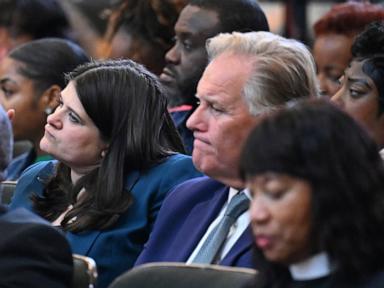
Silence.
In a state where the political divide often feels as wide and unforgiving as the Mackinac Straits in January, a single photograph—or a single shared podium—can stop a room cold.
Consider a hypothetical voter in Macomb County, a lifelong autoworker named Arthur who has spent forty years watching campaign signs sprout and wither on his neighbors' lawns like seasonal weeds. To Arthur, politics has long been a binary sport: red jerseys on one side of the field, blue jerseys on the other, and very little reason for the captains to shake hands before the fourth quarter. So when news broke that Democratic Representative Haley Stevens and Republican former Representative Mike Rogers—two central figures in Michigan’s fiercely contested U.S. Senate race—had appeared together, Arthur did what millions of Michiganders did. He leaned forward, squinted at the screen, and asked a simple question.
What is actually going on here?
To understand why an appearance between Haley Stevens and Mike Rogers sparks immediate turbulence across Michigan’s political ecosystem, you have to understand the state itself. Michigan is not a monolith. It is a patchwork of union halls in Detroit, cherry orchards in Traverse City, suburban cul-de-sacs in Oakland County, and quiet, snow-dusted towns in the Upper Peninsula. For decades, winning statewide office here has required walking a razor’s edge—appealing to the energized base of your own party without alienating the pragmatic middle that decides every close election.
The Anatomy of an Unexpected Moment
In standard political coverage, an appearance between two prominent figures from opposing parties gets reduced to a handful of dry bullet points: the location, the date, the reaction from party strategists, and a flurry of statements from rival campaigns. Yet beneath the surface of press releases and social media commentary lies a much older, more human tension.
Haley Stevens, a Democrat representing Michigan’s 11th Congressional District in Oakland County, built her political identity on manufacturing advocacy, union ties, and a high-energy, retail-politics style forged during her time working on the Obama administration's auto rescue task force. Mike Rogers, a former FBI special agent, state senator, and seven-term Republican congressman who chaired the House Intelligence Committee, carries a very different brand—one rooted in national security credentials, traditional conservative economics, and broad name recognition across suburban and rural Michigan.
In the context of Michigan’s Senate race—a high-stakes battleground contest with national implications for control of the upper chamber—every public move by either figure is scrutinized under a microscope. When Stevens and Rogers appear at the same event or share a public platform, political observers immediately read the tea leaves.
To supporters of bipartisanship, such moments look like proof that governing is still possible—that two people with fundamentally different philosophies can occupy the same space, address shared regional priorities like Great Lakes protection or automotive supply chains, and treat each other with basic civic respect.
To party purists and primary rivals, however, the optics tell a very different story.
Why Optics Trigger Turmoil
Think of a modern political primary like a tightrope stretched over a canyon. On one side, a candidate must prove ideological loyalty to the activists, donors, and primary voters who decide who gets the party nomination. On the other side lies the general electorate—independent and swing voters who frequently tell pollsters they are exhausted by partisan gridlock and performative outrage.
When a Democrat like Stevens shares a stage with a Republican like Rogers, critics within her own party's orbit seize on the visual as evidence of excessive moderation or blurred lines. According to political analysts tracking Michigan’s Senate dynamics, primary campaigns thrive on contrast. If a candidate’s core pitch relies on drawing a sharp moral and policy line between Democrats and Republicans, a cordial joint appearance complicates that message. Suddenly, rival campaigns have a talking point, activist groups have a reason to raise eyebrows, and donors start asking questions.
Conversely, on the Republican side, Rogers faces his own balancing act. Having won the GOP Senate nomination in 2024 in a razor-thin race against Democrat Elissa Slotkin—losing by less than half a percentage point in one of the closest Senate contests in the country—Rogers enters subsequent electoral cycles with both the advantage of universal name recognition and the scrutiny that comes with being a known quantity. For conservative hardliners, any image that softens the partisan edge risks dampening enthusiasm among voters who want an uncompromising fighter.
It is messy. It is confusing. And if you feel a flash of fatigue trying to decode whether a shared appearance is a genuine gesture of cooperation or a calculated political maneuver, you are not alone. Even seasoned political reporters in Lansing and Washington frequently admit that in an era of hyper-polarized media, the gap between what happens in a room and how it plays online can be enormous.
The Invisible Stakes in the Great Lakes State
Step away from the cable news panels and the campaign war rooms for a moment, and look at what is actually at stake for the people living between Lake Huron and Lake Michigan.
Michigan’s economy is in the middle of a historic, uncertain transition. From the shift toward electric and hybrid vehicles to the pressures of inflation, housing costs, and global manufacturing competition, families across the state are navigating real-world disruptions that do not neatly sort themselves into Democratic or Republican talking points.
Consider a hypothetical small-business owner in Grand Rapids—let’s call her Elena—who runs a precision tool-and-die shop employing thirty-five people. Elena does not care which consultant won the messaging cycle on a Tuesday afternoon. She cares about whether federal trade policy protects her shop from subsidized foreign imports, whether interest rates will let her finance a new CNC machine, and whether her employees can afford childcare and groceries.
When Elena sees Haley Stevens and Mike Rogers in the same frame, she isn’t looking for a betrayal of party orthodoxy. She is looking for signs that the people asking for her vote understand the gravity of the moment.
History offers plenty of reminders that Michigan voters reward independence of thought—and punish what they perceive as hollow theatrics. From Republican Governor William Milliken and Democratic Senator Carl Levin to more recent split-ticket outcomes, Michigan has repeatedly demonstrated a streak of political pragmatism. Voters here have a finely tuned radar for authenticity. They know the difference between working across the aisle on a defense authorization bill or a Great Lakes restoration grant and simply staging a photo opportunity.
The Pressure Cooker of Modern Campaigns
Why, then, does a single joint appearance generate so much friction inside party circles?
The answer lies in how modern political campaigns are funded and fought. In the past, local newspaper endorsements, union hall meetings, and county fair handshakes formed the backbone of a Senate campaign. Today, national fundraising networks and viral clips dominate the landscape. A ten-second video or a single photograph can be clipped, stripped of context, and circulated to millions of voters within minutes.
Campaign strategists understand this arithmetic intimately. In a competitive primary or a bruising general election, every visual becomes ammunition. If Stevens appears alongside Rogers at a forum focused on Michigan industry or national security, progressive challengers or critics can frame it as legitimizing an opponent. Meanwhile, conservative critics can frame the same moment as Rogers offering cover to a political rival.
Yet there is a paradox built into this dynamic. The very behaviors that trigger turmoil among party insiders—showing up in mixed company, engaging with an opponent’s audience, acknowledging common ground—are often the exact qualities that undecided voters in places like Kent County, Saginaw County, and Oakland County say they want most from their leaders.
What Happens When the Cameras Turn Off
If you have ever sat in a town hall in suburban Detroit or a diner in mid-Michigan during an election year, you know the sensory reality of Michigan politics. It smells like burnt coffee and damp wool coats in November. It sounds like neighbors arguing passionately about property taxes, union contracts, and foreign policy—and then passing the creamer across the table anyway.
That lived reality is vastly more nuanced than the caricature presented in thirty-second attack ads.
Both Stevens and Rogers know this terrain intimately. Stevens, who flipped a historically Republican suburban district in 2018 and has repeatedly defended her seat in competitive elections, understands how to speak to moderate suburbanites without losing her core Democratic base. Rogers, whose career spans law enforcement, intelligence oversight, and multiple statewide campaigns, knows how to project institutional steadiness while appealing to working-class and suburban conservatives.
Their shared appearance—and the immediate uproar surrounding it—serves as a mirror held up to American politics right now. It exposes the widening gulf between what party machinery demands and what ordinary citizens hope for.
Back in Macomb County, Arthur finishes his coffee and clicks off the television. Tomorrow, his mailbox will be full of glossy flyers telling him who to fear and who to blame. His phone will buzz with fundraising texts warning of imminent disaster. None of those messages will capture the quiet, complicated truth of a state trying to figure out its future—or the simple, stubborn fact that in Michigan, sooner or later, everyone has to share the same road.


