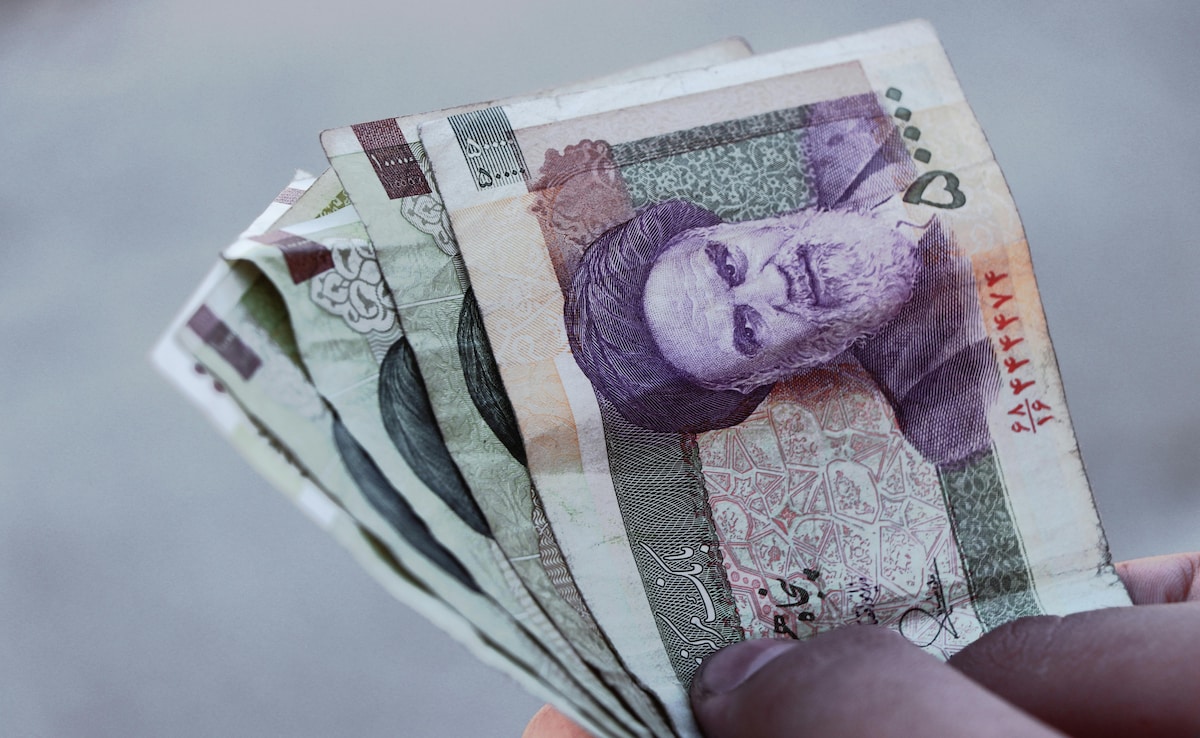
The headlines are screaming about a "freefall." They’re obsessed with the number 1,810,000. It’s a terrifying figure for the casual observer, a nice round number that suggests the total annihilation of the Iranian economy. Financial pundits are lining up to tell you that this is the final nail in the coffin for Tehran.
They’re wrong.
Actually, they’re worse than wrong; they’re lazy. Most Western analysts treat the Iranian Rial like a standard currency operating in a transparent market. It isn’t. When you see the Rial hitting 1.8 million to the US Dollar on the open market, you aren’t looking at a "market failure." You’re looking at a deliberate, calculated outcome of a dual-track economy that has survived under siege for forty years.
The Rial isn't dying. It was murdered long ago, and the current price is just the noise of the scavengers fighting over the bones. If you want to understand what’s actually happening, you have to stop looking at the exchange rate and start looking at who benefits from the chaos.
The Myth of the "All-Time Low"
Every time the Rial hits a new psychological barrier, the media acts surprised. Why? In a country with structural inflation baked into its DNA, an "all-time low" is the status quo. It’s the baseline. Saying the Rial is at an all-time low is like saying the sun is at its highest point at noon. It’s a mathematical certainty under the current regime’s fiscal policy.
The "lazy consensus" argues that the drop to 1,810,000 Rials per Dollar is a sign of imminent regime collapse. I’ve heard this for two decades. I watched the jump from 40,000 to 100,000, then 500,000, then the million mark. Each time, the "experts" promised a revolution led by the middle class.
Here is the truth: The Iranian government doesn't just tolerate a weak Rial; they use it as a pressure valve. A devalued currency allows the state to pay its domestic debts in "monopoly money" while hoarding hard currency (USD, EUR, CNY) obtained through back-channel oil sales and regional trade.
When the Rial drops, the government’s wage bill—paid in Rials—effectively shrinks in real-world value. It’s a hidden tax on the citizenry that funds the state’s survival. It’s brutal. It’s predatory. But it isn't "collapse." It’s an endurance strategy.
The Bonfire of the Middle Class
The people suffering aren't the ones in power. The elite in Tehran aren't holding Rials. They hold real estate, gold, and offshore accounts. The 1.8 million exchange rate is a weapon used to liquidate the savings of the Iranian middle class, forcing them into a state of perpetual survival where political dissent becomes a luxury they can no longer afford.
If you’re looking at the Bonbast or Sana rates and thinking you’re seeing the "price" of Iran, you’re missing the point. Iran operates a multi-tiered exchange system that would make a Swiss banker weep.
- The NIMA Rate: Used for essential imports.
- The Secondary Market: For exporters.
- The Free Market (The 1.8M rate): Where the average person gets crushed.
By keeping these rates separate, the Central Bank of Iran (CBI) creates a massive arbitrage opportunity for those with political connections. They buy dollars at the low official rate and sell them at the 1.8 million free-market rate. This isn't an economic tragedy; it’s a massive wealth transfer from the poor to the connected.
Why the "Sanctions are Working" Narrative is Flawed
The US Treasury loves these numbers. They point to the 1.8 million figure as proof that "maximum pressure" is working. In reality, sanctions have created a "Smuggler’s Paradise."
When you block a country from the global financial system, you don't stop trade; you just move it into the shadows. I’ve seen this play out in dozens of emerging markets. The more you squeeze the official currency, the more you empower the gray market.
Iran has become a master of "sanctions-busting" through:
- Barter Trade: Trading oil for goods with China and India, bypassing the Dollar entirely.
- Regional Integration: Using Iraq and the UAE as massive laundering hubs for hard currency.
- Cryptocurrency: Iran was one of the first nations to officially recognize crypto mining as an industrial activity to bypass SWIFT.
The 1.8 million Rial rate is a distraction. It reflects the difficulty of getting physical dollar bills into a person's hand in a Tehran bazaar. It does not reflect the total value of Iran’s trade balance, which remains surprisingly resilient due to high energy prices and the world's quiet refusal to stop buying discounted Iranian crude.
Stop Asking if the Rial Will Recover
People always ask: "When will the Rial stabilize?"
That is the wrong question. The Rial will never stabilize because the Iranian Central Bank has no incentive to stabilize it. Stability requires transparency, and transparency is the enemy of the Iranian ruling class.
Instead, ask this: What happens when the Rial becomes functionally irrelevant?
We are approaching a "Dollarized" or "Gold-based" informal economy. In Tehran, big-ticket items—cars, apartments, electronics—are already priced in USD or gold coins (Bahar Azadi). The Rial has become a "scrip," a token used for daily bread and low-level transactions.
The 1.8 million mark is a milestone on the road to a dual-society: those who have access to "real" money and those trapped in the Rial-based ghost economy.
The Actionable Truth for Outsiders
If you are an investor, a policy-maker, or an observer, stop waiting for a "breaking point."
Economies can function in a state of hyper-devaluation for decades. Look at Lebanon. Look at Venezuela. The "collapse" happened years ago; what you’re seeing now is the adaptation.
To understand the real state of Iran, ignore the Rial. Watch the price of a basket of basic goods in the provinces. Watch the volume of oil tankers leaving Kharg Island with their transponders turned off. Watch the "hawala" networks in Dubai.
The Rial at 1.8 million isn't a sign of the end. It is the cost of doing business in a world where the official rules no longer apply. The regime has traded the wealth of its people for the survival of its apparatus.
Stop checking the exchange rate. It’s a scoreboard for a game that was rigged before you even started watching.