Back in the 1970s, a solitary search across the volcanic rock of Española Island turned up a grim reality. Only 14 giant tortoises (Chelonoidis hoodensis) remained. Twelve females and two males were scattered across a ruined landscape, too isolated to sustain their own kind. Whalers, pirates, and introduced goats had thoroughly wrecked the ecosystem, leaving behind a barren expanse of thorn scrub where thriving tortoise populations once ruled.
Fast forward to today, and the numbers tell a completely different story. Thanks to decades of aggressive captive breeding and habitat restoration led by the Galápagos National Park Directorate and the Galápagos Conservancy, roughly 3,000 giant tortoises now roam free on Española. This isn't just a win for endangered species conservation. It is a masterclass in ecological engineering where slow-moving reptiles are actively dragging an entire island back from the brink of total collapse.
How Fourteen Tortoises Defied Extinction
Saving the Española tortoise required a desperate, multi-decade gamble. When conservationists realized the remaining wild population was heading toward total oblivion, they scooped up every last survivor they could find. They shipped them to a breeding center on Santa Cruz Island.
Then came a lucky break. Researchers discovered a stray male Española tortoise living in the San Diego Zoo. Brought back to the archipelago in 1977, that single male—famously named Diego—turned the entire program around. Paired with the resident females, Diego fathered hundreds of offspring over the next forty years.
By June 2020, the breeding program had achieved its goal. Rangers packed up Diego and the original 15 adult founders, shipping them home for a permanent retirement on Española. The captive phase was officially over. The wild population was left to carry the torch.
Tortoises As Island Architects
Most people think of herbivores as passive eaters. On Española, giant tortoises behave more like heavy machinery.
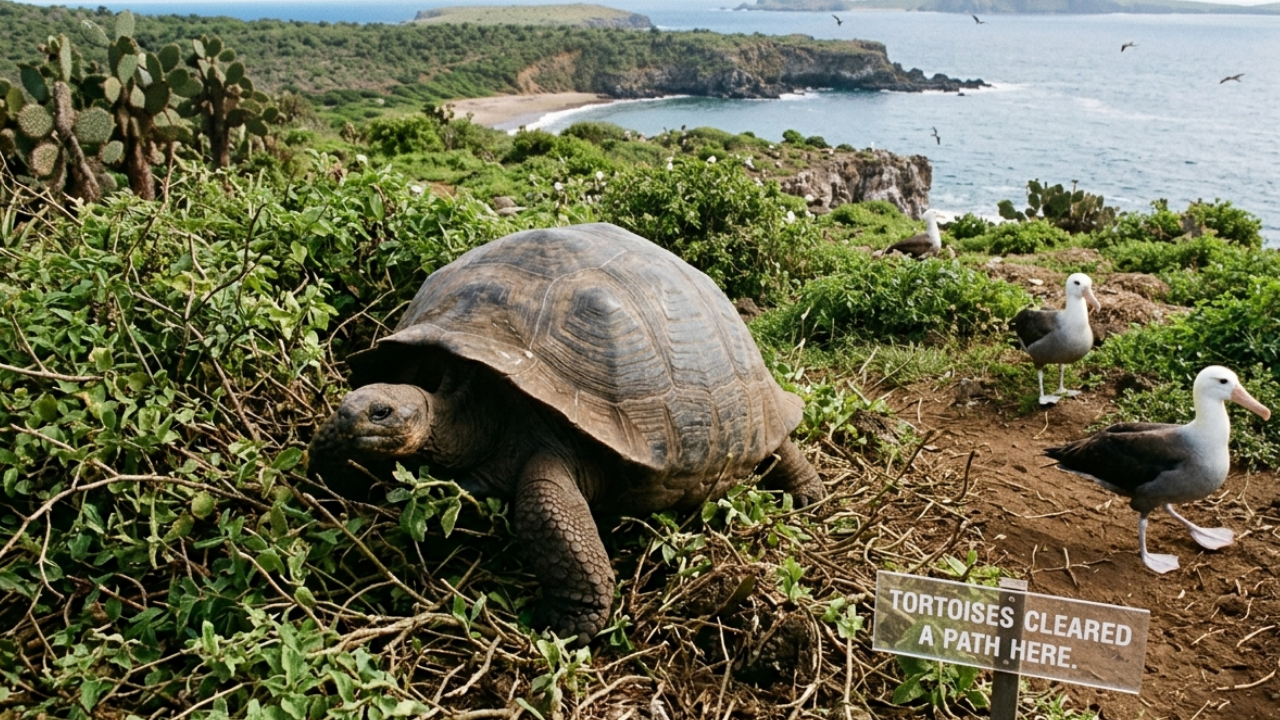
As they lumber across the terrain, they smash through dense thickets, snap woody vegetation, and plow wide pathways through the brush. This heavy-duty movement changes the layout of the island. Unobstructed ground is reappeared, opening up historic nesting zones that had been choked out by invasive plants and overgrown shrubs during the decades the tortoises were absent.
Native waved albatrosses rely directly on this architectural cleanup. These massive seabirds need clear runways to catch the wind and get airborne. When the tortoise numbers plummeted, the vegetation grew too dense for the birds to launch safely. Now that thousands of tortoises are trampling paths and opening up savannah-like clearings, the albatrosses have the runway space they desperately need to breed successfully.
The Hidden Mechanics of Ecosystem Recovery
Rewilding an island isn't just about dropping animals into a habitat and crossing your fingers. It requires restoring the invisible processes that hold an ecosystem together. Tortoises drive these processes in three major ways:
- Long-Distance Seed Dispersal: Tortoises gorge on local vegetation, including native cactus fruit, carrying seeds in their digestive tracts for weeks. As they roam, they drop these seeds miles away from the parent plant, preventing overcrowding and spreading flora across the island.
- Nutrient Transport: These animals regularly wallow in muddy seasonal pools to cool off. They track rich soil and organic matter back and forth between inland areas and water sources, constantly mixing nutrients into the volcanic earth.
- Habitat Shaping: By targeting specific invasive plants and breaking down woody brush, they stop single plant species from taking over the entire island, keeping the landscape diverse and resilient.
Without these biological bulldozers, the island stagnates. With them, the ecosystem functions the way it did centuries ago before human interference broke the chain.
What Conservation Teaches Us About Real-World Rewilding
The triumph on Española offers a blueprint for environmental recovery across the globe. Too often, conservation projects focus purely on protection—putting a fence around a dwindling species and hoping for the best.
Española proved that active intervention works better. You have to remove the root threats first, such as the feral goats that stripped the island bare. Then, you have to breed the right ecosystem engineers in captivity until the wild habitat can handle them again.
Similar tactics are now being tested elsewhere, from gopher tortoises shaping underground habitats in North America to giant tortoises grazing down invasive grasses in Mauritius. When you restore a keystone species, you aren't just saving one animal. You are flipping the switch on an entire ecological machine.
Today, those 3,000 tortoises continue to reshape Española step by heavy step, proving that extinction doesn't always have to be permanent if you are willing to put in the decades of hard work required to undo the damage.