National pride looks great on a podium. It plays well on evening broadcasts. It sounds noble when a Foreign Ministry official stands before a bank of microphones and insists that domestic resources alone will handle a catastrophe of staggering proportions.
Then the dead weight of reality sets in.
When the death toll crosses hundreds and infrastructure fractures into dust, waving away specialized international rescue teams because of institutional ego is not sovereignty. It is criminal negligence disguised as patriotism. The lazy consensus dominating the narrative right now is that local resilience is always enough, that pride keeps communities afloat, and that accepting foreign boots on the ground compromises national dignity.
That mindset kills people trapped under concrete.
I have spent decades watching governments panic during natural disasters, prioritizing political optics over human pulse rates. When disaster strikes hard, every hour spent bickering over bureaucratic jurisdiction translates directly into body bags. Nepal does not have the luxury of turning away heavy-lift helicopters, seismic acoustic locators, or elite urban search and rescue units simply to soothe diplomatic vanity.
The Myth of Self-Reliance in Catastrophic Failures
Let us dismantle the core falsehood driving this isolationist stance. The argument goes that domestic agencies understand the terrain better and should lead the response. True. Local responders possess unmatched contextual awareness. They know the geography, the dialects, and the immediate community networks.
Local knowledge does not pull a crushed torso out from beneath five floors of collapsed reinforced concrete without heavy hydraulic cutters.
Urban search and rescue requires heavy machinery, advanced acoustic and thermal imaging equipment, canine squads trained in live scent detection, and specialized medical teams capable of performing field amputations to prevent crush syndrome toxicity. When the inventory of these specific assets inside a country stands at near zero, pretending that sheer willpower fills the gap is a lethal delusion.
Sovereignty is not weakened by accepting help during an existential emergency. Every major nation on earth, from the United States to Japan, calls for international assistance when facing unprecedented calamity. Japan accepted foreign rescue teams after the 2011 triple disaster. The United States welcomed international aid after Hurricane Katrina. These countries possess massive economic engines and still recognized a basic operational truth: physics does not care about national borders.
When disaster scales beyond domestic capacity, refusing external capacity is an active choice to let citizens suffocate in the rubble.
The Logistics Nightmare Nobody Talks About
The counter-argument from nationalist hardliners usually points to logistical chaos. Foreign teams clog up airports, demand complex supply chains, and sometimes lack cultural fluency.
This criticism has merit, which makes it dangerous because it contains a kernel of truth. I have seen foreign aid bottlenecks paralyze tarmac operations. Uncoordinated relief supplies pile up on runways while distribution networks stall because nobody speaks the local language or understands the road layouts.
Yet, pointing to logistical incompetence as an excuse to reject international help entirely is like refusing to build a hospital because someone once caught a staph infection in one.
The solution to logistical chaos is not isolation. It is command-and-control integration.
A competent government establishes a unified incident command structure immediately. You do not let foreign teams wander around improvising. You assign local liaisons to every incoming international contingent. You funnel their heavy assets directly to high-priority grids identified by local intelligence. You treat foreign rescue units as specialized subcontractors under national oversight, not as independent actors running roughshod over local authorities.
Rejecting the subcontractors because managing them is difficult is the equivalent of a contractor refusing to use cranes because operating a crane requires coordination.
The Human Cost of Political Posturing
Consider what happens on the ground while officials argue about optics.
Golden hours slip away. In search and rescue operations, the survival probability curve drops off a cliff after seventy-two hours. Every day the Ministry spends posturing about self-sufficiency is a day dehydration, internal bleeding, and secondary trauma finish off the survivors who managed to survive the initial impact.
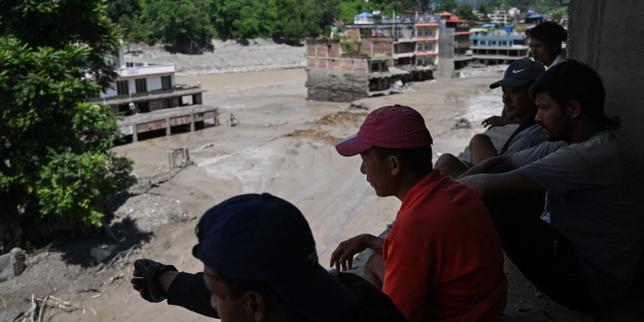
When flash floods sweep away entire settlements and trigger massive landslides, the operational theater demands three things simultaneously: rapid aerial reconnaissance, mass casualty medical stabilization, and heavy engineering clearance.
Nepal’s topography during a monsoon disaster is already a nightmare. Roads wash out. Bridges snap like twigs. Cut off from supply lines, remote mountain districts rely entirely on vertical airlift capacity. If domestic military fleets are stretched thin—which they invariably are during widespread regional flooding—refusing foreign rotary-wing assets means leaving entire valleys entirely cut off from food, clean water, and trauma care.
You cannot eat national pride. Clean water does not flow from political defiance.
What Real Leadership Looks Like
Real leadership requires swallowing institutional pride the moment the scale of destruction exceeds baseline capacity. It means admitting that the state apparatus was built for normal governance, not for apocalyptic shock events.
Governments that handle crises effectively practice radical realism. They map their exact deficit of heavy machinery and specialized personnel within six hours of impact. If the deficit is massive, they pick up the phone, issue a blanket international appeal, and clear the runway for incoming cargo planes before the dust even settles.
They do not wait for the death toll to climb into the hundreds while debating whether accepting foreign aid looks weak. They understand that looking strong while your people die under rubble is the ultimate form of weakness.
The Foreign Ministry needs to drop the defensive playbook. Stop treating rescue operations as a geopolitical chess match and start treating them as an engineering and medical emergency.
Unclog the airspace. Issue the visas on arrival. Hand the international teams the sector maps and point them toward the collapse zones.
Lives depend on abandoning the fantasy that you can fight a mega-disaster entirely alone. Stop defending the ego of the state and start digging out the people who built it.