The air in a federal courtroom carries a specific, sterile weight. It smells of polished oak, industrial carpet cleaner, and the heavy, invisible finality of the state. On a humid Tuesday morning in Fort Worth, that finality descended with a rhythmic thud that left those inside struggling to breathe.
Decades.
Fifty years. Seventy years. One hundred years.
To hear numbers like that attached to human names is to watch the future evaporate in real time. We treat time as a commodity we can always earn back, but inside a federal criminal proceeding, it is a resource that can be seized entirely by the stroke of a pen.
The headlines will tell you the cold mechanics of the day. They will report that federal judges handed down staggering sentences to a group of activists following a violent confrontation outside the Prairieland Detention Center in Alvarado, Texas. They will mention a Fourth of July night that devolved from a noise demonstration into shattered glass, fireworks, and gunfire that left a police officer wounded in the neck.
But the headlines cannot capture the sound of a mother’s voice cracking on the courthouse steps. They do not show you the invisible line where a nation’s legal framework bends into entirely new territory.
Consider what happens when the language of global warfare is brought home to roost on American citizens.
The Night the Rules Changed
Let us go back to July Fourth. Fireworks are a baseline requirement of the holiday, a standard auditory backdrop across America. But outside the gates of the immigrant detention facility, south of Fort Worth, the noise was meant to serve a different purpose. A group of activists had gathered late at night, bringing fireworks to create a wall of sound. The goal, they claimed, was solidarity. They wanted the people locked inside the facility to know someone outside remembered they existed.
It is a familiar script in modern activism. But scripts can go terribly wrong.
A few demonstrators drifted away from the main group. Vandalism began. A guard shack was targeted. Tires were slashed on a government van. A security camera was smashed. In the darkness, the volatile energy of a protest met the rigid defensive posture of federal law enforcement.
Then came the flashpoint.
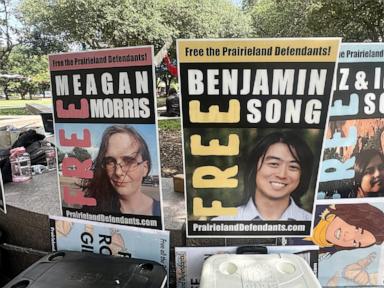
Benjamin Hanil Song, a former U.S. Marine Corps reservist and a student with no prior criminal record, had a weapon. Prosecutors say he opened fire as an Alvarado Police Department officer arrived at the scene. Song’s defense attorney later argued the shots were intended as "suppressive fire" after the officer aggressively drew his own weapon, and that the bullet that struck the officer’s neck was a tragic ricochet.
The officer survived the wound. Song was convicted of attempted murder.
On Tuesday, Judge Reed O’Connor looked at the young veteran and sentenced him to 100 years in federal prison. It is the maximum allowable punishment. It is, for all practical purposes, the end of his life.
The Ghost in the Machine
If the story ended with Song, it would be a familiar, tragic narrative of a protest that crossed an unforgivable line into bloodshed. But the real shift in American jurisprudence lies with the seven other people standing in that courtroom.
They did not pull a trigger.
Savanna Sue Batten is a young woman who spent her early twenties advocating for animal rights before moving into anti-war and human rights circles. Her sister describes her as a compassionate person whose ultimate dream was simple: she wanted to open a bakery.
Autumn Hill believed she was attending something that felt more like an aggressive block party than an insurrection.
They did not shoot anyone. Yet, both women walked out of the courtroom carrying 50-year sentences.
To understand how a broken security camera and a night of chaotic unrest translate into half a century behind bars, you have to look at a legal mechanism that has fundamentally transformed the stakes of American dissent. The Justice Department prosecuted these individuals not merely as rioters or vandals, but under the heavy mantle of domestic terrorism.
The mechanism used was a charge called providing material support for terrorists.
Historically, this charge was designed to intercept cash flows to international networks or disrupt deeply coordinated networks plotting mass casualties. Here, it was applied to a localized group of activists who met through a left-wing book club and a local gun group. Prosecutors built their conspiracy case by pointing to the literature the group read—political zines found during searches—and their use of Signal, an encrypted messaging app used globally by journalists, activists, and ordinary citizens who prefer their texts private.
Look at the math of the punishment. Enrique Tarrio, the leader of the Proud Boys convicted of seditious conspiracy for his role in the January 6 attack on the U.S. Capitol, received 22 years. Stewart Rhodes, leader of the Oath Keepers, received 18.
The young adults in Texas, loosely bound by a shared ideology and a disastrously managed night of unrest, are looking at double and triple those terms.
Even those who weren't there were caught in the dragnet. Daniel Sanchez-Estrada was not present at the Prairieland facility on July Fourth. But after his wife, Maricela Rueda, was arrested, he agreed to move her collection of political zines and reading materials away from their home. For that act of concealment, he was convicted of corruptly concealing a document.
His sentence is 30 years.
The Precedent Left Behind
Every landmark legal case leaves a legacy that stretches far beyond the individuals in the dock. When the dust settles on this Fort Worth courtroom, the immediate reality is a collection of shattered families. There is Hope Song, defending her son’s character while grappling with the reality that he may never walk free again. There are siblings and friends wondering how a trajectory that began with animal rights advocacy ended in a maximum-security facility.
But the broader reality is a chilling effect that scales across the entire political landscape.
By utilizing consecutive sentencing—stacking the penalties for individual counts one after the other rather than letting them run at the same time—the court has signaled a zero-tolerance paradigm for unrest that carries even a flavor of ideologically driven resistance. The designation of decentralized movements under domestic terror frameworks means the boundary lines of the First Amendment have been re-drawn in the sand.
It forces a terrifying question upon anyone who steps into the street to voice a grievance: If a demonstration fractures into violence, where does your personal liability end? If someone you stood next to in a crowd makes a catastrophic choice, does your presence, your reading habits, or your encrypted texting app constitute material support for an act of terror?
The courtroom is empty now. The marshals have led the defendants away to begin processing them into a system that will hold them until they are old or dead. The oak tables are bare.
The state has made its point with absolute, crushing force. Security has been defended. Law and order have been reasserted. But as the courthouse doors swing shut, the air outside feels a little tighter, the margin for error infinitely smaller, and the cost of an American voice suddenly, unimaginably high.


