The sound of a tennis ball striking the sweet spot of a racket at Center Court is usually a clean, sharp crack. It echoes off the pristine white roof, bouncing over the perfectly manicured, emerald-green grass. It sounds like luxury. It sounds like tradition. But if you listened closely to Jannik Sinner during the final Sunday of the championships, his strikes sounded different. They carried the heavy, thudding echo of a ghost.
A few weeks prior, that ghost wore a different color. Red.
To understand the gold trophy flashing in the London sun, you have to look at the clay stains that refused to wash out of Sinner’s socks a month earlier. Tennis fans watch the grand slams as isolated chapters, neat little boxes ticked off a calendar. But the human body does not work in chapters. The mind does not have a reset button. When Sinner suffered a devastating, heartbreaking collapse on the clay of Roland Garros—a loss that felt less like a sporting defeat and more like a public interrogation of his nerve—the tennis world did what it always does. It doubted.
They said his body was too fragile for the brutal, five-set marathons. They whispered that his cold, calculated demeanor was actually a mask for a lack of killer instinct.
Then he stepped onto the grass.
The Weight of the Melt Down
Defeat in professional sports is rarely elegant. When a top-tier athlete falls just short of a major final, it is not a gentle slide. It is a violent crash. For Sinner, the loss in Paris was a physical and emotional eviction. He had been the man of the hour, the reigning Australian Open champion, the flame-haired savant who was supposed to effortlessly inherit the throne of the Big Three.
Instead, he left France limping. His hip was a question mark. His psyche, usually as impenetrable as a bank vault, showed hairline fractures.
Consider the sheer physical whiplash of what these athletes endure. Within a span of less than twenty days, a player must transition from clay—a surface that demands sliding, endless patience, and heavy topspin that grinds the joints into dust—to grass. Grass is a different sport entirely. It is low-skidding, lightning-fast, and slick as ice. It rewards instinct over calculation. If you carry the baggage of a clay-court trauma onto the lawns of SW19, the grass will expose you in minutes. One bad foot fault, one hesitant split-step, and you are on a plane home.
Sinner arrived in London with the media spotlight burning a hole through his tracksuit. Every press conference was a disguised autopsy of his previous failures.
"How is the hip, Jannik?"
"Are you worried about the stamina, Jannik?"
He answered with his characteristic, deadpan monotony. But beneath the surface, a reinvention was taking place. He wasn't trying to forget Paris. He was using it as fuel.
The Architecture of Resilience
There is a common misconception about resilience. We tend to view it as a shield, a rigid piece of armor that deflects pain. It isn't. Real resilience is more like the grass courts themselves. It absorbs the stomp, the slide, the violent changes of direction, and somehow, it grows back overnight.
Sinner’s team knew that changing his technique wasn't the answer. You don't rewrite a world-class forehand in a fortnight. Instead, they worked on his relationship with discomfort.
During the early rounds of the tournament, Sinner looked far from perfect. He dropped sets to lower-ranked opponents. He slipped on the baseline, scrambling to his feet with grass stains coloring his whites. In the past, these moments of friction would cause a subtle shift in his eyes—a flicker of panic. This time, there was only a chilling, calm focus.
An analogy helps clarify his evolution. Think of a high-performance sports car hitting a patch of black ice. The amateur driver panics, slams on the brakes, and spins out of control. The expert driver steers into the skid, accepts the temporary loss of grip, and waits for the tires to find purchase again.
Sinner steered into his own frailty. When his first serve deserted him in the quarterfinals, he didn't press. He accepted the grind. He won the ugly points. He became a master of the unglamorous survival.
The Sunday Redemption
By the time he reached the final, the narrative had completely shifted. The doubters who had written his obituary after the clay season were suddenly clamoring for front-row seats on the bandwagon.
The final match was not a showcase of effortless beauty. It was a tactical chess match played at two hundred kilometers per hour. Across the net stood an opponent who smelled blood, someone determined to test Sinner's physical limits, to push that troublesome hip to the breaking point.
But Sinner’s movement was majestic. The low bounces that usually trouble taller players were met with a deep, agonizingly low knee bend. His backhand, down the line, was an absolute laser, clipping the lines with millimeter precision.
When the final point landed out, Sinner did not drop to his knees. He did not scream at the sky. He walked to the net, shook his opponent's hand, and smiled a small, private smile. It was the look of a man who had gone down into the dark, looked at his own sporting nightmares, and calmly walked back out into the light.
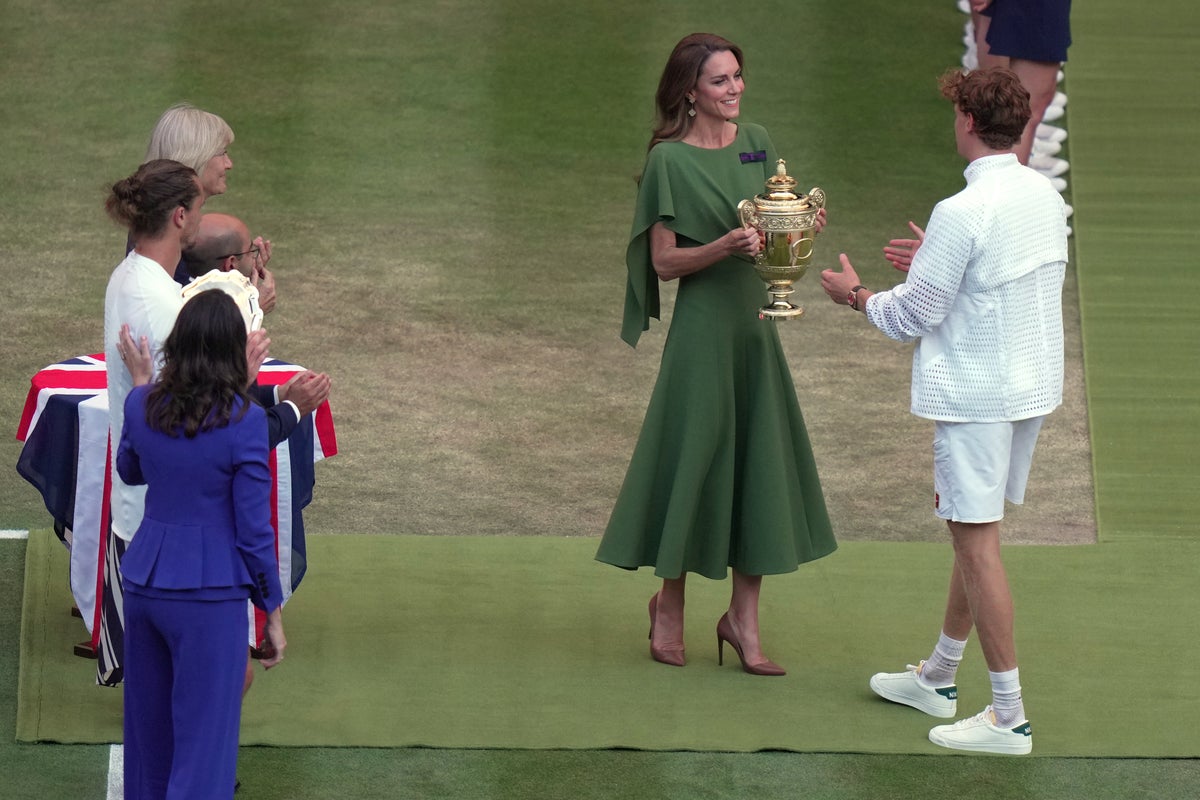
The trophy was lifted. The flashes blinded the court. The pundits spoke of a new era, of ranking points, of technical adjustments.
But as Sinner held the silver gilt cup aloft, the real story was written on his shoes. Hidden beneath the fresh green stains of Wimbledon were the invisible, indelible marks of the Parisian clay. He didn't win despite his heartbreak. He won because of it.