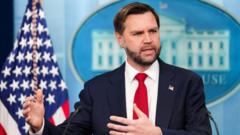
The white noise of official diplomacy usually defaults to a predictable vocabulary. When White House officials announced that Vice President JD Vance had abruptly cancelled his flight to Switzerland, they blamed the logistical complications of intercontinental diplomacy. Journalists waiting at Joint Base Andrews were told the framework for technical talks was merely delayed.
The bureaucratic spin failed to obscure a far harsher reality. The multi-nation summit in the Swiss mountains of Bürgenstock did not stall because of flight schedules or administrative friction. It fell apart because the foundational premise of President Donald Trump’s landmark 14-point memorandum of understanding, signed just days ago at Versailles, is already colliding with the unyielding realities of Middle Eastern warfare.
The ceasefire was supposed to freeze regional hostilities for 60 days, reopen the Strait of Hormuz, and force Tehran to negotiate the dismantling of its highly enriched uranium stockpile. Instead, a dramatic escalation of violence between Israel and Hezbollah in Lebanon, coupled with intense domestic blowback in Washington and deep paranoia in Tehran, has exposed the fundamental fragility of the administration's exit strategy. The United States removed its naval blockade and allowed Iranian oil to flow freely again, but Washington has quickly discovered that buying a way out of a war does not mean controlling the peace.
The Lebanon Friction Point
The core defect of the Versailles accord was the illusion that Washington and Tehran could dictate terms to regional actors who view the conflict as existential. The memorandum explicitly called for a permanent cessation of hostilities across all fronts, including Lebanon. Yet, hours before Vance was scheduled to depart, Hezbollah forces killed four Israeli soldiers, triggering a wave of retaliatory Israeli airstrikes in south Lebanon and the Bekaa Valley that killed at least 18 people.
For Iran’s new Supreme Leader, Ayatollah Mojtaba Khamenei—who assumed power after his father was killed in the opening airstrikes of the war on February 28—the ongoing Israeli campaign is an immediate threat to his regime's regional credibility. Iranian state media outlets quickly signaled that Tehran would not send its chief negotiator, Mohammad Bagher Ghalibaf, to Geneva while Israeli jets were dropping bombs on their primary proxy.
                  [ Versailles Memorandum of Understanding ]
                                      |
                     +----------------+----------------+
                     |                                 |
         [ US Lifts Naval Blockade ]        [ Regional Ceasefire Mandate ]
                     |                                 |
         (Iranian Oil Flows Freely)          (Violated by Israel-Hezbollah
                     |                                 Escalation)
                     v                                 v
         [ Reduced US Leverage ]            [ Tehran Delays Swiss Talks ]
                     |                                 |
                     +----------------+----------------+
                                      |
                                      v
                    [ Diplomatic Deadlock in Switzerland ]
The administration miscalculated the leverage it retained after lifting the maritime blockade. By allowing oil tankers to move through the Strait of Hormuz before technical talks even commenced, the US surrendered its most potent economic lever up front. Tehran responded with predictable transactional cynicism.
Through the semi-official Tasnim news agency, Iranian officials announced they needed to see physical signs of American sanctions compliance before they would bother boarding a plane to Europe. They also dismissed the White House's request for a formal Swiss signing ceremony as an unnecessary American photo opportunity, noting that President Masoud Pezeshkian had already signed the document.
The High Cost of an Exit Strategy
Back in Washington, the political blowback has been fierce, cutting across traditional party lines. Foreign policy hawks and members of the president's own party have openly labeled the deal an unprecedented capitulation. Senator Bill Cassidy publicly condemned the agreement as a catastrophic foreign policy blunder.
The critics have a point. The interim agreement requires Iran to commit to renouncing its nuclear ambitions in writing and to dilute its highly enriched uranium under International Association of Energy Agency supervision. However, much of that material is currently buried deep under the rubble of facility sites struck by Western forces last year. Uncovering and verifying those stockpiles will require an unprecedented level of intrusive access.
In exchange for this highly uncertain verification process, the US and its regional partners have agreed to:
- Terminate primary maritime sanctions.
- Grant extensive financial waivers for Iranian crude oil exports.
- Facilitate the release of a $300 billion regional reconstruction fund.
- Relinquish sole oversight of the Strait of Hormuz, recognizing a joint management framework between Tehran and Oman.
The geopolitical calculation shifted the moment the wartime blockade ended. Under the new arrangement, Iran intends to charge international commercial vessels service fees to navigate the strait—a mechanism that did not exist before the conflict began. While these fees are suspended during the 60-day negotiation window, the structural reality is clear. The US military spent months executing high-intensity operations only to negotiate a return to a status quo that is distinctly more favorable to Tehran than the pre-war reality.
Defending the Indefensible
The task of selling this deal to a highly skeptical Congress has fallen squarely on Vance. The vice president, whose political identity was largely forged on a platform of ending foreign military entanglements, spent Thursday conducting tense briefings on Capitol Hill. He argued that the deal operates on a strict model of performance-based reciprocity. If Iran maintains good behavior, economic relief continues; if they violate the terms, the administration reinstates restrictions.
This framework assumes that the threat of renewed American bombardment remains a credible deterrent. But the administration’s public rhetoric has undermined that exact leverage. The president openly defended the deal to reporters by stating that the only alternative was weeks of continued bombing that would fail to open the Strait of Hormuz and potentially trigger a global economic depression.
When a superpower explicitly acknowledges that it lacks the political or economic stomach for continued military action, its adversary reads that admission as a license to stall. Ayatollah Khamenei reinforced this perspective in a written address to his followers, noting he authorized the negotiations but emphasizing that face-to-face talks do not mean accepting the enemy's terms.
The Fractured Alliance
The most volatile element in this diplomatic equation remains the profound rift between Washington and Jerusalem. Israel was entirely excluded from the Versailles negotiations and has actively distanced itself from the 14-point memorandum. The Israeli leadership views the $300 billion reconstruction fund and the lifting of oil sanctions as a direct subsidization of Iran's regional proxy network.
This disconnect explains why the violence in Lebanon escalated precisely as Vance’s advance team was setting up secure communications lines in Bürgenstock. The Israeli military is determined to degrade Hezbollah’s capabilities regardless of Washington's diplomatic timeline. Meanwhile, the White House is discovering that a bilateral understanding with Tehran cannot hold if the regional allies of both nations refuse to cooperate.
The technical talks in Switzerland are not permanently canceled, and the Swiss foreign ministry emphasizes that preparatory work continues. But the scheduling delay has exposed the fundamental flaw of the administration’s strategy. You cannot negotiate a durable nuclear and maritime treaty while treating the active wars on the ground as an afterthought. Washington wanted a quick, telegenic foreign policy victory to mark the end of a costly military campaign. Instead, it has entered a labyrinth of technical disputes, proxy provocations, and vanishing leverage.
The 60-day clock is ticking, the naval blockade is gone, the oil is flowing, and the American delegation is still on the tarmac in Maryland.