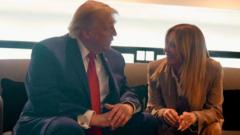
The public unraveling of the relationship between US President Donald Trump and Italian Prime Minister Giorgia Meloni has escalated into an outright diplomatic feud, shattering the illusion of a unified Western right-wing populist front. While the immediate trigger appears to be a bizarre social media squabble over who "begged" whom for a photograph at the Group of Seven summit in Evian-les-Bains, France, the actual rift runs far deeper. It is anchored in critical disagreements over national sovereignty, international law, and military operations in the Middle East.
On Saturday, Meloni took to Instagram to directly hit back at Trump’s repeated assertions that she was suffering from plummeting approval ratings and trying to manufactured a photo-op to boost her domestic political standing.
"President Trump, these constant, unprovoked attacks are senseless," Meloni wrote in English. "As for my popularity, being your friend has certainly not helped it, nor does it depend on my relationship with you. My popularity is none of your concern. I suggest you focus on yours."
The raw animosity marks a definitive break for two leaders who, just eighteen months ago, were positioned as close ideological allies. To understand how a relationship that began with Meloni being the only European leader invited to Trump's January 2025 inauguration devolved into public insults, one must look past the superficial metrics of social media popularity and examine the harsh realities of geopolitics.
The Airfield Disagreement
The genuine breaking point between Rome and Washington did not happen at a photo-op. It occurred in March, during the opening weeks of the US-led military campaign against Iran.
As Washington and Israel initiated offensive operations, the United States requested the use of strategic military installations on Italian soil, most notably airfields in Sicily. For the US military machine, Sigonella Naval Air Station is an invaluable logistical hub for projecting power into the Mediterranean and West Asia.
Meloni refused the request.
Italy's constitution explicitly restricts the country's participation in acts of active aggression against sovereign nations without clear international mandates or direct parliamentary approval. Meloni’s government stood firm, asserting that allowing American bombers to launch offensive sorties from Italian territory would violate both Italian domestic law and bilateral defense agreements.
Trump used his Truth Social platform on Saturday to explicitly link his grievances over the photo-op to this logistical snub. Misspelling the Italian leader's name, he claimed she was doing poorly in local polls "possibly because she turned down the United States of America... when it came to denying Iran from obtaining or developing a Nuclear Weapon." He complained that Italy "wouldn't even let us use Italy's landing strips or runways, a great logistical inconvenience."
Meloni’s counter-offensive went directly to the heart of national autonomy.
"Their use is governed by agreements that we have always respected and that cannot be violated," she stated. "As long as I am prime minister, Italy remains a sovereign nation."
The Mirage of Global Populism
For years, political commentators predicted that the rise of right-wing populist leaders across the West would create a durable, interconnected international alliance. This theory ignored the fundamental mechanic of nationalist politics.
Nationalism is inherently self-serving. When two leaders both operate on an unyielding platform of prioritizing their own nation above all else, conflict is mathematically inevitable the moment their strategic or economic goals diverge.
| Country | Leader | Primary Strategic Imperative | Friction Point |
|---|---|---|---|
| United States | Donald Trump | Unilateral projection of military and economic power; strict alliance conformity. | Mediterranean base access for Middle Eastern campaigns. |
| Italy | Giorgia Meloni | Continental stability, adherence to constitutional limits, economic sovereignty. | Protection of national legal frameworks from foreign overreach. |
The breakdown highlights the fragility of ideological partnerships when confronted with structural state interests. Meloni cannot afford to alienate an Italian electorate that remains deeply skeptical of entanglement in Middle Eastern conflicts, regardless of her personal alignment with Trump's conservative rhetoric.
The Irony of the Popularity Metric
Trump’s assertion that Meloni is desperately trying to "get her numbers up" by clinging to his coat-tails collapses under empirical scrutiny.
Recent polling data indicates that public approval for Meloni’s administration has actually stabilized and risen to roughly 35%, recovering from a dip in late 2025. Her Brothers of Italy party continues to command a comfortable lead in domestic polls at approximately 28%, well ahead of the opposition Democratic Party.
By contrast, recent Reuters/Ipsos polling places Trump’s domestic approval rating at around 36%. His numbers have remained low through the first half of 2026, weighed down by persistent domestic anxiety regarding the cost of living.
When Meloni pointedly remarked that being Trump's friend "has certainly not helped" her domestic numbers, she was referencing a palpable reality in Western Europe. Association with Washington's current unilateral foreign policy is increasingly viewed by European voters as a liability rather than an asset.
Real Diplomatic Costs
The escalation of this dispute has already triggered concrete diplomatic fallout. Italian Foreign Minister Antonio Tajani abruptly canceled a high-profile, scheduled visit to Washington following Trump's initial public assertions that Meloni had "begged" for a photo because he felt sorry for her. Tajani characterized the comments as serious, offensive, and an insult to the Italian people.
European solidarity has quickly closed ranks around Rome. Spanish Prime Minister Pedro Sánchez, despite sitting on the opposite end of the ideological spectrum from Meloni, issued a statement of solidarity, viewing the situation as an unacceptable breach of diplomatic decorum by a head of state against a key European ally.
This public fracture sets a tense backdrop for the upcoming NATO summit in Turkey. With Washington frustrated by what it views as a lack of structural cooperation from European partners during the Iran conflict, and European states dug into positions of legal and territorial sovereignty, the alliance faces an internal strain that cannot be smoothed over by a choreographed photo.
The era of transactional, personality-driven diplomacy has met its limit against the hard boundaries of state sovereignty. Meloni's public rejection of Trump's narrative signals that European leaders, even those who share his populist roots, are increasingly unwilling to compromise their domestic legal frameworks or national dignity for the sake of maintaining a superficial friendship with the White House.