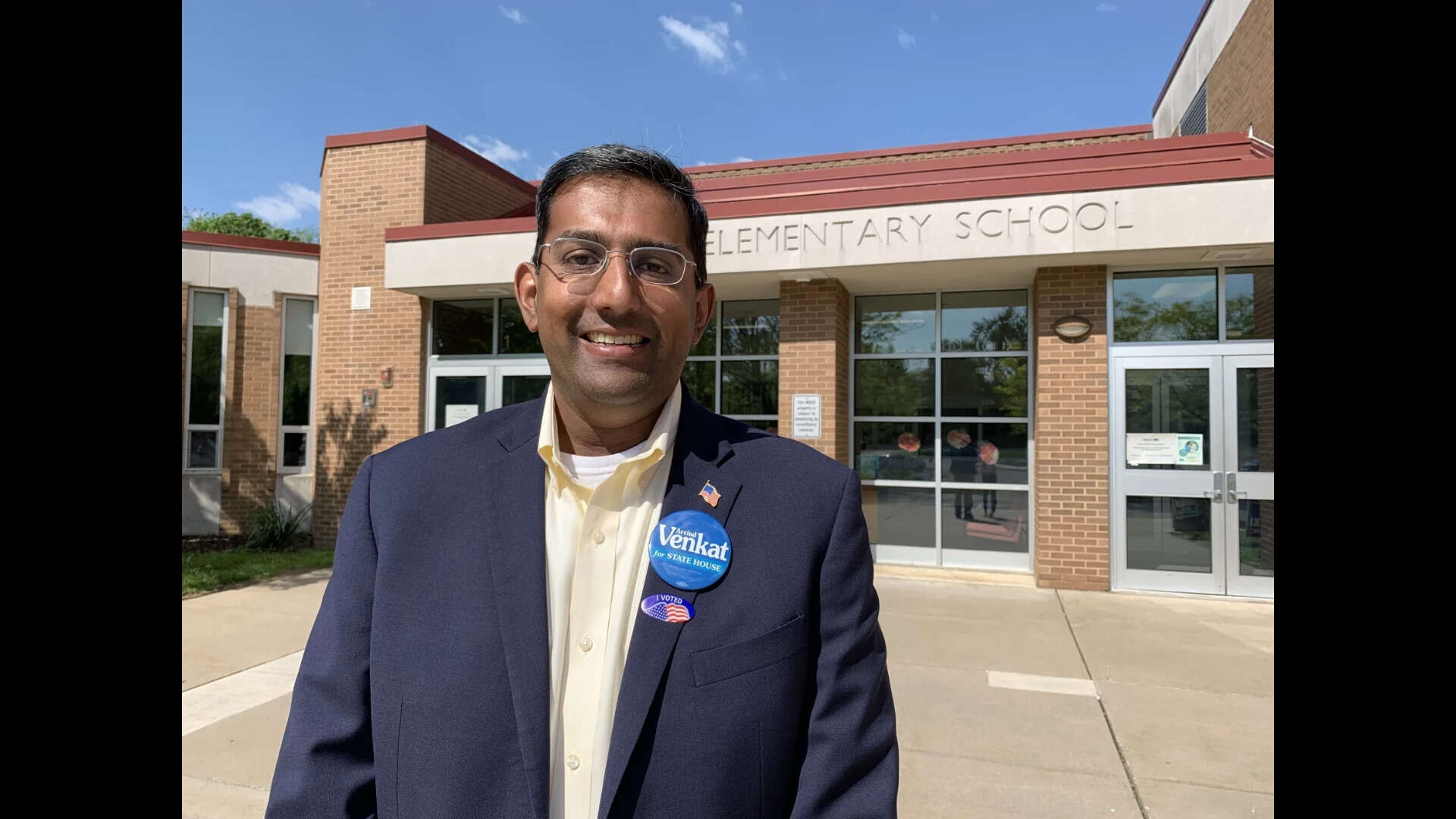
When Dr. Arvind Venkat stood before the Pennsylvania House of Representatives on a recent Wednesday, he wasn't just performing a ceremonial duty. By reading from the Isha Upanishad, the first Indian-American state representative in Pennsylvania history signaled a deeper shift in the state's political identity. It was a move calculated to honor the 50th anniversary of the Sri Venkateswara Temple in Penn Hills—the first freestanding Hindu temple built in North America—but the implications go far beyond a simple anniversary.
Venkat’s decision to chant the Sanskrit verses and provide an English translation is a high-stakes play in a state where the "model minority" is finally demanding a seat at the head of the table. For a Harvard-trained emergency physician who spent the pandemic on the front lines, the choice of the Isha Upanishad was a deliberate bridge between his background in acute care and his current role as a policymaker.
The Anatomy of a Political Statement
The Isha Upanishad is one of the shortest yet most influential texts in the Vedantic tradition. Its primary focus is the concept of oneness—the idea that the divine resides in all things and that one must act with a sense of detached duty.
"Everything animate or inanimate that is within the universe is controlled and owned by the Lord. One should therefore accept only those things necessary for himself, which are set aside as his quota, and one should not accept other things, knowing well to whom they belong." — Isha Upanishad, Verse 1
By bringing this specific text to the House floor, Venkat is attempting to reconcile his progressive Democratic platform with traditional South Asian values. In a political climate where identity is often weaponized, Venkat is using his to claim space. He is the first physician to serve in the Pennsylvania General Assembly in nearly 60 years. This dual identity—doctor and devotee—allows him to frame universal issues like healthcare access through a lens of communal responsibility.
The Penn Hills Milestone and the 130,000 Voters
The timing of this reading wasn't accidental. The Sri Venkateswara Temple, often referred to as the "S.V. Temple," is a landmark of the Hindu diaspora. Its establishment in 1976 was a radical act of permanence by an immigrant community that, at the time, was largely invisible in the rust belt of Pennsylvania.
Today, that invisibility has vanished. Pennsylvania is home to an estimated 130,000 Hindus, a demographic that has become a critical swing factor in statewide elections. As the Democratic party faces shifts in its traditional coalitions, the "Hindu vote" is no longer a monolithic bloc that can be taken for granted. Venkat’s public display of faith is a reminder to the establishment that this community has both the financial capital and the boots on the ground to swing tight races in Allegheny County and beyond.
Why the Isha Upanishad Matters Now
Critics might dismiss the reading as mere performative multiculturalism. However, a deeper look at Venkat’s legislative record suggests a more tactical integration of faith and policy. He has been a vocal advocate for:
- Medical debt relief: Aligning with the Upanishadic principle of reducing suffering.
- Gun violence prevention: Framing public safety as a collective moral imperative.
- Reproductive rights: Utilizing his medical background to counter ideological arguments with clinical reality.
The challenge for Venkat, and for the growing number of Hindu-Americans in public office, is the "dual-loyalty" trap. When a legislator invokes a non-Western religious text, they often face a double standard that their Christian or Jewish colleagues do not. Yet, by leaning into the Sanskrit tradition, Venkat is betting that the Pennsylvania of 2026 is ready for a representative who doesn't feel the need to secularize his heritage to be "palatable."
Beyond the Ceremony
The reality is that Venkat’s reading serves as a benchmark for the political evolution of the North Hills suburbs. District 30, which includes places like McCandless and Franklin Park, was once a Republican stronghold. Venkat didn't just win it; he secured it by double digits in back-to-back elections.
His victory was predicated on a "physician-first" brand, but his tenure is increasingly defined by a refusal to hide his cultural origins. This isn't just about a prayer; it's about the normalization of a different moral vocabulary in the halls of Harrisburg. As the state nears its next major election cycle, the question isn't why Venkat read from the Upanishads, but rather how many others will follow his lead in bringing their own "sacred" perspectives to the legislative floor.
The Sri Venkateswara Temple began as a small gathering in a basement before it became a marble-clad icon on a hill. Venkat’s career seems to be following a similar trajectory—from the quiet urgency of the ER to the vocal, public assertion of a new American identity.
Would you like me to analyze how the growing Hindu-American donor base is specifically impacting the 2026 Pennsylvania primary races?