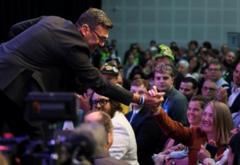
Andy Burnham has secured his ticket back to the House of Commons. By winning the Makerfield by-election with 24,927 votes, the former Mayor of Greater Manchester has cleared the absolute institutional hurdle preventing him from challenging Keir Starmer for the leadership of the Labour Party. This was not a standard mid-term vote. It was a calculated political maneuver engineered to bypass the party rules requiring any leadership contender to hold a seat in the Parliamentary Labour Party. Burnham beat Reform UK candidate Robert Kenyon by 9,231 votes, capitalizing on an anti-Reform coalition that compressed the Conservative, Liberal Democrat, and Green vote to a combined three percent.
The immediate narrative frame offered by party insiders is one of regional resurgence and a final warning shot to an unpopular Downing Street administration. Yet, beneath the triumphant rhetoric delivered at the Life convention centre in Wigan, lies a complex and high-stakes gamble. The engineered resignation of Josh Simons to vacate the seat exposes deep, structural coordination within the labor movement and parliamentary factions who view the current prime minister as a liability. Burnham ran on a platform explicitly declaring that Westminster is failing the country, and his victory transforms a simmering internal party conflict into an open war for the future of British governance.
The Architecture of the Makerfield Maneuver
Securing a seat in parliament through an engineered vacancy is a rare phenomenon in modern British politics. The last time a major figure utilized a targeted by-election to enter parliament specifically to pursue leadership was the Leyton by-election in 1965. The National Executive Committee of the Labour Party usually acts as a gatekeeper for the leadership, frequently blocking candidates aligned with factional rivals. Indeed, Burnham’s previous attempt to contest the Gorton and Denton by-election in February 2026 was explicitly blocked by the party executive.
The shift that allowed him to secure the nomination in Makerfield without a local party vote reflects a significant erosion of Starmer's control over his own internal apparatus. Prominent shadow cabinet figures and senior party officers, including Deputy Leader Lucy Powell and former health secretary Wes Streeting, actively intervened to clear Burnham’s path. This internal shifting of alliances suggests that the drive to replace Starmer extends far beyond the traditional soft-left factions that Burnham historically represented.
To understand why this seat became the staging ground, one must look at the electoral geography of the north-west. Makerfield was once considered a secure industrial heartland. However, the rise of populist right-wing parties has fundamentally altered the terrain. Reform UK mounted an intensive campaign, capturing 35 percent of the vote under Robert Kenyon. Burnham’s victory relied heavily on a temporary coalition of tactical voters. Former Conservative and Green supporters abandoned their parties entirely, choosing to back Burnham as a defensive bulwark against Reform UK.
This tactical compression means Burnham’s mandate is broad but highly volatile. He cannot claim that Makerfield has suddenly rediscovered an unalloyed love for the national Labour project. Instead, he won because he positioned himself as an independent actor capable of fighting the very system his party currently leads.
The Myth of the King in the North
During his nine years as Mayor of Greater Manchester, Burnham constructed a distinct political brand centered on defiance against London rule. He clashed frequently with central government over funding, pandemic restrictions, and regional infrastructure. This earned him a reputation as an advocate for the English regions. His campaign focused heavily on this outsider status, promising to bring what he termed the "Makerfield test" to the heart of national policy.
Yet, this regional populism masks a fundamental contradiction. Burnham is not an outsider. He is a quintessential veteran of the Westminster system. He served as a special adviser, an MP for Leigh for sixteen years, and held major cabinet positions including Health Secretary and Chief Secretary to the Treasury under Tony Blair and Gordon Brown. His return to parliament is less an invasion by a regional insurgent and more the return of an experienced operator who understands the machinery of state power intimately.
The strategy relies on exploiting a profound sense of regional abandonment. In his victory speech, Burnham noted that voters feel the country works for other places but not for them. By framing his return as unfinished business, he attempts to bridge the gap between working-class northern constituencies and the metropolitan voter base that Labour requires to maintain power. This dual appeal makes him dangerous to Starmer, but it also exposes him to immediate scrutiny. As an MP, he no longer possesses the executive freedom of a regional mayor. He is now bound by parliamentary discipline, committee assignments, and the constant demands of a party machine that will seek to neutralize his influence.
The Looming Leadership Crisis
The timeline for a challenge against Keir Starmer is accelerating. Burnham’s allies are already advising restraint, attempting to persuade ministers against immediate resignations that could plunge the government into immediate chaos. The goal appears to be an organized transition where the prime minister is pressured to lay out a definitive timetable for his departure.
The public polling presents a stark reality for the incumbent administration. A recent Ipsos poll indicated that 25 percent of British adults prefer Burnham as prime minister, compared to just 12 percent for Starmer. This gap creates an unsustainable dynamic within the Parliamentary Labour Party. Backbenchers facing difficult re-election prospects in volatile seats are looking at Burnham as an electoral life raft.
| Candidate | Vote Share (Makerfield 2026) | Regional Base | Public Preference Rating |
|---|---|---|---|
| Andy Burnham | 54% | Greater Manchester / North West | 25% |
| Robert Kenyon (Reform) | 35% | Industrial North / Working Class | Variable |
| Keir Starmer (Incumbent) | N/A | London / Metropolitan | 12% |
The parliamentary math required to trigger a leadership contest involves securing the signatures of a specific percentage of Labour MPs. While Burnham’s supporters believe they can easily assemble the necessary numbers, the presence of other challengers complicates the scenario. Wes Streeting has signaled a readiness to trigger a contest as early as next week. This creates a potential fracturing of the anti-Starmer vote within the parliamentary party. Streeting represents the modernizing right of the party, whereas Burnham positions himself as a unifying, pragmatic figure who transcends traditional factional divides.
A prolonged leadership battle during a period of economic strain risks alienating the wider public. Starmer has already stated his intention to fight any direct challenge, meaning the party faces the prospect of a public civil war while attempting to govern.
The Reform UK Threat and the Fragile Coalition
The high vote share achieved by Reform UK in Makerfield demonstrates that the political realignment under way in British politics has not stopped. Robert Kenyon’s 35 percent share shows that the populist right retains a firm grip on a significant portion of the post-industrial working class. Burnham managed to contain this threat by absorbing voters from the political center and left, but this strategy is difficult to replicate on a national scale during a general election.
The collapse of the Conservative vote to negligible levels in Makerfield suggests that traditional party loyalties have entirely disintegrated in these areas. The voters who backed Burnham did so because of his specific, localized profile as a defender of northern interests. A national campaign led by Burnham would face immediate counter-attacks from Reform UK, who would paint him as an architect of the very New Labour era that many of these communities blame for industrial decline.
Furthermore, the emergence of the hardline Restore Britain party, which secured seven percent of the vote in its first major outing, shows that the political spectrum is fragmenting further. This party drew votes away from both traditional Labour loyalists and right-wing populists by campaigning on strict nationalist and protectionist policies. Burnham’s vision of a politics based on hope and regional devolution faces an uphill battle against these increasingly polarized movements.
The Policy Blueprint and Economic Realities
Behind the scenes, Burnham has already begun assembling a team of senior economists to draft an alternative policy framework ahead of a formal leadership bid. This economic strategy seeks to move away from the cautious fiscal orthodoxy defined by Rachel Reeves and the current Treasury team. Burnham’s economic advisors are focusing on large-scale infrastructure investment, regional wealth funds, and the accelerated devolution of tax-raising powers to regional authorities.
This approach presents significant fiscal risks. The UK economy remains constrained by high public debt and low productivity growth. A program centered on major state-led investment in regional infrastructure would require substantial borrowing or a restructuring of the tax system. Critics within the party’s right wing argue that Burnham’s economic proposals are an unrealistic return to tax-and-spend policies that would alarm international financial markets and undermine economic stability.
Burnham’s record as mayor provides a template for his national ambitions. He successfully regulated the Greater Manchester bus network through the creation of the Bee Network, overcoming prolonged legal challenges from private operators. This model of public control and capped fares is popular with the public, but scaling such interventions to a national level requires vast regulatory machinery and substantial financial underwriting from the state.
The Battle Lines are Drawn
The political landscape has been fundamentally altered by this by-election. The next obstacle for the Labour Party is managing the vacancy left by Burnham’s departure from the Greater Manchester mayoralty. A massive by-election involving two million voters is scheduled for July 30, forcing the party into another grueling campaign against Reform UK while simultaneously managing a leadership crisis in London.
The current prime minister faces a choice between fighting a destructive internal battle or negotiating a managed exit that preserves the unity of his government. Burnham’s return ensures that the debate over British governance will no longer be dictated solely by the priorities of the Westminster village. The pressure on Downing Street will intensify daily as backbenchers calculate their own political survival against the polling numbers of a resurgent rival. The coming weeks will determine whether this maneuver successfully resets the direction of the country or simply accelerates the fragmentation of the governing party.