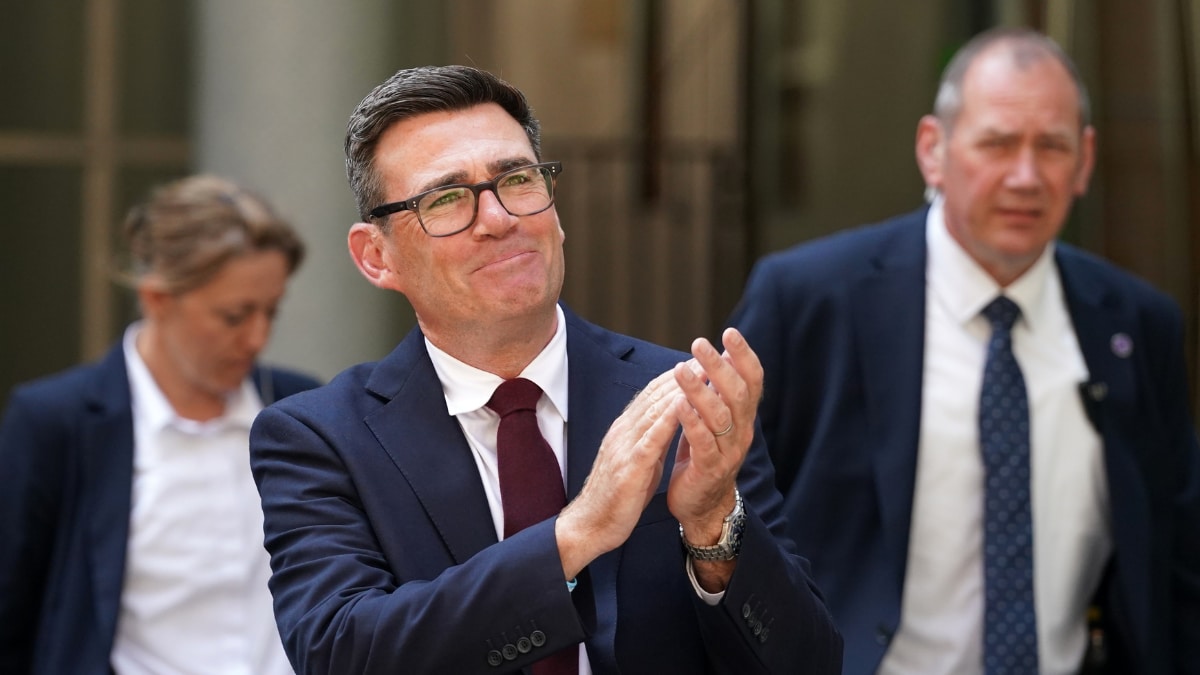
The rain in Manchester does not fall so much as it hangs. It is a damp, heavy mist that clings to the wool of your coat, the kind of weather that forces people to look down at their boots as they hurry toward the neon warmth of a corner pub. For years, Andy Burnham was a fixture of that specific gray backdrop. To watch him walk down Deansgate was to see a man completely synchronized with the rhythm of a city that felt left behind by the glossy, glass-towered excess of London.
But on Tuesday morning, the rain was different. It fell on the smooth black tarmac of Downing Street, and the man in the dark coat was no longer looking at his boots.
The official bulletins from the Labour Party headquarters were characteristically bloodless. They spoke of vote shares, internal party democracy, and constitutional transitions. They used words that felt designed to drain the blood out of what was, in reality, a political earthquake. The facts are simple enough to state: Andy Burnham has been confirmed as the leader of the governing Labour Party, positioning him to become the next Prime Minister of the United Kingdom.
Behind those dry metrics lies a human drama that has been brewing for more than a decade. This is not just a story about a politician winning an election. It is a story about the changing geography of power in a country that has spent generations believing that everything of consequence happens within a three-mile radius of Westminster.
The King of the North Comes South
To understand why this moment feels so heavy with implication, you have to go back to the days when Burnham was widely dismissed as a relic of a bypassed political era. After losing the Labour leadership race in 2015, his career in national politics looked finished. The London commentators wrote him off. He was too earnest, they said. Too regional.
So he left. He went home to the North.
In the years that followed, as Mayor of Greater Manchester, Burnham did something unusual for a modern politician: he became a genuine local folk hero. He fought the central government over pandemic funding, standing on the steps of the Bridgewater Hall in an open-necked shirt, furious on behalf of people who felt unseen. He took control of the local bus network, painting the fleet a defiant yellow to match the city's historic worker bee emblem. He became, in the eyes of millions, the "King of the North."
Now, that same man has captured the ultimate prize in British public life. The transition from regional champion to national leader is treacherous. It requires a shifting of gears that can easily shatter a politician's authenticity.
Consider the sheer scale of the machinery he now inherits. The British prime minister is not just a policy maker; they are the living symbol of the state. Every word spoken is parsed by global markets. Every gesture is analyzed by foreign intelligence agencies. For a man who built his reputation on unvarnished, emotional appeals from the steps of northern town halls, the gilded cage of Downing Street can feel suffocating.
The Quiet Violence of a Party Coup
The path to this moment was not a clean, democratic march. It was messy. It was painful. The departure of the previous leadership left behind a party fractured by deep ideological fault lines and exhausted by years of internal warfare.
Behind the closed doors of the committee rooms in the Palace of Westminster, the tension during the final hours of the leadership count was palpable. One insider described the atmosphere as resembling a hospital waiting room. People spoke in whispers. The hum of the fluorescent lights felt unnaturally loud. There were no cheers when the final numbers were verified, only a collective, heavy exhale.
The country Burnham takes over is not an easy one to govern. The National Health Service is creaking under the weight of historic backlogs. The cost of daily life has turned grocery shopping into an exercise in high-stakes budgeting for millions of families. The infrastructure that holds the nation together feels frayed at the edges.
The question that hovers over this new administration is whether the passion that animated a regional mayor can be scaled up to fix a broken nation. It is easy to be a rebel when your enemy is a distant government in London. It is infinitely harder when you are the government, and the buck stops on your desk at three o'clock in the morning.
The View from the Commuter Train
To find the true stakes of this political shift, you have to leave the Westminster bubble and board the 07:14 from Crewe to Manchester Piccadilly.
Imagine a woman named Sarah. She is forty-two, teaches biology at a local comprehensive school, and has spent the last five years watching her disposable income evaporate. She does not read party manifestos. She does not care about factional warfare between the soft-left and the hard-left. But she remembers when Burnham stood up for her town when the factories closed. She remembers the feeling that someone, somewhere, actually knew what it was like to worry about the price of a winter coat.
For people like Sarah, Burnham’s ascent is accompanied by a fragile, dangerous thing: hope.
Hope is the most volatile currency in politics. When you promise nothing, people are rarely disappointed. But when you build a brand on empathy, on understanding the lived reality of ordinary communities, the expectations are terrifyingly high. If Burnham fails to deliver tangible improvements to the schools, the hospitals, and the weekly pay packets of the British public, the disillusionment will be profound.
The new leader faces an immediate test of his authority. The financial markets are watching to see if his reputation for public spending will translate into fiscal instability. The traditionalist wing of his own party is waiting for any sign of weakness, ready to pull him back into the old factional battles that have paralyzed Labour for generations.
The Weight of the Door
When a new prime minister-designate walks through the black door of Number 10, the transition is instantaneous. The security detail changes. The red boxes filled with top-secret briefings begin to arrive. The noise of the outside world is suddenly muffled by three-foot-thick brick walls that have housed Walpole, Pitt, Churchill, and Thatcher.
On his first afternoon as leader, Burnham stood briefly in the entry hall. Those who were there noted that he looked smaller than he did on the campaign trail, framed by the portraits of the giants who preceded him. He spent a long moment simply looking at the floorboards, as if adjusting to the sudden, immense gravity of the room.
The coming weeks will be filled with the theater of statecraft. There will be cabinet appointments, tense negotiations with civil servants, and the first, crucial prime minister's questions in the House of Commons. The dry political columns will analyze every policy tweak and every staff appointment.
But the success of this new era will not be measured in the briefing rooms of Whitehall. It will be measured on the rainy platforms of regional train stations, in the quiet kitchens where parents balance their checkbooks, and in the communities that have waited decades to feel like they matter to the people in power. The King of the North has come south. The crown he wears now is heavy, and the whole country is watching to see if he can carry the weight.