The television screen in the corner of the diner has been muted since Tuesday night, yet nobody asks to turn it off.
Outside, a cold November rain streaks the plate-glass window of Miller’s Diner in eastern Pennsylvania, turning the neon "OPEN" sign into a blurry smear of red and blue. Inside, Arthur—a retired machinist who spent thirty-eight years coaxing precision out of stubborn steel—stares down at his lukewarm coffee. Across from him sits his daughter, Maya, a high school civics teacher with dark circles under her eyes and three ungraded stacks of essays sitting in her canvas tote bag.
The midterm elections are over. The banners are coming down from chain-link fences. The pundits on that muted television have already moved on to the horse race of the next presidential cycle, speaking in the sterile, triumphant shorthand of "wave elections," "flipped seats," and "divided government."
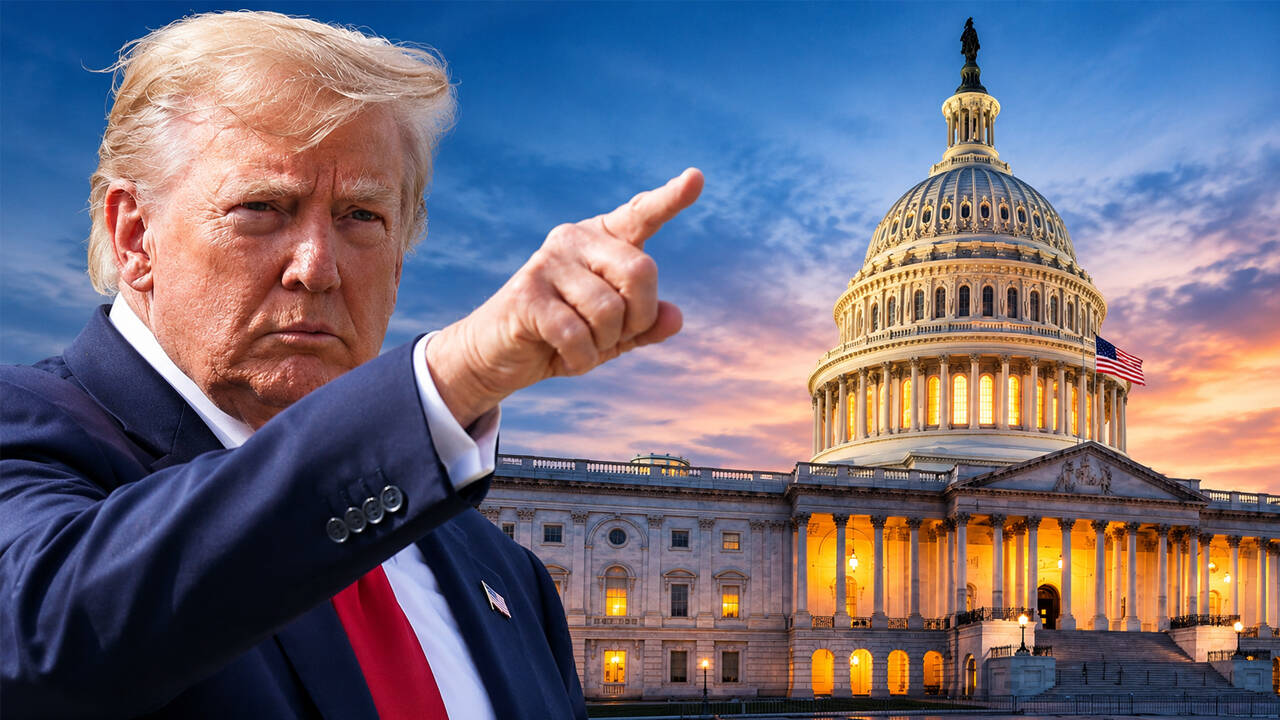
Democrats have won control of Congress. Donald Trump enters the final two years of his second presidency facing a legislative branch determined to check his every move.
On paper, it sounds like a stalemate. A cooling-off period. The system working precisely as the founders intended, applying the brakes to an accelerating engine.
Arthur takes a slow sip of his coffee and grimaces. He knows machines. He knows what happens when you slam a spinning turbine into reverse while the throttle is still wide open.
It doesn't stop quietly. It shears the gears.
The Illusion of the Braking Mechanism
When we talk about divided government in America, we usually rely on a comforting architectural metaphor. We call it "checks and balances," a phrase that conjures images of a balanced scale resting peacefully on a mahogany desk.
That metaphor is broken. A far more accurate analogy for Washington right now is two freight trains sharing a single track, their engineers refusing to touch the brakes because neither wants to be the first to blink.
To understand why the next twenty-four months carry so much volatile energy, you have to look past the celebratory confetti in Democratic headquarters and the defiant rallies in red states. You have to look at the mechanics of power when a president loses the legislature in his final term.
Historically, a president entering his seventh and eighth years—the classic "lame duck" window—faces a shrinking horizon. Without the ability to pass sweeping domestic legislation through a hostile House and Senate, the Oval Office undergoes a profound metamorphosis. It stops being a partner in lawmaking and becomes an engine of unilateral action.
Think back to the final years of Barack Obama’s presidency, when a Republican Congress blocked his judicial nominees and legislative priorities, prompting a surge in executive orders on immigration and climate policy. Look further back to Bill Clinton in 1998, facing impeachment proceedings from a Republican House while simultaneously launching military strikes abroad and governing through regulatory decrees. Or consider Harry Truman, seizing steel mills by executive fiat when Congress refused to act during the Korean War.
Power in Washington behaves like water. When you build a dam on Capitol Hill, the current doesn't evaporate. It finds every crack in the foundation and surges through with terrifying pressure.
For Donald Trump, a leader whose entire political identity is built on momentum, disruption, and the projection of absolute strength, the label of "lame duck" is an existential insult. Stripped of a friendly Speaker of the House to shepherd bills to his desk, a second-term president turns inward toward the vast, sprawling machinery of the executive branch—an apparatus that requires zero congressional votes to deploy.
The Invisible Frontlines of Executive Power
Maya looks up from her phone, where a local school board alert has just flashed across her screen. For her, the abstract constitutional clash between Pennsylvania Avenue and Capitol Hill isn't a spectator sport. It shows up in her classroom every Monday morning.
"My students keep asking me if everything just stops now," she tells her father, rubbing her temples. "They think because the other party won Congress, the president basically goes on vacation until the next election."
It is an understandable mistake. Civics textbooks teach us that Congress makes the laws and the president enforces them. They rarely capture the staggering discretion hidden inside that single word: enforces.
Consider what happens next when a president decides to govern exclusively through the levers of the executive branch.
First, there is the regulatory state. Cabinet agencies—from the Environmental Protection Agency to the Department of Education, the Department of Labor, and the Department of Health and Human Services—write tens of thousands of pages of rules every year. With a hostile Congress blocking new statutes, the White House will inevitably accelerate the rewriting of federal regulations. Student loan repayment formulas, overtime pay thresholds, emissions standards for local factories, and federal funding conditions for public schools can all be reshaped with the stroke of a regulatory pen.
Second, there is trade and foreign policy. Under statutes passed decades ago, the president holds sweeping, largely unchecked authority to impose tariffs in the name of national security, renegotiate international agreements, and deploy military assets around the globe. When domestic legislative victories become impossible, presidents historically look outward to the world stage, where Congress has the least power to interfere.
Third, and perhaps most volatile, is the power of the pardon and the direction of the Justice Department. Without the need to court moderate lawmakers for future legislative votes, the political guardrails that normally restrain a president during his first term begin to dissolve. There is no re-election campaign left to run. There is no legacy of bipartisan compromise left to protect.
Wait. Pause and think about that for a second.
For nearly a century, modern presidents have operated under an invisible tether: the fear of losing the next election, either for themselves or for their party's immediate congressional majority. In the final two years of a second term, that tether snaps. What remains is pure, unfiltered presidential will colliding head-on with a newly empowered opposition.
The Subpoena Cannon and the Counter-Offensive
If the White House becomes an engine of unilateral decrees, Capitol Hill transforms into a courtroom.
Winning Congress does not give Democrats the ability to pass their own agenda—not when any bill they send down Pennsylvania Avenue faces a guaranteed presidential veto, and not when they lack the two-thirds supermajority required to override it.
So what does a newly minted congressional majority actually do with its power?
It investigates.
Control of the House and Senate hands Democrats the gavel in every major committee room—Judiciary, Oversight, Ways and Means, Intelligence, and Foreign Affairs. And with the gavel comes the subpoena power.
We have seen this movie before, yet each sequel raises the stakes higher than the last. Over the next two years, the halls of the Rayburn and Hart office buildings will echo with the footsteps of cabinet secretaries, mid-level bureaucrats, corporate executives, and former White House aides summoned to testify under oath. Every tariff exemption, every regulatory rollback, every agency staffing decision, and every foreign phone call will be placed under a high-powered microscope.
To understand the human toll of this collision, step out of the marble corridors of Washington and back into Miller’s Diner.
Arthur spent forty years watching how management and union leaders fought each other at the manufacturing plant down the road. He remembers the autumn of 2008, when the plant’s owners and the union representatives locked themselves in a war of attrition over pension rules and safety inspections. Neither side gave an inch. Both sides claimed they were fighting for the soul of the company.
Meanwhile, the orders dried up. The maintenance on the milling machines got deferred. And by spring, three hundred families were staring at severance notices while the executives and union bosses were still screaming at each other across a mahogany table.
"When the bosses go to war," Arthur says quietly, tapping his finger against the formica table, "the folks on the shop floor are the ones who get caught in the crossfire."
The Anatomy of a Shutdown
The most immediate weapon in a divided Washington isn't a subpoena or an executive order. It is the calendar.
The federal government runs on appropriations bills—laws that must pass both chambers of Congress and be signed by the president simply to keep the lights on. In a functional system, funding the government is basic housekeeping. In an explosive divided government, every funding deadline becomes a high-stakes hostage crisis.
Let us walk through a hypothetical scenario—a composite of the budget standoffs of 1995, 2013, and 2018, mapped onto the political reality of the coming months.
Imagine it is late September. The fiscal year is ending. The Democratic Congress sends a funding bill to the White House that strips out funding for key presidential initiatives—perhaps border enforcement expansions, specific agency restructurings, or targeted tax enforcement rules—while adding protections for federal civil servants.
The president refuses to sign it. He demands his priorities be restored, knowing that a government shutdown will dominate every news cycle and force his opponents to negotiate.
At 12:01 a.m. on October 1, the federal government closes its doors.
On cable news, the shutdown is framed as a tactical chess match. Anchors track approval ratings like stock tickers. Strategists debate who is "winning the messaging war."
In the real world, the effects ripple outward like shockwaves from an underwater earthquake.
In Maryland and Virginia, hundreds of thousands of federal workers—air traffic controllers, food safety inspectors, park rangers, and VA hospital nurses—are told to stay home without pay, or worse, to keep working while their bank accounts drain toward zero.
In Pennsylvania, a small business owner waiting on a Small Business Administration loan to expand her bakery finds her application frozen in an empty office building.
In rural counties across the Midwest, agricultural extension offices lock their doors right in the middle of harvest season, leaving farmers without access to federal crop data and disaster relief processing.
And the longer the standoff drags on, the harder it becomes for either side to back down without looking weak to their base. In an era where primary voters reward ideological purity and punish compromise as treason, a politician who blinks first risks ending their career.
Why This Time Feels Different
I have covered politics long enough to know that every election cycle is advertised as "the most consequential of our lifetimes." We grow numb to the hyperbole. We develop calluses over our civic anxiety just to get through the week.
So it is worth asking honestly, without the dramatic music of a cable news bumper: Why shouldn't we just tune this out? Haven't we survived divided governments before?
Yes, we have. Ronald Reagan famously traded quips and compromises with Democratic House Speaker Tip O’Neill over drinks after hours. Bill Clinton and Newt Gingrich, despite their bitter ideological warfare, eventually hammered out welfare reform and balanced budgets together.
The difference today isn't found in the Constitution. It is found in our information ecosystem and the vanishing of the political middle.
In 1986, when Reagan faced a Democratic Congress in his final two years, both parties still watched the same three evening news broadcasts. There were dozens of conservative Democrats in the South and liberal Republicans in the Northeast who needed to appeal to swing voters back home. Compromise wasn't just possible; it was necessary for survival.
Today, those moderate bridge-builders have largely been hollowed out by gerrymandered districts and hyper-partisan media echo chambers. A Democratic representative from a safe urban district and a Republican senator from a deep-red state live in entirely different informational universes. They are rewarded not for passing laws—which requires the messy, unglamorous work of splitting the difference—but for viral moments of confrontation.
When you combine an uncompromising, media-savvy president in his final two years with a triumphant opposition party eager to prove to its base that it will fight every inch of the way, you remove the shock absorbers from the American republic.
Every minor policy dispute becomes an existential battle for democracy. Every judicial nomination becomes a scorched-earth campaign. Every debt ceiling deadline flirts with global financial contagion.
The Quiet Cost of Perpetual Crisis
The true danger of the next two years isn't a single catastrophic event. It is exhaustion.
Look back at Maya, sitting in that booth in Pennsylvania, staring at the stack of essays she still has to grade before tomorrow morning. She isn't an activist. She isn't a party operative. She is a thirty-four-year-old woman trying to teach sixteen-year-olds how a bill becomes a law while watching the adults in Washington burn the rulebook every afternoon.
"Do you know what the hardest part of my job is right now?" she asks, wrapping both hands around her mug to warm her fingers. "It’s not teaching them about the separation of powers. It’s convincing them that any of this actually matters to their lives. When all they see is screaming, gridlock, and investigations, they just check out. They decide the whole thing is broken beyond repair."
That cynicism is the invisible casualty of explosive politics.
When government becomes a theater of perpetual conflict, normal governance—fixing bridges, modernizing the power grid, addressing the rising cost of healthcare, preparing workers for an economy reshaped by artificial intelligence—gets pushed to the margins. Urgent, slow-moving crises are ignored because they don't fit into a thirty-second clip or a fundraising email.
And slowly, almost imperceptibly, citizens stop expecting their government to solve problems at all. They begin to view Washington not as a tool for collective action, but as a source of endless stress—a loud, violent storm raging outside the window while they huddle inside trying to protect their own families.
Finding Solid Ground in the Storm
If the political forecast for the next twenty-four months is turbulence, how do we navigate it without losing our minds or our faith in the democratic experiment?
First, we have to learn to separate the theatrical noise from the actual mechanics of power. When a fiery speech trends online or a committee hearing turns into a shouting match, ask a simple question: Did any actual policy change today, or was this just performance? Nine times out of ten, the loudest explosions in Washington produce the least amount of actual movement. Paying attention to federal court rulings, regulatory filings, and municipal budgets will tell you far more about the real world than watching pundits yell at each other on television.
Second, we have to rediscover the power of proximity. Washington is designed to make us feel powerless, reducing tens of millions of citizens into spectators cheering from the bleachers. Yet the decisions that shape our daily lives—how our schools are funded, how our neighborhoods are zoned, how our local hospitals are staffed, how our property taxes are spent—happen in city halls, county commissions, and school board meetings within twenty minutes of our front doors.
Divided government in Washington often paralyzes federal initiatives, which ironically makes state and local leadership more vital than ever. When the federal engine stalls, states become the laboratories where real policy gets written and tested.
Finally, we have to resist the temptation to let the bitterness in Washington poison the relationships across our own kitchen tables.
Outside Miller’s Diner, the rain finally lets up, leaving the wet asphalt gleaming under the streetlights. Arthur pulls a crumpled five-dollar bill from his wallet and lays it beside his coffee cup. Maya gathers her tote bag, slinging the heavy strap over her shoulder.
They don't vote the same way. They haven't agreed on a presidential candidate in over a decade. When the television in the corner flashes images of Capitol Hill or the White House, they see two entirely different stories playing out on the same screen.
Yet as they step out into the crisp November air, Arthur holds the glass door open for his daughter, waiting while she adjusts her scarf against the wind.
Washington is bracing for two years of fire and fury, convinced that the fate of the nation hangs on who wins the next skirmish on Capitol Hill. Perhaps it does. But out here, away from the cameras and the gavels, the country is still held together by something much quieter, and far more durable, than anything written in the Congressional Record.