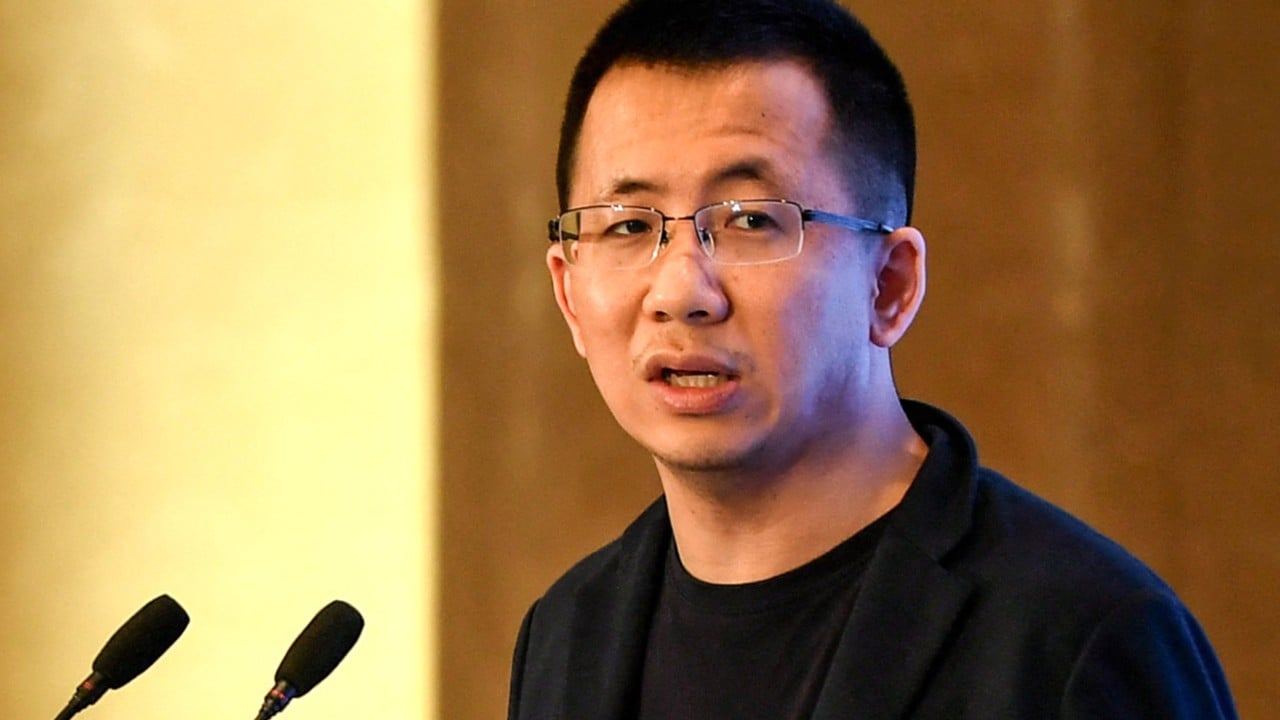
The fluorescent lights in a cramped Beijing apartment buzzed with the low, persistent hum of a cheap refrigerator, illuminating a whiteboard covered in frantic marker strokes that smelled faintly of alcohol and exhaustion. It was 2012, and the man holding the dry-erase cap was not wearing a tailored suit, nor was he flanked by bodyguards or publicists. Zhang Yiming looked less like a titan of industry and more like an exhausted graduate student who had forgotten to eat lunch, squinting through wire-rimmed glasses at a problem no one else in China thought was worth solving. At that exact moment, while the rest of the tech world was obsessed with building social networks where human beings manually curated their own friendships, Zhang was quietly sketching out a machine designed to bypass human choice altogether.
Fourteen years later, that machine has turned him into the wealthiest person in China, sitting atop a staggering fortune of $99.7 billion.
Numbers that large tend to numb the human brain, flattening a profound cultural shift into a sterile leaderboard entry. When financial publications announce that ByteDance’s founder has claimed the top spot on the China rich list as artificial intelligence fuels a new wave of tech fortunes, we skim the headline, register the zeroes, and scroll on. We treat ninety-nine point seven billion dollars as a scoreboard metric, a mere trophy in a game played by men in private jets. Yet behind that cold figure lies one of the most intimate, unsettling stories of our modern lives, because Zhang Yiming did not build his empire by selling us a physical product we could hold in our hands. He built it by learning how to read the unspoken impulses of our own nervous systems faster than we can consciously recognize them ourselves.
The Boy Who Preferred the Pattern to the Crowd
To understand how a soft-spoken software engineer from Fujian province outmaneuvered the loudest billionaires in Beijing and Silicon Valley, you have to strip away the myth of the charismatic founder. History has conditioned us to expect tech moguls to be relentless showmen—think of Steve Jobs pacing a darkened stage in a black turtleneck, or Jack Ma rallying stadium crowds with martial arts metaphors and fiery speeches. Zhang Yiming was the exact opposite, a man who once described himself as someone who disliked socializing, hated small talk, and preferred reading technical manuals to attending industry banquets.
Consider a hypothetical scenario to picture the contrast: imagine two architects hired to build a massive public library. The first architect spends months interviewing thousands of visitors, asking them what books they claim to admire, what genres they want to be seen reading, and how they wish to organize the shelves. He builds a grand, dignified hall filled with classic literature and lofty philosophy, only to watch the building sit half-empty because people feel intimidated by the weight of their own aspirations. The second architect doesn't ask a single visitor what they want. Instead, he quietly installs pressure sensors beneath the floorboards, tracks where people's eyes linger for a fraction of a second longer than usual, and rearranges the shelves every ten seconds based on what actually makes their pupils dilate.
Zhang Yiming was that second architect, and ByteDance was his library.
When he launched Toutiao—a news aggregation app—in 2012, the dominant internet giants of China, known collectively as BAT (Baidu, Alibaba, and Tencent), barely glanced in his direction. Search engines relied on you knowing what question to ask; social networks relied on you choosing whom to follow. Zhang saw a fundamental flaw in both models: humans are terrible at knowing what they actually want, and even worse at admitting it. He stripped out the search bar and eliminated the need to follow friends, feeding users a continuous stream of content governed purely by predictive algorithms. If you lingered on a video of a stray dog for two seconds too long, the machine noticed. If you scrolled past a political essay in half a heartbeat, the machine adjusted.
I remember the first time I experienced the quiet pull of that architecture, long before the world knew the name TikTok. Sitting on a delayed commuter train in the rain, thumb hovering over a glowing glass screen, I opened an app expecting to kill three minutes before my stop. The videos didn't ask me to subscribe, didn't demand that I build a profile, and didn't require me to search for a single keyword. Within ten minutes, the feed had narrowed in on a bizarrely specific intersection of my own unvoiced anxieties and nostalgia—old jazz piano tutorials, rainy street scenes from cities I had visited in my twenties, and dry comedic sketches about bureaucratic absurdity. When I finally looked up, my stop had passed twenty minutes ago, and my thumb was still twitching downward on the glass as if pulled by an invisible magnet. That slight, disorienting jolt—the realization that a piece of software knew my subconscious appetites better than my closest friends did—is the exact psychological engine that minted Zhang Yiming’s $99.7 billion fortune.
Why Artificial Intelligence Changed the Math
For years, skeptics argued that ByteDance’s recommendation engine was simply a clever trick, a dopamine slot machine vulnerable to regulation or shifting cultural tastes. When Beijing cracked down hard on the domestic technology sector in 2020 and 2021—clipping the wings of e-commerce and gaming giants, wiping hundreds of billions of dollars off market valuations, and forcing founders into quiet retreats—many assumed the era of the mega-billionaire in China had permanently ended. Zhang Yiming himself stepped down as CEO in May 2021, famously writing in an internal letter that he lacked some of the skills that make an ideal manager and preferred daydreaming and reading over managing daily operations.
Yet stepping out of the spotlight did not stop the compounding power of what he had built; in fact, it positioned him directly in the path of the largest technological wave of the decade.
While Western observers often view artificial intelligence through the lens of chatbots writing emails or generating surreal digital art, the true financial gravity of AI lies in infrastructure, data scale, and predictive modeling at planetary volume. ByteDance had spent over a decade accumulating the single richest real-time behavioral dataset in human history, generated by more than a billion people swiping through Douyin and TikTok every single day. When the generative AI boom accelerated over the past two years, ByteDance didn't have to scramble to invent a reason for consumers to interact with machine learning—it already owned the daily habit of half the connected world.
The surge in Zhang’s net worth to $99.7 billion reflects a brutal economic reality that is reshaping global wealth in real time: artificial intelligence does not distribute prosperity evenly; it acts as a massive force multiplier for whoever already controls the distribution pipes. By pouring billions into its own large language models like Doubao, integrating generative AI tools directly into creator workflows, and powering cloud infrastructure across Asia, ByteDance transformed from a social entertainment company into an indispensable AI powerhouse. Even as rivals like Tencent’s Pony Ma and Pinduoduo’s Colin Huang battled for market share in gaming and discount retail, ByteDance’s valuation climbed past the $250 billion mark in private secondary markets, lifting Zhang’s personal stake above every other fortune in the country.
The Illusion of Control in an Algorithmic Age
There is a deep, lingering unease that accompanies a fortune built this way, and pretending otherwise would be dishonest. We like to believe we are sovereign individuals making deliberate choices about how we spend our finite hours on earth. We tell ourselves that we read the news to stay informed, watch videos to unwind, and buy products because we genuinely need them.
Zhang Yiming’s rise exposes the fragility of that self-image.
To grasp how this works beneath the surface, think of a traditional television network as a megaphone shouting one message into a crowded square, hoping a few thousand people turn their heads. By contrast, ByteDance’s recommendation system acts like a billion invisible whisperers, each standing directly behind a single person’s shoulder, murmuring the exact sentence calibrated to make that specific individual turn around. An algorithm does not possess malice, ideology, or empathy; it possesses only an objective function—maximize engagement, minimize friction, predict the next micro-second of human attention.
That cold mathematical neutrality is precisely what makes it both astonishingly lucrative and profoundly unnerving. During the 2021 regulatory storms in China, algorithms were scrutinized for everything from keeping teenagers awake past midnight to encouraging reckless consumer spending. Simultaneously, across the Pacific in Washington, lawmakers debated bans and forced divestitures, terrified that a Beijing-headquartered company held an algorithmic mirror up to tens of millions of American voters every evening. Caught between two superpowers locked in a geopolitical cold war over technological supremacy, Zhang Yiming did what he had always done: he vanished from public view, bought no mega-yachts, gave no television interviews, and let the code continue compounding in silence.
What Ninety-Nine Billion Dollars Actually Buys—and What It Costs
When you look closely at the trajectory of China’s wealth rankings over the past twenty years, the top spot has always served as an X-ray of what the country—and the global economy—valued most at that exact historical moment. In the early 2000s, the richest men in China were real estate developers and manufacturing magnates, men who built fortunes out of concrete, steel, and sweat. By the 2010s, the crown passed to e-commerce and messaging pioneers who digitized how people shopped and talked. Now, in the mid-2020s, the crown rests with a forty-something engineer whose empire is built entirely out of statistical probability and human attention.
Let us be candid about what remains uncertain here. A $99.7 billion paper fortune tied largely to a privately held company facing ongoing regulatory friction in both Washington and Beijing is not cash sitting in a vault; it is a monument to market belief in an algorithmic future. If geopolitical pressures force a fractured restructuring of TikTok’s global operations, or if a new generation of users grows exhausted by endless algorithmic feeds and retreats into smaller, closed human communities, those valuations could shift with dizzying speed. History is littered with empires that looked invincible right up until the moment human taste quietly changed direction.
Still, it is impossible to ignore what Zhang Yiming proved about modern human nature. He understood before almost anyone else that the scarcest resource on a planet of eight billion people is not oil, lithium, or even capital—it is the three seconds of undivided attention a human being gives before flicking a thumb upward. He built a quiet, relentless machine to harvest those three seconds at a scale no emperor, media baron, or software giant had ever imagined possible.
Somewhere right now, in a quiet apartment or a nondescript office far from the cameras, the man worth nearly a hundred billion dollars is likely reading a technical paper or tweaking a strategic memo, entirely unrecognized by the strangers passing on the street outside. Meanwhile, on a billion glowing screens across every time zone on earth, millions of thumbs are sliding upward in synchronized silence, feeding the quietest empire ever built.