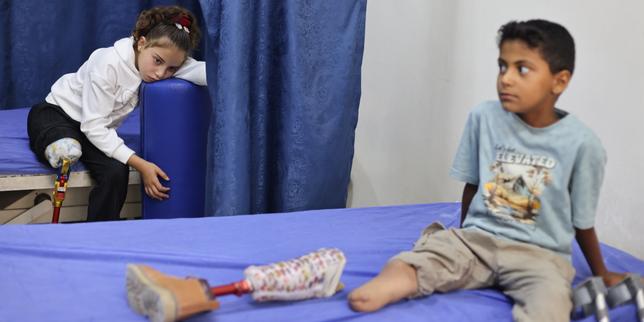
The media loves a tragic hero. Standard war reporting follows a predictable, highly emotional script: a child loses a limb, a well-meaning international NGO flies in with a high-tech prosthetic, and the child smiles for the camera, supposedly whole again. The competitor article focusing on a child in Gaza enduring physical agony just to "look normal" highlights the classic symptom of a broken humanitarian philosophy.
It is a heartbreaking story. It is also an intellectual failure.
Western-funded medical interventions routinely treat amputation as a purely mechanical problem solved by a physical device. They drop advanced carbon-fiber limbs into active conflict zones, tally the distribution numbers for their donor donor reports, and leave.
This is a dangerous delusion. A prosthetic limb is not a cure; it is a lifetime subscription to a highly complex, resource-heavy medical ecosystem. By focusing entirely on the immediate, visible trauma of a missing limb, international aid organizations are setting up thousands of amputees for chronic pain, severe skeletal deformities, and systemic psychological rejection.
We need to stop treating prosthetics as a quick-fix moral victory.
The Mechanical Lie: Why High-Tech Limbs Fail in Low-Resource Zones
The popular narrative assumes that the main barrier to recovery is the availability of the prosthesis itself. If we can just ship enough advanced components to Gaza, Yemen, or Ukraine, we solve the crisis.
This assumption betrays a fundamental ignorance of biomechanics and prosthetics engineering.
A prosthetic device requires constant, precise adjustments. In a growing child, a socket needs to be replaced every six to nine months. If the socket does not fit perfectly, it creates shear stress on the residual limb, leading to skin breakdown, deep tissue infections, and bone spurs.
I have seen international missions fit dozens of children with state-of-the-art devices, only to return a year later and find those same devices rotting in closets. Why? Because the child grew two inches, the socket began cutting off their circulation, and there was no local infrastructure to modify it.
- The Component Trap: Imported, high-mobility ankles and micro-processor knees look great on Instagram. They fail catastrophically in dusty, unpaved, or rubble-strewn environments.
- The Maintenance Vacuum: When a proprietary joint breaks in a blockaded territory, it cannot be fixed with local materials. It becomes expensive trash.
- The Growth Factor: A pediatric amputee does not just need a limb today; they need twenty distinct limbs over the course of their childhood.
When we give a child a device that cannot be maintained locally, we are not giving them mobility. We are giving them a ticking clock.
The Psychological Cost of Forcing "Normalcy"
The competitor piece rightly notes the immense psychological pressure on mutilated children to hide their differences. Yet, the mainstream analysis blames this entirely on societal stigma or vague "war trauma."
Let's look at the brutal reality: the humanitarian apparatus itself drives this toxic coping mechanism.
By centering the entire rehabilitation narrative on "restoring" what was lost, we reinforce the idea that an amputee is fundamentally broken until they look symmetrical again. We force children into agonizing physical setups—wearing ill-fitting, heavy plastics in 90-degree heat—just to spare the feelings of the able-bodied people around them.
The data from long-term conflict rehabilitation studies, including historical data from the International Committee of the Red Cross (ICRC), shows that psychological adaptation correlates with functional independence, not cosmetic replication.
Imagine a scenario where a child is trained extensively to navigate their environment using a highly functional, locally made, lightweight pair of crutches or a rugged wheelchair. They move fast. They play. They are independent. Now imagine forcing that same child into a cosmetic prosthetic that causes open sores, slows their movement to a crawl, but makes them "look normal" in a classroom.
Which child is actually rehabilitated?
Our current approach prioritizes the comfort of the viewer over the utility of the user. We are sacrificing the actual, daily mobility of these children on the altar of cosmetic conformity.
People Also Ask: The Flawed Premise of War-Zone Rehabilitation
Why can't we just send more advanced medical teams to fit these children?
Because fly-in, fly-out medical missions are structurally incapable of providing continuity of care. A surgical team can perform twenty amputations or fit fifty primary sockets in a week. But they are not there when the child develops heterotopic ossification—where bone abnormally grows into the soft tissue of the residual limb—requiring revision surgery.
Isn't any prosthetic better than no prosthetic at all?
Absolutely not. An improperly fitted prosthetic limb causes permanent damage to the developing musculoskeletal system. To compensate for a painful or poorly aligned device, a child will alter their gait. This unnatural biomechanical compensation leads to premature osteoarthritis in the sound knee, chronic lower back pain, and spinal misalignment before they even hit puberty. No device is infinitely better than a destructive device.
Shift the Capital: The Case for Low-Tech, High-Autonomy Infrastructure
If we want to actually help amputated children survive the long-term consequences of war, we have to burn down the current donor-driven model. We must stop funding the export of Western hardware and start funding the radical localization of basic engineering.
This means shifting resources toward raw materials that can be shaped, melted, and re-formed using rudimentary tools. Polypropylene technology, championed by organizations like the ICRC in past decades but often sidelined by flashier tech initiatives, is a prime example. It is cheap, highly durable, and easily modifiable by a local technician with a heat gun.
The downside to this contrarian approach? It is not photogenic.
Donors do not get thrilled about funding a stack of plastic sheets and a local worker's salary. They want to see a child taking their first steps on a shiny, carbon-fiber foot stamped with a corporate logo. We have to accept that real, sustainable care is boring, tedious, and entirely unsuited for fundraising galas.
We must measure success not by the number of limbs shipped, but by the percentage of local technicians running independent clinics five years after the conflict fades from the news cycle.
Stop trying to make war-torn children look like nothing happened to them. They are survivors of catastrophic violence. Give them the unglamorous, rugged, hyper-local tools they need to navigate their actual reality, not a Western fantasy of a seamless recovery. No more performative charity. Build the local workshops or get out of the way.