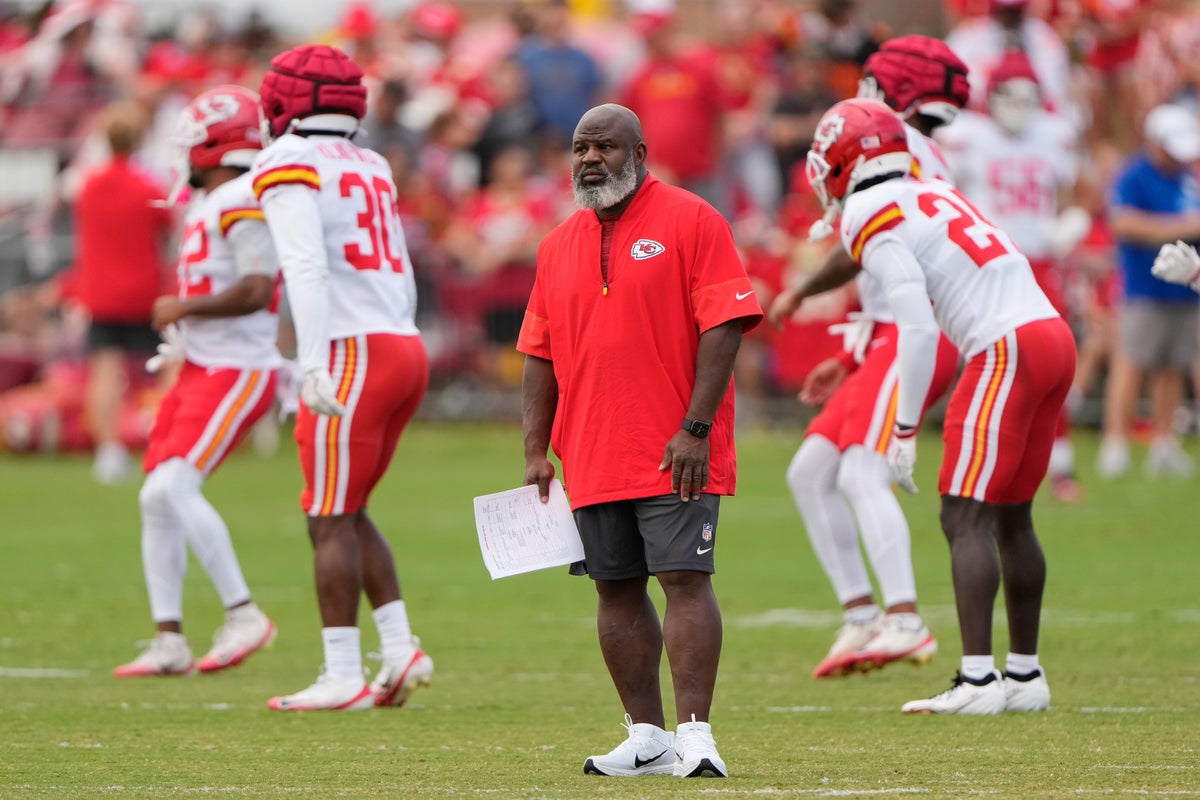
Eric Bieniemy stands as one of the most anomalous case studies in modern professional football operations. Despite presiding over an offensive system that generated multiple championships, consecutive Super Bowl appearances, and elite offensive metrics as the offensive coordinator for the Kansas City Chiefs, his repeated exclusion from National Football League head coaching vacancies remains a point of intense scrutiny within organizational behavior and labor market efficiency studies. When personal security incidents, such as the reported shooting at his residence in Virginia and subsequent public commentary regarding career pivots, intersect with professional timelines, the broader narrative shifts from pure on-field performance to a complex intersection of media relations, organizational risk aversion, and institutional hiring inertia. Deconstructing this trajectory requires moving past anecdotal media coverage and examining the operational mechanics of how coaching talent is evaluated, valued, and filtered through executive search parameters.
The labor market for elite coaching personnel operates under severe information asymmetry. Franchises evaluate candidates not merely on tactical acumen, which is difficult to isolate from institutional infrastructure like elite quarterback play and established franchise stability, but on leadership chemistry, cultural fit, and media management capability. When public incidents occur outside the facility, they introduce volatility into an already risk-averse hiring calculus. Front offices operate under strict loss-minimization heuristics. A candidate who attracts external scrutiny, regardless of fault or context, introduces a public relations liability variable that risk-averse ownership groups frequently choose to bypass entirely. This dynamic explains why raw operational output does not always correlate linearly with upward career mobility in closed corporate ecosystems.
Evaluating the structural components of Bieniemy's career path reveals three distinct friction points that impede lateral or upward transition within the executive hierarchy of professional sports management.
The attribution problem represents the first major barrier. In complex team environments, executive and coaching success is constantly subjected to attribution errors. When an offense breaks records, external evaluators frequently credit the head coach or the generational talent under center rather than the coordinator designing the weekly game plans and managing position groups. Conversely, when performance dips, coordinators absorb disproportionate blame. This structural attribution bias creates a glass ceiling for coordinators operating under established offensive-minded head coaches, as ownership groups struggle to independently verify the candidate's distinct contribution to the enterprise's overall success.
The second friction point involves cultural and narrative alignment. Modern sports organizations place an unprecedented premium on narrative control and corporate communication styles. Coaches are expected to function as public-facing CEOs who project specific psychological profiles that resonate with diverse stakeholder groups, from millennial athletes to risk-averse corporate boards. When public narratives drift toward personal friction, controversial commentary, or external distractions, the candidate's perceived institutional compatibility drops. Front offices calculate the cost of managing the narrative against the potential competitive advantage the coach provides, frequently leading to conservative hiring decisions.
The third variable centers on the mechanics of the interview process itself. Executive search firms and team presidents utilize standardized interview matrices that reward specific presentation styles, strategic frameworks, and cultural signifiers. Candidates who challenge these established matrices or whose communication style diverges from institutional norms often face headwinds during the evaluation phase. The insistence on specific behavioral archetypes filters out qualified operational minds who do not fit the narrow cultural mold preferred by ownership committees.
Addressing these systemic inefficiencies requires examining how teams quantify coaching impact. Standard metrics such as yards per play, third-down conversion efficiency, and red-zone conversion rates fail to capture leadership equity, locker room management under pressure, or weekly preparation discipline. Without a standardized valuation framework for coaching contributions, hiring cycles remain vulnerable to cognitive biases, network-based hiring, and risk-averse herd behavior among franchise executives.
The operational reality of moving between collegiate and professional systems further complicates career trajectories. When coaches navigate transitions back to collegiate programs or alternative professional tiers, they encounter entirely different operational constraints, including recruiting dynamics, administrative compliance, and institutional fundraising pressures. Success in one ecosystem does not guarantee seamless portability to another, as the fundamental key performance indicators shift dramatically based on the organizational mandate.
Ultimately, the stagnation or lateral movement of elite coordinators highlights structural flaws in how talent pipelines operate. Until ownership groups and search consultants develop objective, performance-based evaluation metrics that isolate tactical mastery from external narrative volatility, the market will continue to misprice elite coaching assets based on superficial criteria rather than measurable operational output.
The immediate strategic play for evaluating similar personnel crises involves establishing a centralized, data-driven audit of internal coaching contributions. Organizations must decouple a candidate's tactical performance data from external media cycles by implementing blind evaluation protocols during the preliminary screening phases, thereby isolating core competence from peripheral noise and neutralizing institutional bias.