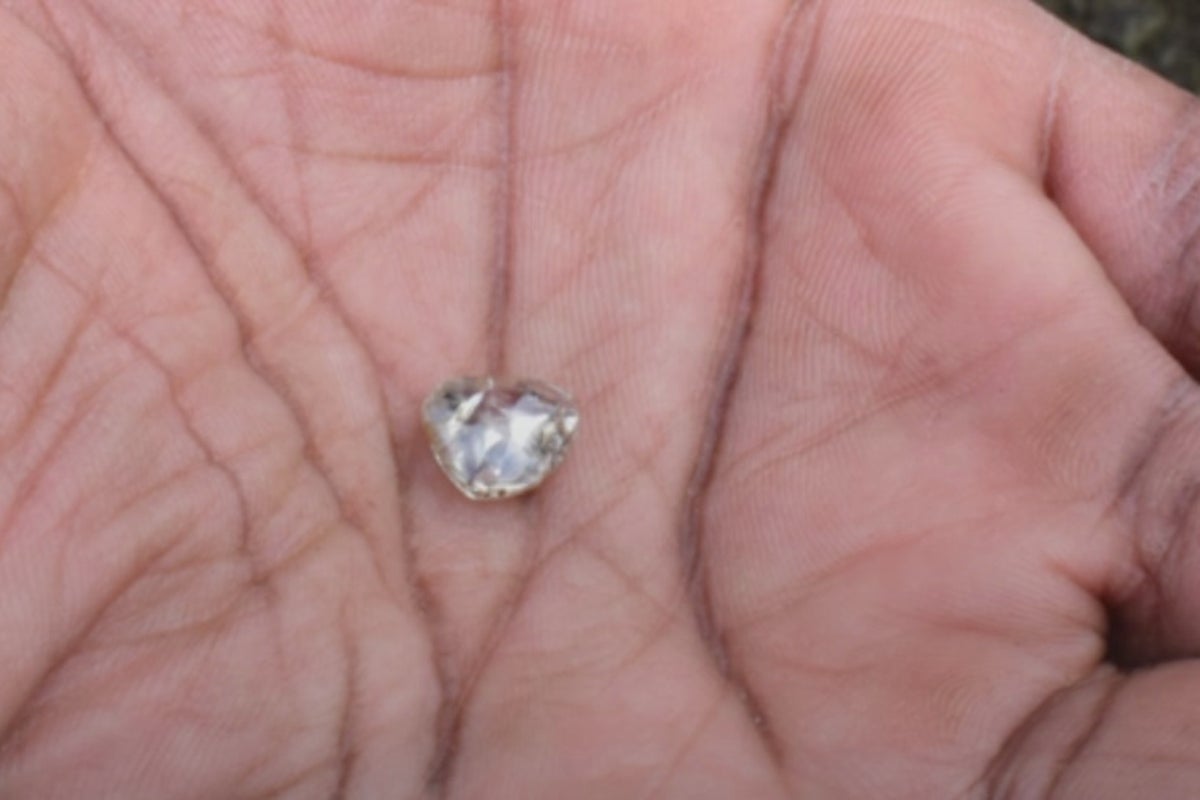
The convergence of psychological trauma and extreme statistical outliers—such as finding a 3-carat diamond in a public state park—is often framed as a narrative of "destiny." However, a rigorous analysis of the Crater of Diamonds State Park in Murfreesboro, Arkansas, reveals that such events are the product of specific geological mechanics, erosion cycles, and a unique model of public resource accessibility. To understand why a visitor in a state of emotional distress might encounter a high-value gemstone, one must first deconstruct the physical and operational frameworks of the site.
The Geological Mechanism of Surface-Level Concentration
The primary driver of diamond availability at the site is the Lamproite Pipe, a volcanic conduit that transported diamonds from the mantle to the surface approximately 95 million years ago. Unlike traditional diamond mines that utilize heavy machinery for deep-crust extraction, the Arkansas site operates as a weathered, secondary deposit. You might also find this connected article interesting: The Great European AC Myth Why the Continent is Choosing Sweat Over Sanity.
The probability of a surface discovery is dictated by the Erosion-Exposure Cycle:
- Chemical Weathering: The "blue ground" (unweathered lamproite) breaks down into "yellow ground," a softer, friable soil. This process naturally liberates diamonds from their host rock matrix without human intervention.
- Hydraulic Sorting: Diamonds possess a high specific gravity—roughly $3.52$—making them significantly denser than the surrounding quartz, fieldspar, and organic matter. During heavy rainfall, water acts as a natural sluice. It washes away lighter sediment while heavier minerals, including diamonds, garnets, and barite, settle into the furrows and depressions of the 37.5-acre plowed field.
- The Albedo Effect and Visual Identification: Because diamonds are adamantine and often hydrophobic, they repel water and remain clean even in muddy conditions. On a clear day following a storm, the high refractive index of the stone creates a distinct visual "sparkle" against the matte background of damp soil.
The find in question—a 3-carat stone—is not merely a stroke of luck but a result of the visitor being present at the optimal point in this hydraulic cycle. The park staff regularly plows the field to bring fresh material to the surface, essentially resetting the "searchable surface area" and maintaining the site’s viability as a functional diamond-bearing deposit. As highlighted in latest coverage by ELLE, the results are significant.
The Psychological Utility of Low-Probability High-Reward Events
In the context of bereavement, the discovery of a gemstone acts as a Binary Psychological Pivot. Grieving individuals often experience a sense of loss of agency or a perceived "void" in the causal structure of their lives. The sudden acquisition of an object of high rarity and value provides a sharp, undeniable counter-signal to that void.
The Value Matrix of Found Objects
The utility of a diamond found in this manner is calculated through three distinct lenses:
- Intrinsic Mineralogical Value: Based on the "Four Cs" (Carat, Cut, Color, Clarity). A 3-carat raw stone is a significant anomaly; most finds at the park are under 0.20 carats.
- Symbolic Weight: In a state of grief, the "rarity" of the stone is mapped onto the "rarity" of the lost relationship. The physical durability of the diamond—the hardest natural substance—offers a tangible metaphor for the permanence of memory.
- Narrative Resolution: For a visitor grappling with the random cruelty of death, the random "generosity" of the earth provides a temporary sense of cosmic rebalancing.
Operational Constraints and Searcher Bias
The "find" rate at Crater of Diamonds is influenced by Searcher Density and Methodology. Most visitors employ one of three strategies:
- Surface Searching: Walking the rows after a rain. This is high-efficiency but low-probability, relying entirely on the Albedo Effect mentioned previously.
- Dry Sifting: Using a screen to find smaller stones. This increases the quantity of finds but limits the searcher to a small physical footprint.
- Wet Sifting (Saruca Method): Hand-sorting gravel in water. This is the most technically rigorous method, leveraging the diamond’s specific gravity to center it in a circular screen.
The specific find of a 3-carat stone typically occurs during surface searching. Larger stones have a larger surface area, making them more susceptible to being unearthed by heavy runoff. There is a documented correlation between major storm events and the discovery of stones exceeding 2 carats. For a visitor walking the field "to clear their head," surface searching is the default behavior, placing them in the correct operational category for a significant discovery.
The Economic Model of Public Diamond Access
The Crater of Diamonds is the only site in the world where the public can prospect for diamonds at the source and retain their finds. This creates a unique Micro-Economic Ecosystem:
- Low Barrier to Entry: The nominal entrance fee represents a negligible "buy-in" for a lottery with a non-zero chance of a high-value payout.
- Zero-Sum Surface Area: Once a stone is found, it is removed from the system permanently. Unlike a renewable resource, the "crop" of diamonds is finite, though the vast depth of the pipe (reaching hundreds of feet) ensures that plowing will continue to yield results for centuries.
- Information Asymmetry: Professional "regulars" at the park understand the drainage patterns and "pockets" where heavy minerals accumulate. Casual visitors, such as the woman in the reference, are at a disadvantage unless environmental factors (like a recent heavy rain) democratize the search field by exposing stones in plain sight.
Quantifying the "Meaning" of the Discovery
While the emotional narrative focuses on the "need" for the stone, a structural analysis identifies this as a Validation Event. The visitor’s statement—"I really needed this"—identifies the stone as a compensatory mechanism for emotional trauma. In statistical terms, the event is an outlier ($p < 0.001$ for a stone of that size on any given day), but in a system that hosts over 100,000 visitors annually, such outliers are a mathematical certainty over a long enough time horizon.
The intersection of extreme grief and extreme good fortune creates a potent narrative, but the mechanism remains grounded in the physical reality of the Arkansas lamproite pipe. The stone was not "meant" to be found; rather, the visitor was the first sensor to intersect with the stone's coordinates following its liberation from the soil matrix.
Strategic Selection for Future Prospecting
To replicate or optimize the chances of a significant mineral find, an individual must move beyond the "fate" narrative and adopt a systematic approach based on the Sedimentation Law:
- Time Selection: Arrive within 24 to 48 hours of a rainfall exceeding 2 inches. This ensures that the hydraulic sorting has occurred but the "visual competition" (other visitors) has not yet cleared the surface.
- Location Strategy: Focus on the lowest elevations of the field where the "washout" ends. This is where the heaviest particles, including diamonds and lamproite concentrates, are most likely to settle.
- Visual Calibration: Look for a metallic or "greasy" luster rather than a glass-like shine. Raw diamonds do not look like polished jewelry; they look like unpolished bits of glass with a distinctive rounded edge or "octahedral" shape.
The most effective strategy for finding high-value gemstones in a secondary deposit is to treat the field as a fluid-dynamics problem rather than a treasure hunt. Success is a function of total surface area covered during peak visibility windows. While the emotional impact of a 3-carat find is immeasurable for a person in mourning, the occurrence itself is a predictable result of geological exposure and human persistence.
The discovery serves as a reminder that the natural world operates on a scale of time and pressure that is indifferent to human experience. A diamond formed billions of years ago and a human experiencing loss meet at a specific coordinate of erosion and chance. The strategic move for any seeker is to align their presence with the environmental triggers that force these deep-earth assets to the surface.