Silence.
That is the first thing you notice when a forty-foot coastal cypress comes down, not the roar of the chainsaw that preceded it, nor the sickening, splintering crack of heartwood giving way to gravity, but the sudden, unnatural vacuum in the air where a living lung used to breathe. I still remember standing at the edge of a coastal bluff three winters ago, watching a neighbor’s crew haul away the dismembered limbs of an old-growth Monterey pine that had sheltered our street from Pacific gales since the Truman administration, and feeling a strange, hollow ache in my chest that had nothing to do with property lines. The wind, once filtered into a gentle, resin-scented sigh through thousands of needles, suddenly slapped against my cheek like an open palm.
We have a peculiar, dangerous habit in coastal towns of treating living ecosystems like inconvenient curtains blocking a television screen.
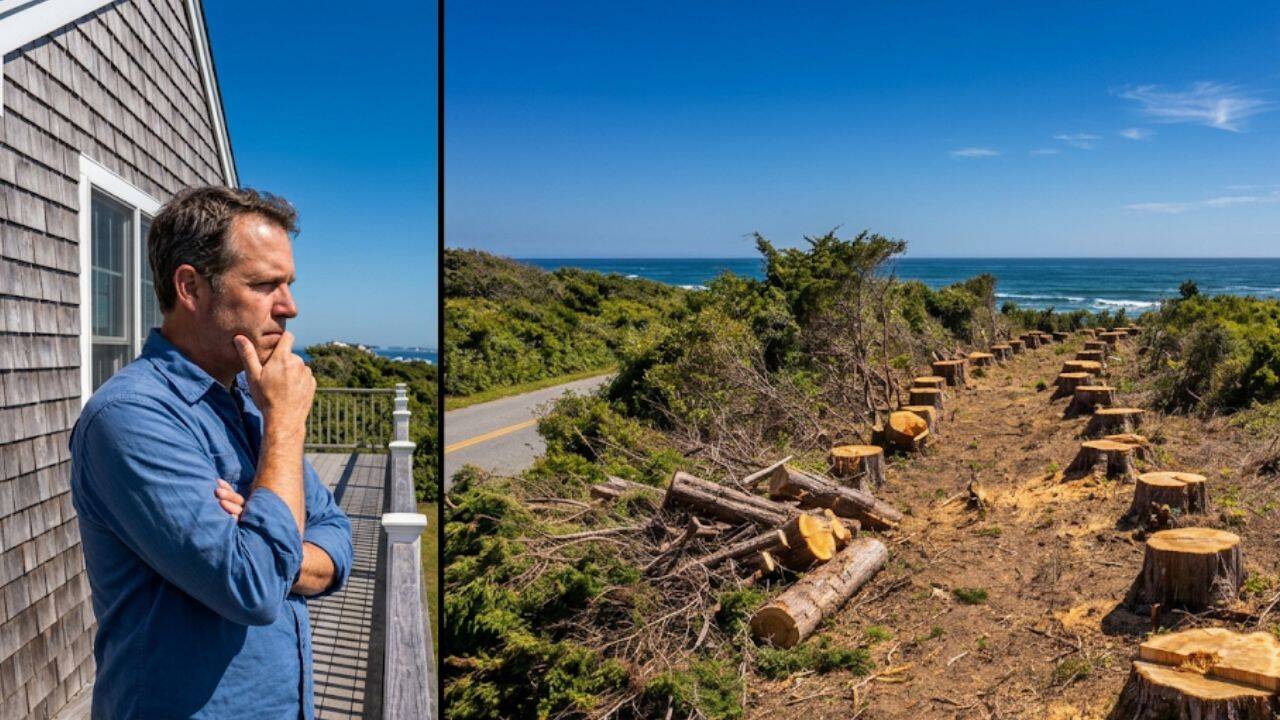
Consider the case making headlines along the coast right now, where a homeowner stands accused of illegally cutting down more than sixteen mature trees just to carve out a cleaner, wider slice of an ocean view. On paper, in the dry, sterile ink of a municipal code violation or a brief local news blurb, it reads like a petty squabble over foliage and fines. Sixteen trees. A clearer sightline to the water. A slap on the wrist, perhaps a restitution fee paid out of a deep pocket, and life moves on.
Except it doesn’t. When you strip away the legal jargon and look at what actually happens when a property owner decides their personal panorama outweighs half a century of root systems, you uncover a quiet war being waged on coastlines from California to Maine, from the Mediterranean to the South Pacific. It is a story about vanity, invisible physics, and the staggering financial and ecological price tag hidden behind a "million-dollar view."
The Anatomy of a View Theft
To understand why someone risks tens of thousands of dollars in fines and the permanent enmity of an entire neighborhood over a handful of trunks and branches, you have to understand the intoxicating drug of coastal real estate.
Let us construct a hypothetical scenario—one that mirrors dozens of documented municipal court cases across coastal counties over the last decade. Picture a buyer, we will call him Arthur, who spends four million dollars on a mid-century modern glass house perched sixty feet above the surf. When Arthur tours the home in January, the winter storms have thinned the canopy, and the real estate agent gestures sweepingly toward the living room windows, promising "sweeping, unobstructed ocean vistas." By June, however, the coastal fog rolls in, the native oaks and pines flush with spring growth, and Arthur’s sweeping vista narrows to a sliver of blue wedged between two massive, sprawling crowns.
Arthur does not see eighty-year-old carbon sinks or avian nurseries. He sees an asset depreciating in real time. In high-end coastal markets, industry appraisers routinely estimate that an unobstructed water view adds anywhere from fifteen to thirty percent to a home’s resale value. On a four-million-dollar property, those sixteen trees sitting between Arthur’s deck and the horizon aren't just wood and leaves; in his ledger, they represent eight hundred thousand dollars of blocked equity.
So, on a quiet Tuesday morning while the neighbors are at work, a private tree service pulls up in an unmarked flatbed. No permits are taped to the front window. No certified arborist has signed off on disease or structural failure. Within four hours, sixteen mature trees—each taking forty to sixty years to reach its current height—are reduced to sawdust and stacked cordwood. The ocean is suddenly, brilliantly visible from Arthur’s kitchen island.
He thinks he has bought himself a view. In reality, he has just pulled the pins out of the hillside holding his house in the sky.
What Roots Do in the Dark
Most people look at a mature tree and see only what rises above the grass, mistaking the trunk for a flagpole and the canopy for an umbrella. That is a fundamental misunderstanding of botanical engineering.
Think of a coastal hillside not as solid ground, but as a slow-motion waterfall of dirt, sand, and fractured rock waiting for an excuse to slide into the sea. Mature trees are the rebar in that concrete. Below the soil line, a single healthy coastal oak or pine spreads a lateral root network two to three times wider than its canopy, weaving an intricate, subterranean basket that locks thousands of tons of topsoil in place. More importantly, those roots act as biological sump pumps. A single mature tree can absorb and transpire upwards of one hundred gallons of water on a warm day, pulling heavy, destabilizing moisture out of the earth before gravity can turn a coastal bluff into a mudslide.
When you sever sixteen mature trees in a single afternoon, you do not immediately trigger a landslide. You start a ticking clock.
For the first two years, the dead roots remain tangled in the dirt, still offering a phantom grip on the slope. You get to enjoy your pristine sunset photos from the hot tub. You host dinner parties where guests marvel at the uninterrupted line where sea meets sky. Meanwhile, underground, fungi and bacteria are quietly digesting the dead cellulose. By year three or four, those subterranean anchors rot into soft, spongy voids. The next time an atmospheric river dumps six inches of rain onto the coast in forty-eight hours, the water has nowhere to go. It saturates the unanchored soil, turns the clay layer beneath into a greased slide, and suddenly, the view isn't the only thing moving toward the ocean.
I have walked the perimeter of coastal properties in Marin County and Big Sur after winter blowouts where illegal clearing preceded a slope failure. The homeowners always look bewildered, standing beside yellow caution tape as geotechnical engineers explain that stabilizing a failing bluff with steel tiebacks and shotcrete retaining walls will cost upwards of half a million dollars—often far more than the view ever added to the appraisal.
The Invisible Bill Sent to the Neighborhood
The tragedy of illegal tree cutting—known in legal and forestry circles as "view vandalism" or "timber trespass"—is that the perpetrator rarely pays the full bill alone. The costs bleed outward, absorbed silently by neighbors who never consented to the trade.
Consider what happens next when a dense stand of sixteen mature trees vanishes from a residential street.
First comes the thermal shift. Mature coastal canopies create microclimates, moderating harsh afternoon glare and trapping cool marine air near the ground. Strip them away, and the ambient temperature on surrounding patios can jump by five to eight degrees on sunny afternoons, driving up summer cooling bills for everyone downwind.
Second comes the acoustic assault. Foliage is nature’s finest sound baffle, absorbing and scattering the low-frequency rumble of highway traffic, distant leaf blowers, and crashing surf. Neighbors who once slept with their windows cracked to a gentle hush suddenly find themselves staring at the ceiling at three in the morning, listening to the amplified roar of the coastal highway half a mile away.
Then there is the loss that cannot be measured on a utility bill or a decibel meter. Coastal trees are critical waystations along major migratory flyways. A single mature native oak supports hundreds of species of caterpillars, beetles, and native bees, which in turn feed warblers, hawks, owls, and coastal songbirds. When sixteen trees disappear in a day, the local food web doesn't gently relocate; it collapses. The morning chorus vanishes. The red-tailed hawk that used the tallest snag as a hunting perch abandons the territory.
And what about the neighbors' own views? In a cruel irony, the very trees one homeowner destroys to see the ocean were often the exact living screen hiding that homeowner’s stucco wall, roof vents, and bright security lights from the people living uphill. One person’s unobstructed ocean vista becomes twenty neighbors’ unobstructed view of someone else’s back deck.
Why Fines Fail to Stop the Chainsaw
If the ecological and social damage is so obvious, why does this keep happening? Why do municipalities across North America and Europe continue to report brazen, unpermitted clear-cutting in protected coastal zones and heritage tree districts?
The answer lies in simple, brutal math.
In too many jurisdictions, environmental enforcement still operates on a pricing model designed in the 1970s. If a city ordinance imposes a flat fine of one thousand or even two thousand dollars per illegally felled tree, a homeowner cutting down sixteen trees faces a maximum penalty of sixteen to thirty-two thousand dollars. To someone sitting on a five-million-dollar coastal estate, thirty-two thousand dollars is not a deterrent. It is a permitting fee paid in arrears. It is a line item in the landscaping budget.
I used to think strict tree ordinances were bureaucratic overreach—another layer of red tape preventing homeowners from managing their own yards. When I first bought a home with aging trees near the roof, I resented having to pay an arborist and wait six weeks for a city inspector just to prune heavy limbs. It felt intrusive, slow, and expensive. It took watching a neighbor’s unpermitted clear-cutting turn a quiet, shaded cul-de-sac into a wind-scoured, eroded dust bowl to realize that private property lines are an ecological fiction. Water, wind, roots, and birds do not read county parcel maps. When you own land on a fragile coastline, you are less of a monarch and more of a temporary steward holding a single thread in a very tight net.
Fortunately, municipalities are finally waking up to the fact that pocket-change fines invite wealthy lawbreakers to treat public beauty as a private commodity.
Across California, Washington, and parts of New England, lawmakers and courts have begun shifting from punitive flat fines to replacement-value restitution and view-obstruction remedies. Under modern timber trespass statutes, courts don't just fine a homeowner for breaking a rule; they calculate the appraised ecological and aesthetic value of a mature, forty-year-old tree—a figure that routinely hits thirty to fifty thousand dollars per tree when evaluated by the Council of Tree and Landscape Appraisers' trunk formula method. Suddenly, sixteen trees isn't a thirty-thousand-dollar nuisance; it is an eight-hundred-thousand-dollar liability, often tripled under state treble-damage laws for willful destruction.
Even more effective is the rise of the "spite wall" or view-blocking mandate. Several progressive coastal towns now enforce ordinances stating that if you illegally cut down trees to gain a view, the city will erect—at your sole expense—a solid visual barrier or scaffolding structure on the exact footprint of the destroyed canopy, leaving it standing until newly planted replacement trees grow tall enough to block your sightline again.
Nothing cures view vandalism faster than knowing the chainsaw will buy you twenty years of staring at a city-mandated wooden billboard.
Reading the Warning Signs Before the Saw Starts
If you live in a neighborhood blessed with mature trees, you do not have to wait until you hear the two-stroke engine whining at seven in the morning to protect your block’s canopy. Illegal clearing almost always leaves footprints before the first branch hits the ground.
Pay attention when a property changes hands, particularly if the real estate listing emphasized "potential views" or "underutilized sightlines." Watch for tree crews arriving in unmarked trucks without municipal permit notices posted visibly near the street; legitimate, licensed arborists operating in protected zones know that cutting without a displayed permit risks their contractor’s license, whereas fly-by-night operators take cash and vanish before code enforcement arrives.
If you hear chainsaws on a protected slope or heritage lot, step outside with your phone. Document the truck’s license plate, photograph the standing trees before they fall, and call your city’s code enforcement or urban forestry hotline immediately—not next week, not via an online form that sits in an inbox for ten days, but right then. Once a fifty-year-old trunk hits the dirt, no court order in the world can glue it back together.
We like to imagine that luxury means bending the natural world to suit our preferences—shaving down hills, pushing back tides, and erasing whatever grows between our eyes and the horizon. Yet the irony of the coastal view thief is that in trying to capture the beauty of the ocean, they destroy the very living edge that makes the coast worth inhabiting in the first place.
Walk past a cleared coastal lot at dusk a year after the saws have gone quiet. There is no rustle of wind in high needles, no flicker of evening birds settling into roosts, no scent of damp bark cooling after the sun drops below the water. You can see every inch of the empty ocean, stretching out cold and flat to the edge of the earth, framed on either side by raw, scarred stumps bleeding sap into the dirt.


