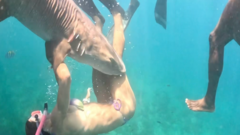
Salt stings the back of your throat before you even touch the water. It is a sharp, metallic taste mixed with sunscreen and adrenaline. Through the viewfinder of a heavy housing unit, the blue is not a color; it is a weight. It presses against your chest, promising absolute weightlessness on one side and a primal, unyielding indifference on the other.
Then, the shadow appears.
It starts as a smudge of graphite against the sun-shafted turquoise. Within seconds, it resolves into muscle, slate-gray skin, and a pair of obsidian eyes that do not blink, do not judge, and most certainly do not care about your follower count.
You press the shutter anyway.
TikTok has taught us to look at the ocean through a keyhole. We swipe past vertical windows of electric reefs, neon swimsuits, and sleek, torpedo-shaped predators gliding past human bodies as if choreographed by a Hollywood director. The comments roll by in a blur of flame emojis, heart eyes, and questions about presets. What filter did you use? Where is this? Can I pet it?
We consume the final product like candy, stripped of the wrapper, the sweat, and the blood.
Consider what happens behind the frame.
I stood on a boat off the coast of Jupiter, Florida, a few summers ago, watching a young creator prep her gear. She was twenty-four, armed with a mirrorless camera, a dome port, and an ambition that burned hotter than the midday sun. Her brand was built on proximity. If you weren’t close enough to touch the danger, you weren’t relevant.
"If I get the shot with the lemon shark brushing my shoulder," she told me, adjusting her bikini top with deliberate nonchalance, "the algorithm will push me past the fifty-thousand mark."
She wasn't stupid. She was desperate. The architecture of modern social media demands constant sacrifice at the altar of novelty. Yesterday it was cliff-jumping; today it is apex predators. To stand still is to vanish. So you swim deeper, you stay longer, and you push closer to a creature that has spent four hundred million years perfecting the art of survival.
Sharks do not hate us. They do not love us. They are simply testing machines equipped with ampullae of Lorenzini, sensing the frantic, thumping electrical pulse of a human heart hammering at one hundred and forty beats per minute. That panic tastes like opportunity to an animal whose primary job description is cleaning the ocean floor.
The statistics rarely make it into the caption. Between the viral reels of serene underwater ballets lie the emergency room visits, the reconstructive surgeries, and the quiet, unfilmed moments of absolute terror when a six-foot reef shark decides a flailing arm looks less like a bystander and more like a mistake.
Marine biologists call it habituation. When humans dispense bait, chum the water, or crowd a cleaning station just to capture a trendy aesthetic, we teach wild animals that people equal food.
(Note: This is a direct behavioral conditioning loop. When a shark associates the hum of a drone or the splash of a GoPro-toting swimmer with a free meal, the evolutionary caution that kept them safe from humans begins to fray.)
The result is predictable, tragic, and entirely hidden beneath layers of trending audio tracks.
The creator I met that afternoon did get her shot. It was magnificent. The water was crystal clear, the sun caught the tip of the dorsal fin, and her expression was a masterclass in serene, effortless fearlessness. She posted it on a Tuesday. By Thursday, it had three million views.
By Friday, she was sitting in a West Palm Beach clinic with gauze wrapped tightly around her forearm, staring numbly at a patch of missing flesh roughly the size of a teacup.
She hadn't been attacked out of nowhere. She had ignored the warning sign that every experienced diver knows by heart: the drop of the pectoral fins, the erratic, figure-eight swimming pattern. The shark was giving her every chance to leave its living room. It was saying, clearly and without malice, you are too close.
She thought it was posing.
We have entered an era where sensory capture supersedes survival instinct. The lens acts as a psychological shield, convincing our brains that whatever is happening on the other side of the glass is safely contained, like a movie on a television screen. You forget that the glass isn't there. You forget that you are breathing compressed air while the creature beside you is breathing an element that fills your lungs with fluid in seconds.
The human element of this digital gold rush is rarely discussed with empathy. We mock the influencers on comment boards, calling them Darwin Award candidates, shaking our heads at their recklessness. But underneath the hubris is a profound, aching loneliness. We live in hyper-digitized isolation, craving validation from strangers who swipe left or right in fractions of a second. To make someone pause, to make them stop their thumb mid-scroll, requires volume. It requires extremity.
If a picture of a sunset is no longer enough, you must swim with the teeth.
Step back for a moment and look at the ecosystem we are disrupting. It is not just the physical sharks we are altering; it is the entire narrative of marine conservation. For decades, scientists fought an uphill battle to convince the public that sharks are vital apex regulators, not mindless movie monsters waiting to drag us under.
Now, a new generation is swinging the pendulum in the opposite direction, treating them like living props for clout. One day they are majestic guardians of the deep to be protected; the next, they are dangerous props to be poked, prodded, and circled for a twelve-second loop.
The ocean does not negotiate with algorithms.
When you slip beneath the surface, you enter a domain where you possess none of the biological advantages. You cannot swim faster than a bull shark. You cannot smell a drop of blood from a mile away. You cannot hold your breath for twenty minutes. Your only superpower is your intellect—the capacity to recognize your own insignificance and respect the boundaries of an environment that does not owe you a viral moment.
Yet, every weekend, the boats head out. The cameras click. The blood in the water mixes with the chum, and the invisible tally climbs.
There is a quiet dignity in observation from a distance. There is poetry in letting wild things remain wild, unbothered by our need for proof that we were there. The best memories are often the ones we failed to capture because our hands were too busy holding onto reality.
The water closes over your head. The silence is absolute, save for the mechanical hiss of your regulator. Somewhere out in the blue, the shadow turns, indifferent to your lens, your story, and your need to be seen, moving forward into the dark where the light can no longer reach.