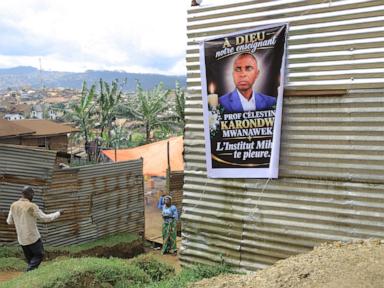
The air inside the clinic smelled of wet earth, chlorine, and unyielding fear. Outside, the dust of Kivu rose in amber clouds kicked up by passing trucks, coating the green foliage in a pale gray pallor. Inside, behind a makeshift wooden desk, sat a man whose hands were steady despite the chaos around him. He was not a soldier. He carried no weapon save for a clipboard, a pen, and an encyclopedic knowledge of virology wrapped in an infinite well of patience.
His name was not widely known across the globe. To the international bulletins, he was a statistic, a local coordinator, a data point in an ongoing outbreak. To his neighbors, he was the bridge. He was the one who walked into hostile alleyways where motorcycles were routinely burned, who spoke in low, calm tones in local dialects, explaining why the chlorine spray did not mean death, why the isolation wards were not execution chambers, and why the blood running through the veins of their sick children required science, not sorcery. If you enjoyed this article, you might want to check out: this related article.
Then, the silence broke.
Fear is a volatile element. When mixed with generations of institutional neglect, political instability, and the sudden, terrifying appearance of a hemorrhagic fever that liquefies the body from the inside out, it becomes explosive. People threw stones before they threw questions. Rumors mutated faster than the filovirus itself. The whispers claimed the foreigners brought the pestilence, and that local doctors working alongside them were merchants of a strange, dark trade. For another angle on this event, see the latest coverage from Reuters.
He stepped out to meet the crowd. He did not raise his voice. He did not call for armed escorts. He simply wanted to look them in the eye, to tell them that his own family drank from the same wells, that he breathed the same dust, that the enemy was microscopic and shared by all.
He did not finish his sentence.
When a Congolese health worker falls while defending an Ebola response, the world pauses for a brief news cycle, drops a tear into the digital ether, and moves on to the next crisis. But the shockwave left behind is seismic. It shatters the invisible infrastructure of trust that keeps epidemics from swallowing entire continents.
Medicine is often taught as a triumph of chemistry. We memorize the replication cycles of pathogens, the protein spikes of viruses, the cold math of transmission chains. We chart R-nought values on whiteboards and model exponential curves in air-conditioned rooms thousands of miles away from the epicenter. We forget that viruses do not move through vacuums. They move through human touch, through grief, through ancient burial customs, through whispered confidences in dark bedrooms.
And stopping them requires something far more fragile than a vaccine vial. It requires human belief.
To understand why a community turns on its own healers, you have to step back into the psychology of chronic abandonment. Imagine living in a region where the central government is a distant rumor, where roads are swallowed by mud every rainy season, and where healthcare, when it arrives at all, comes in the form of armed men or fleeting aid workers who pack up and leave the moment the cameras turn away.
When a new, terrifying disease arrives under these conditions, skepticism is not irrationality. It is a defense mechanism honed by a history of betrayal. If you have been lied to for decades, why should you believe that men in white moonsuits have come to save you? When they isolate your loved one behind plastic sheeting and you never see them alive again, why wouldn't your mind construct an alternative narrative? In the absence of transparency, conspiracy fills the vacuum.
This is where the true battle is fought. Not just in the containment ward, but in the muddy courtyards and market squares where rumor battles reality.
The fallen coordinator knew this better than anyone. He understood that every time a community member fled a treatment center, it was born of terror, not malice. He knew that forcing compliance at gunpoint only drove the sick deeper into hiding, turning private homes into silent incubators where entire families could be wiped out in a week. He chose the harder path. He chose dialogue. He chose to listen to the grievances of angry youths, to answer the accusations of grieving mothers, to stand in the harsh light of suspicion and absorb the hostility so that the truth might have a chance to take root.
His death was a tragedy, but it was also a warning. When you kill the translator, you guarantee that the two sides will remain forever incomprehensible to one another.
Consider the mechanics of an outbreak response. It is a massive, clumsy machine driven by international urgency. It deploys millions of dollars, heavy logistics, specialized gear, and legions of foreign experts. Yet, its success hinges entirely on the final three feet—the distance between the gloved hand of a nurse and the trembling hand of a terrified patient.
If those three feet are broken by suspicion, the entire machine collapses under its own weight.
In the weeks following the attack, the local response did not stop, but it changed shape. Armed guards multiplied. Checkpoints tightened. The physical distance between the responders and the community widened into a yawning chasm of distrust. The clinic doors remained open, but fewer people came. Patients hid their symptoms until it was too late, terrified of both the disease and the armed presence guarding the cure. The math of the epidemic grew worse. More chains of transmission went untraced. More lives slipped away into the quiet anonymity of rural graves.
This is the hidden cost of violence against health workers. It is not just the loss of an irreplaceable human life, though that alone is immeasurable. It is the silent multiplication of the virus, feeding on the fear that the attack itself generated.
We must confront an uncomfortable truth about global health interventions. Technical brilliance is useless without social architecture. We can sequence a viral genome in hours, manufacture millions of doses of monoclonal antibodies, and deploy advanced thermal imaging across international borders. Yet we routinely fail to invest in the slow, unglamorous work of building trust before the crisis hits. We show up with answers to questions people are not asking, while ignoring the deep, historical wounds that make them doubt our motives.
The physician working in Kivu understood this. He did not wear his hazard suit like armor to intimidate; he treated it as a barrier he constantly had to cross with his words. He knew that science is only as effective as the human relationship carrying it.
When we look at the recurring cycles of outbreaks—whether Ebola in Central Africa, respiratory viruses in sprawling megacities, or novel pathogens yet to emerge—we are looking at mirrors of our own societal fractures. The disease tests our biology, but the response tests our humanity.
The wooden desk where the coordinator sat is empty now. The papers have been cleared away. The dust still rises in amber clouds along the Kivu roads, settling over the green leaves, indifferent to the grief left in its wake.
Yet, somewhere in that same clinic, a young nurse who worked alongside him pulls on her boots, adjusts her mask, and steps out into the sun. She remembers the words. She remembers the patience. She knows the danger is absolute, and she knows the cost of turning back.
She walks out to meet the crowd. She begins to speak. The work continues, carried forward by the fierce, quiet stubbornness of those who refuse to let fear have the final word.