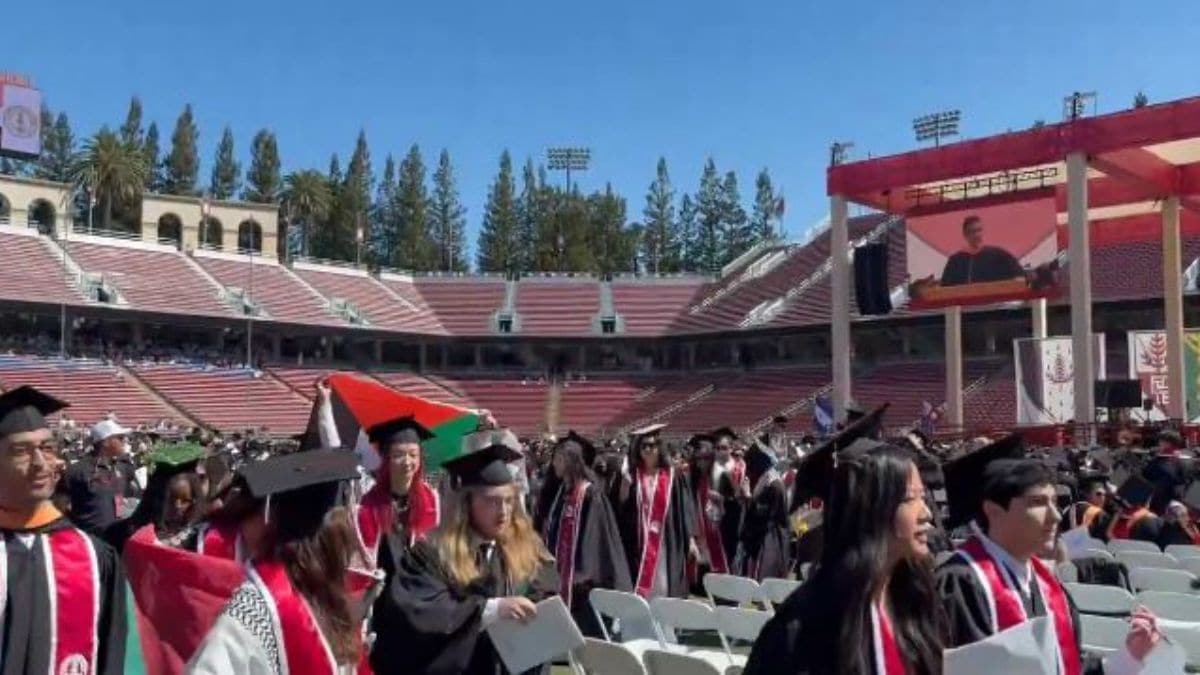
The late spring sun over Stanford Stadium was blinding, the kind of California heat that softens asphalt and turns heavy graduation gowns into personal saunas. For hours, the mood was classic, irreverent Palo Alto. Graduates paraded through the traditional Wacky Walk riding inflatable horses, wearing cardboard replicas of Caltrain, and, in a few cases, sporting nothing but red briefs and sunglasses beneath their academic robes. It was a celebration of elite achievement, a victory lap for nearly six, thousand of the brightest minds on earth.
Then the university president stepped to the podium to introduce the keynote speaker.
Sundar Pichai walked toward the microphone. He is an alumnus, a man who sat in these same rows three decades ago before rising to lead Alphabet and Google, arguably the most powerful digital empire in human history. The introduction praised his thoughtfulness, his humility, and his leadership.
But as Pichai took the stage, the celebratory mosaic fractured. Boos rippled through the stadium. Rows of black caps and gowns suddenly stood up.
Roughly two hundred graduate and undergraduate students turned their backs on the podium. They did not just quietly slip away. They marched down the stadium aisles, hoisting Palestinian flags and unfurling hand-painted banners reading "Genocide Runs on Google" and "ICE spies with Google AI." As they exited into the blinding noon heat, their chants of "Free, free Palestine" echoed against the concrete bowls of the stadium, cutting clean through the polite applause of the remaining crowd.
For those walking out, the moment was not about disrespecting a tech pioneer. It was a refusal to swallow a corporate sermon while the infrastructure of the modern world feels, to them, increasingly weaponized.
The Invisible Engine
To understand why a student would walk away from their own graduation ceremony—the culmination of years of sleepless nights, exorbitant tuition, and immense familial pride—you have to look past the stadium walls and into the invisible plumbing of the global internet.
The protest was anchored to a specific, piece of corporate architecture: Project Nimbus.
To the average consumer, Google is a search bar, a map, a convenient place to store photos. But to governments and massive enterprises, Google is a landlord. Project Nimbus is a $1.2 billion cloud-computing and artificial intelligence contract signed jointly by Google, Amazon, and the government of Israel.
Cloud computing is a deceptively soft phrase. It evokes images of weightless data floating harmlessly in the ether. In reality, the cloud is a massive network of industrial data centers, roaring servers that require millions of gallons of water just to keep from melting down. This infrastructure provides the sheer computational horsepower required to run facial recognition databases, automated border surveillance, and predictive AI modeling.
Imagine a hypothetical software engineer named Maya. She joins a tech giant straight out of college, eager to build tools that help people navigate traffic or translate languages. One morning, she realizes the database clustering algorithms she is optimizing are being deployed to monitor checkpoints or categorize civilian populations thousands of miles away. The line between commercial utility and military application evaporates.
That is the friction point. Google has repeatedly stated that Project Nimbus is not directed at highly sensitive, classified, or military workloads relevant to weapons or intelligence services. But for the students walking out, that distinction is a semantic shield. They argue that providing the baseline digital muscle to a state engaged in a devastating military campaign makes the provider complicit, regardless of what the specific terms of service say.
Two Realities in One Valley
As the departing students gathered under the shade of nearby oak trees to hold an alternative "People's Commencement"—surrounded by banners, listening to Nina Simone tracks, and attempting to reclaim the moral purpose of their education—Pichai kept speaking inside the stadium.
He appeared unfazed. He is a master of corporate composure, a man whose career has been defined by navigating congressional hearings and intense internal employee revolts.
This graduation season had already been brutal for tech executives. At other universities across the country, speakers were routinely booed down the moment they mentioned artificial intelligence. The anxieties of the graduating class of 2026 are raw. There is a deep, ambient fear that the machines being built just down the road in Mountain View and Cupertino are designed to render these graduates' expensive degrees obsolete, fracturing the job market before they even cash their first check.
Pichai, remarkably, did not mention artificial intelligence once.
Instead, he delivered a speech that felt like a dispatch from an older, simpler Silicon Valley. He spoke of his own journey arriving from India, the sacrifices of his family, and the necessity of personal resilience. He offered three timeless guideposts: choose optimism, say yes to hard things, and do what excites you. He told stories of rural women in India using smartphones to learn new trades, highlighting technology as an equalizer.
It was a good speech. For the vast majority of the stadium who remained seated, it was exactly what a commencement address should be: inspiring, polished, and safe.
But the juxtaposition was jarring. On stage stood a man celebrating the democratic power of technology to uplift humanity. Out in the courtyard stood hundreds of his junior peers, arguing that this same technology was being leveraged to enforce state violence. Both realities exist simultaneously in the Silicon Valley ecosystem.
The Split in the Tech Soul
The walkout highlights a profound generational split regarding what technology actually is.
To the pioneers who built the modern web, technology was an inherent good. If you connect the world, the world becomes a better place. Information wants to be free. The internet was supposed to flatten hierarchies and democratize access.
To the generation entering the workforce today, that optimism feels naive, even dangerous. They have grown up in the shadow of data breaches, algorithmic radicalization, and autonomous warfare. They do not see the tech industry as an underdog fighting the establishment; they see it as the establishment itself, a corporate monolith entangled with state intelligence, immigration enforcement, and military operations.
This tension is causing immense friction within companies like Google. This was not an isolated campus stunt. Over the past few years, tech workers inside these corporations have organized protests, signed petitions, and faced termination for speaking out against military contracts. The students walking out of Stanford Stadium are the exact demographic Google relies on to recruit its next generation of top-tier talent. When the elite engineers of tomorrow look at the industry leaders of today and see complicity instead of inspiration, the corporate pipeline begins to crack.
The reaction to the protest online was immediate and deeply polarized. High-profile venture capitalists publicly blasted the students, calling them entitled, short-sighted, and selfish. They argued that walking out on a company that pioneered the very tools used to lift billions out of poverty was an act of performative privilege.
But the students view it through a different lens of privilege. They believe that holding a degree from an institution like Stanford gives them a rare, powerful megaphone. To sit quietly and applaud, in their eyes, would be an act of silent consent.
The ceremony eventually ended. The families took their photos by the fountains, the inflatable horses were deflated, and the stadium emptied out into the quiet Palo Alto afternoon. Pichai left the venue through a side exit. When a journalist pressed him for a reaction to the scores of students who had rejected his presence, the chief executive kept walking, offering no comment, his face unreadable as the tinted glass of a corporate limousine slid shut.
The silence spoke louder than the speech. The data centers will keep humming, the contracts remain signed, and the cloud will continue to expand, indifferent to the human friction on the ground.