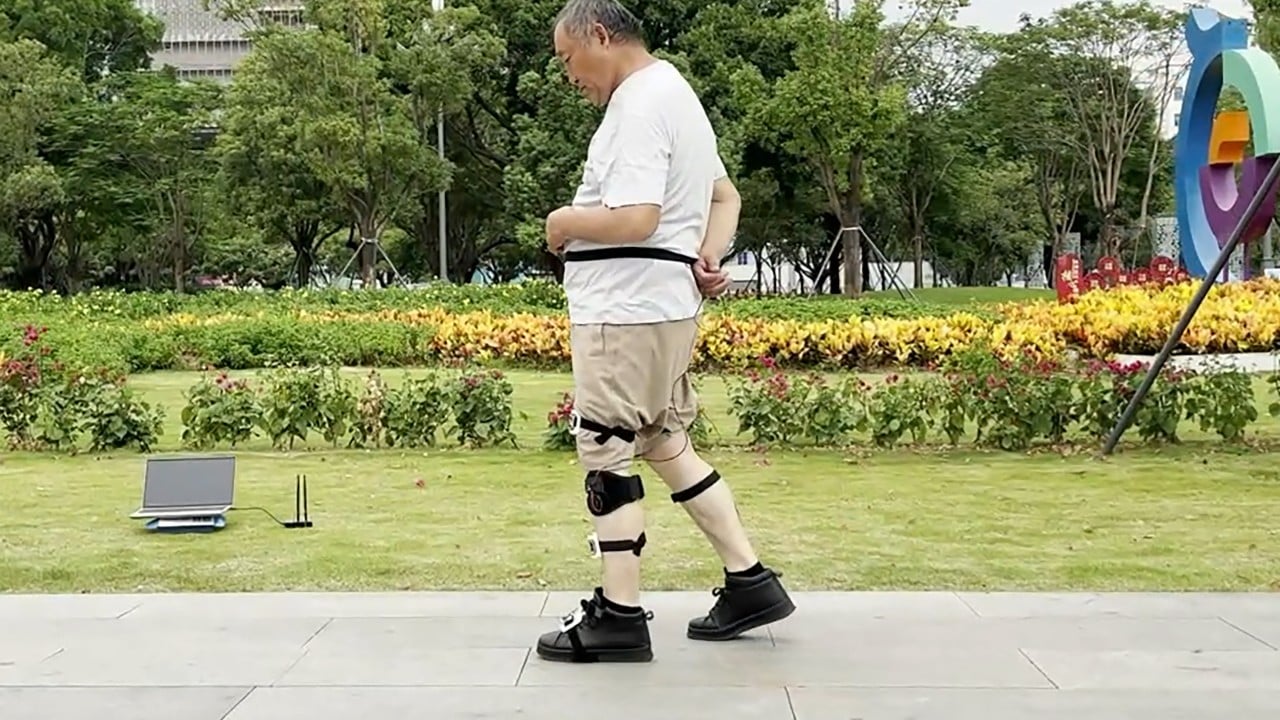
When a stroke disrupts motor control, the human body often gets trapped in a frustrating mechanical loop. A patient wants to move forward, but the neural pathways signaling the ankle to lift fail, resulting in foot drop, dragging strides, and a high risk of falls. Traditional rehabilitation relies on tedious physical therapy or bulky, external hardware tethered to wall outlets and heavy battery packs. Researchers across Hong Kong and mainland China have introduced a lightweight, battery-free neural stimulation device that harvests kinetic energy directly from the wearer's movements to power electrical muscle stimulation.
This self-powered mechanism represents a distinct shift in how biomedical engineers approach neuro-rehabilitation. Instead of treating power supply as an external engineering problem requiring heavy lithium batteries, the device turns the physical motion of walking into its own electrical fuel source. As the user moves, mechanically coupled energy-harvesting units capture kinetic friction and pressure, transforming that mechanical energy into precise electrical impulses. These impulses target the peroneal nerve and tibialis anterior muscle, forcing the foot to clear the ground at precisely the correct micro-interval of the gait cycle.
Moving Past the Tethered Clinic
For decades, functional electrical stimulation, commonly known as FES, has suffered from an awkward logistical bottleneck. Clinicians have long understood that applying small electrical currents to paretic muscles can retrain the brain and restore functional movement through neuroplasticity. The catch has always been the gear. Clinical-grade stimulators require external controllers, calibration rigs, and heavy power sources that restrict use to specialized hospital rooms and treadmills.
Patients cannot take a hospital wall unit home for daily grocery runs or neighborhood walks. By eliminating the battery entirely, this new class of wearable hardware strips away the weight that fatigues weakened limbs. The entire assembly operates autonomously, drawing only on the user's kinetic footprint to generate the necessary voltage.
Consider a hypothetical patient named Arthur, recovering from an ischemic stroke that left his right side persistently sluggish. In a conventional clinical setting, Arthur spends forty minutes twice a week strapped into a multi-thousand-dollar rig, wired to a control box monitored by a physical therapist. The moment he steps outside the clinic, those gains plateau because his daily routine lacks continuous, targeted muscle activation. A battery-free, wearable kinetic harvester changes the equation by embedding the therapy directly into his morning walk to the bakery. Every step he manages to take generates the exact electrical prompt required for the next step, closing the loop between intent and execution without requiring a charging cable or a battery swap.
The Engineering Mechanics of Kinetic Capture
To understand why this specific hardware design matters, look closely at the physics of human gait instability. Following a stroke, a patient's stride lacks symmetry and acceleration. The initial contact phase of the heel strike is weak, and the toe-off phase is frequently absent entirely.
Conventional stimulators rely on pre-programmed timers or manual foot-switch triggers placed inside the shoe. These setups frequently misfire when a patient changes pace, encounters an uneven sidewalk, or grows fatigued. The Chinese research team's device bypasses this electronic complexity by using mechanical coupling. The harvester is built directly into the joint dynamics of the brace, meaning the electrical output scales naturally with the user's movement speed. If the wearer walks faster, the mechanical frequency increases, producing a proportional boost in stimulation output.
This self-regulating feedback loop addresses a core complaint from clinical trial participants: the jarring mismatch between rigid machine timing and human biology. When a machine forces a rhythm onto a patient without regard for their micro-fluctuations in balance, the user fights the device. By tethering the electrical output directly to the kinetic input of the user's own compromised stride, the device responds in real time to the wearer's actual physical effort.
Navigating the Clinical Reality Check
Despite the enthusiasm surrounding battery-free neural prosthetics, medical device analysts point out significant hurdles before these systems become standard clinical tools. Energy harvesting is remarkably efficient for capturing large motions, but human walking is notoriously variable, especially in post-stroke recovery.
When a stroke survivor experiences severe spasticity or sudden muscle freezing, kinetic energy generation drops sharply. If the wearer cannot produce enough mechanical momentum to initiate the energy harvester, the device receives no power, resulting in a temporary loss of stimulation precisely when the patient needs support the most. Engineers are currently exploring hybrid fail-safes, such as micro-capacitors that store small reserves of ambient kinetic energy, but balancing weight constraints with power reliability remains an ongoing engineering tightrope.
Furthermore, skin impedance poses a persistent obstacle for non-invasive surface electrodes. Sweat, dry skin, and daily shifting of the brace can alter electrical resistance, changing how the stimulation feels and how effectively it triggers the underlying motor nerves. Ensuring that a lightweight, unmonitored home device maintains precise electrode placement over weeks of daily wear requires rigorous user-fit testing that laboratory trials have yet to fully validate on a mass scale.
The Broader Landscape of Neuro-Assistance
This breakthrough does not exist in a vacuum. It arrives amid a broader push across Asian and global biomedical engineering labs to decentralize rehabilitation. Traditional medicine has long treated recovery as a hospital-bound event. Modern neuro-engineering increasingly aims to turn everyday environments into continuous recovery zones.
Similar momentum is visible in non-invasive brain-computer interface caps and robotic exoskeleton hybrids being tested in clinical hubs from Shanghai to Hong Kong. Yet, heavy exoskeletons remain prohibitively expensive for everyday home use, often costing tens of thousands of dollars and requiring professional technicians to operate. A lightweight, battery-free mechanical stimulator targets a completely different market segment: the millions of stroke survivors who do not need a full robotic suit, but do require targeted assistance to keep from tripping over their own feet during a walk down the street.
The implications extend beyond pure stroke recovery. Researchers have noted that the underlying energy-harvesting architecture could eventually be adapted for orthopedic rehabilitation, elderly mobility assistance, or even athletic endurance training where mechanical efficiency dictates performance.
The transition from bulky, wall-powered clinical hardware to autonomous, user-powered biomechanical tools marks a turning point in assistive technology. As engineers refine the reliability of kinetic harvesting and address the realities of skin-electrode interfaces, the gap between hospital-grade therapy and independent daily living continues to narrow. The real test will not be how well these devices perform on pristine laboratory treadmills, but how reliably they hold up against the unpredictable terrain of the real world.