Every financial reporter in Britain fell for the same cheap magic trick this November.
When the High Court granted Poundland an extra ten working days of creditor protection earlier this month, headlines celebrated a "lifeline". Analysts talked about breathing room. Politicians wrung their hands about saving 11,000 high street jobs before Christmas. And then, predictably, the clock ran out on November 25, AlixPartners walked through the doors, and the whole house of cards collapsed into administration anyway.
Let us call that court-approved extension what it actually was. It was not a rescue. It was an expensive, agonizing delay of the inevitable that burned through cash, strung along suppliers, and gave distressed-debt operators a few more weeks to rearrange deck chairs on a ship that hit an iceberg in 2018.
If you want to understand why British retail keeps repeating this exact funeral march—from Wilko to BHS to Poundland—you have to stop reading press releases from restructuring advisers and start looking at unit economics.
The Lie of the "Breathing Room" Narrative
The lazy consensus in retail journalism goes like this: a beloved high street staple hits a rough patch, a private equity savior steps in, the court grants a Notice of Intention to appoint administrators, and everyone crosses their fingers for a white knight.
That framing is completely backward. In modern UK retail, a second Notice of Intention is rarely a bridge to a solvent buyout. It is a liquidation staging area.
Look at the timeline here. US restructuring giant Gordon Brothers bought Poundland from Pepco Group for a nominal £1 back in June 2025, dangling up to £80 million in turnaround financing. They swung the axe immediately. Nearly 150 stores closed. Roughly 2,200 people lost their jobs. By September 2026—barely fifteen months later—Gordon Brothers threw in the towel and hired Alvarez & Marsal to auction the remaining 600 shops.
When the first creditor shield was set to expire in mid-November, the High Court handed management ten extra working days, backed by £9 million in emergency liquidity. Observers treated that £9 million like a vote of confidence.
I have sat across the table from turnaround funds during dozens of retail workouts, and I can tell you what that money actually buys. It buys peak November footfall. Distressed owners do not fund ten-day extensions out of charity for high street heritage. They fund them because trading through late November converts stale warehouse inventory into cash—cash that flows straight back up the capital stack to secured lenders before unsecured suppliers see a single penny.
Follow the Fees, Not the Press Releases
If you want to know why no solvent buyer materialized before the deadline, stop looking at Poundland's shop floors and look at its debt ledger.
Reports surrounding the collapse revealed that Gordon Brothers extracted more than £18 million in fees and charges from the business in less than eighteen months. Meanwhile, bids on the table from groups like Xyra Holdings and Martin Property Group stalled out, partly because offers fell short of the £30 million debt load sitting on the company's back. Three directors walked off the board in October in protest over how the owner was handling the business.
Think about the math a prospective buyer faces in that room.
To buy Poundland as a going concern outside of administration, a suitor has to swallow:
- Legacy lease liabilities across hundreds of high street locations that no longer generate enough footfall to cover business rates.
- Thirty million pounds in shareholder debt obligations.
- Angry trade creditors whose credit insurance was pulled months ago.
Why would any rational buyer—whether it is Tesco, Lidl, Iceland, or a turnaround vehicle fronted by former BHS boss Tony Brown—pay full freight for a bloated corporate shell when they can wait ten days, let AlixPartners take the keys, and cherry-pick the best 150 leases out of administration debt-free?
They wouldn't. Nobody does. Extending the deadline did not help Poundland find a buyer; it simply gave suitors more time to sharpen their knives for the insolvency auction.
The Structural Rot Nobody Wants to Admit
The deeper misconception here is that Poundland was a fundamentally healthy business ruined by bad timing or an aggressive owner. It was not. The single-price-point variety store is a broken business model in an economy with sticky wage inflation and ruthless supermarket discounters.
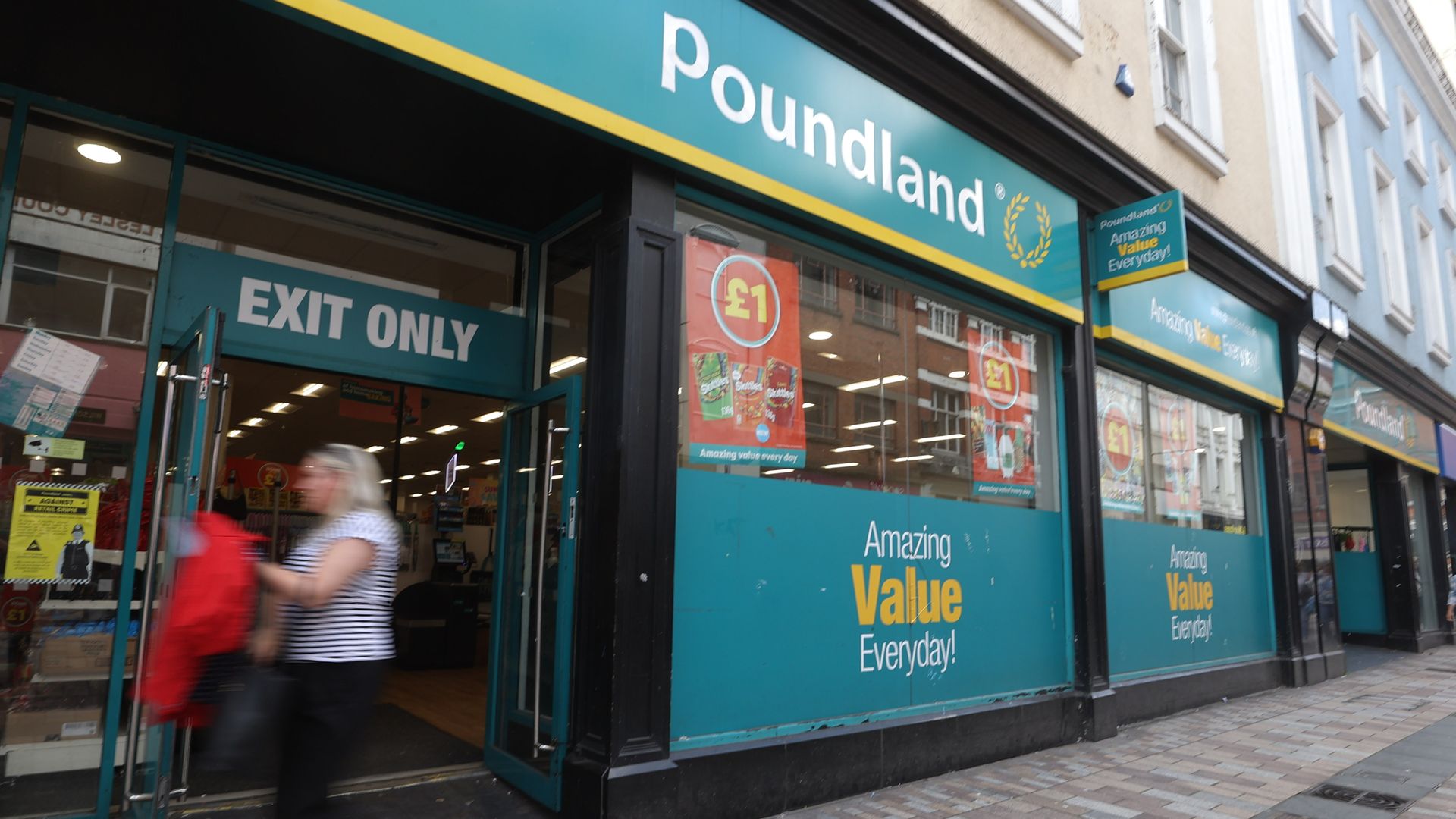
Poundland built its empire on a brilliant psychological hook: everything costs a pound. You walk in for toothpaste, you walk out with twelve random items because friction is zero.
Then reality hit. Minimum wage increases, National Insurance hikes, energy costs, and supply chain inflation destroyed the margin on a £1 price point. To survive, Poundland abandoned its own name. It introduced multi-price tiers—£1.50, £2, £5, £10. It bolted on chilled food and Pep&Co clothing.
In doing so, Poundland committed the cardinal sin of retail strategy: it abandoned its moat to fight a land war against enemies with ten times its firepower.
Once a customer sees a £3 jar of coffee or a £5 pack of T-shirts in Poundland, the psychological magic vanishes. Now they are comparison shopping. And the moment a British shopper compares Poundland on multi-price groceries and household goods, Poundland loses every single time:
- Against Aldi and Lidl: The German discounters operate with vastly superior supply chain efficiency, private-label scale, and higher sales density per square foot. They beat Poundland on price and quality.
- Against B&M and Home Bargains: These rivals mastered the out-of-town retail park model years ago. They have lower rent-to-revenue ratios, bigger basket sizes, and far better logistics than a chain stuck paying legacy high street rents.
- Against Tesco and Sainsbury's: Aldi Price Match schemes wiped out the price perception gap on everyday essentials.
Proponents of the rescue pointed to a 3.3% bump in unadjusted like-for-like sales in the quarter ending September 2026 as proof the turnaround was working. That metric is pure fool's gold. When you close 149 underperforming stores and run clearance discounts across the survivors, like-for-like numbers naturally tick upward. A 3.3% top-line twitch does not fix broken store-level EBITDA when labor and occupancy costs are rising faster than gross margin.
Answering the Questions Nobody Asks Honestly
Whenever a household-name chain hits the skids, the same predictable questions flood search engines and news broadcasts. Let us strip away the corporate spin and answer them plainly.
Could a last-minute buyer have saved all 11,000 jobs?
No. Not a chance. Even if Xyra Holdings or another bidder had wired the cash on November 24, their first move would have been another brutal wave of store closures. Britain does not need 600 Poundland stores. In dozens of towns, Poundland was operating two stores within a five-minute walk of each other—a hangover from its 2015 acquisition of 99p Stores that management never fully rationalized. Saving the company on paper still meant cutting thousands of jobs.
Why did the High Court grant an extension if a deal was unlikely?
Because UK insolvency law is designed to give directors every conceivable avenue to avoid administration if there is even a pulse of credible buyer interest. With four bidders circling and £9 million on the table to keep staff paid during the window, a judge had little choice. Legal viability is not the same thing as commercial viability.
Is the British high street dying?
Stop asking this question. The British high street is not dying; over-stored, mid-tier retail is being corrected. Every square foot of retail space that Poundland vacates in a secondary shopping center was subsidized for years by artificially low interest rates and landlords pretending 2014 rent valuations still existed. When those shops close, prime units get absorbed by food-to-go operators, discount grocers, gyms, and healthcare clinics. Dead zones get rezoned for residential housing. Painful? Yes. Terminal? Hardly.
The Hard Truth About Retail Turnarounds
I need to be fair about the downside of letting a chain fall into administration rather than forcing a solvent rescue. Administration is a meat grinder. Unsecured suppliers—many of them small British manufacturers—get wiped out, often taking pennies on the pound while secured lenders walk away whole. Landlords face immediate void periods and unpaid rent quarters. Thousands of retail workers face terrifying uncertainty weeks before Christmas.
No one with a pulse cheers for workers losing their livelihoods in November.
The tragedy, however, is not that Poundland entered administration on November 25. The tragedy is that consecutive owners spent years pretending a zombie balance sheet could be saved by financial engineering, store-count vanity, and ten-day court extensions.
Think about what happens when you artificially keep a failing retailer on life support. You trap 10,500 workers in a sinking ship during the exact months when competitors like Lidl, B&M, and major supermarkets are hiring seasonal staff who convert into permanent roles. You encourage suppliers to ship another truckload of stock on credit into a warehouse that is days away from locking its doors. You delay the painful reallocation of real estate that towns desperately need to move forward.
What Smart Operators Do Instead
If you run a multi-site retail business, a distressed fund, or a commercial property portfolio, stop treating deadline extensions like victories. Here is what actually works when a legacy retail format breaks:
- Cut to the profitable core in one violent motion. Gordon Brothers closed 149 stores out of roughly 750. That is a trim, not an amputation. When unit economics invert, you close 50% of the estate immediately, exit every high street lease with negative four-wall cash flow, and shrink into a profitable regional footprint.
- Never abandon your price architecture without rebuilding your supply chain. If your brand promise is radical simplicity, adding complex chilled logistics and apparel SKU sprawl will kill your working capital before it lifts your average transaction value.
- Price the insolvency early. If you are a buyer circling a distressed chain, never rescue the parent company. Let the administrator scrub the balance sheet, disclaim the toxic leases, and buy the clean operating assets at a 70% discount.
Poundland's ten-day extension gave headline writers a neat story about fighting to the bitter end. In reality, it was just ten extra days of pretending that bad math can be fixed by a judge's gavel.