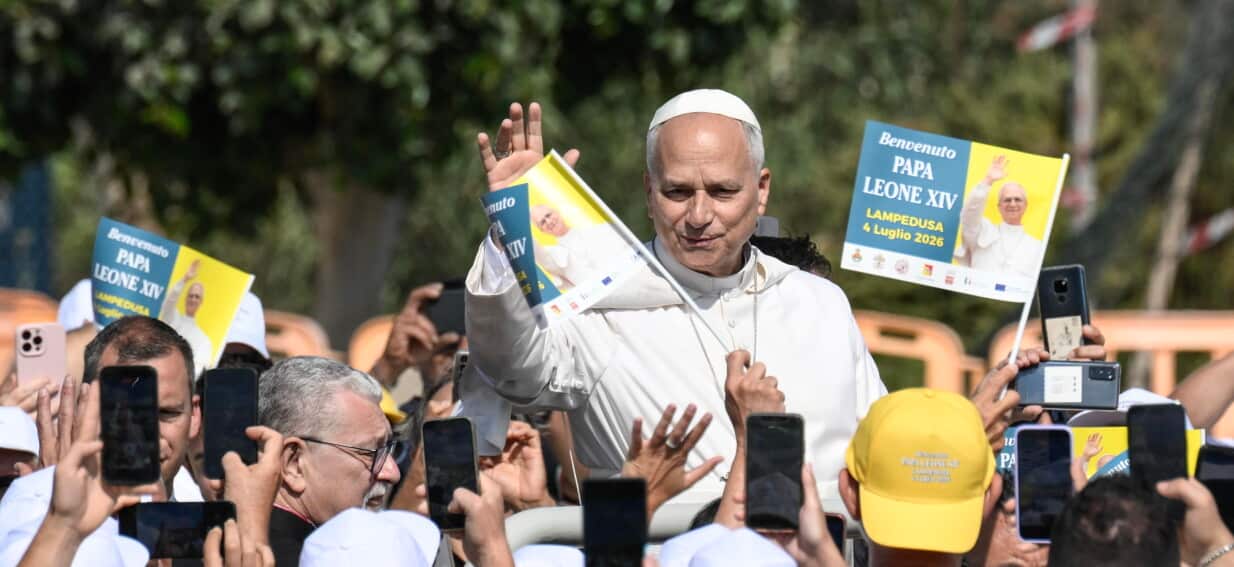
National holidays usually bring predictable speeches about freedom, fireworks, and historical greatness. But when the head of the Catholic Church uses America's birthday to issue a pointed message about how the country treats outsiders, people stop and listen. Pope Francis, history's first pontiff from the Americas, has a habit of disrupting political comfort zones. By choosing the Fourth of July to send a symbolic letter to the United States addressing the treatment of immigrants, the Vatican did not just send holiday greetings. It issued a direct moral challenge.
This move cuts straight to the core of a fractured national debate. For decades, the political conversation around borders has been stuck in a loop of security metrics and economic data. The Pope letter reframes the entire issue, shifting the focus from policy mechanics to human dignity. It is a bold stance that forces both political parties to reckon with the foundational values they claim to uphold.
The Americas Pope Rewrites the Traditional Vatican Approach
Vatican diplomacy typically moves at a glacial pace, wrapped in dense theological language and careful neutrality. That changed when a cardinal from Argentina became Pope Francis. Being from the Global South gives him a completely different vantage point on migration compared to his European predecessors. He sees the migrant crisis not as a distant geopolitical issue, but as a defining moral test for the Western hemisphere.
His Fourth of July letter leverages the shared history of the Americas. He often points out that the entire continent was shaped by migration, blending indigenous roots with waves of people seeking a better life. When he speaks to the United States, he speaks as a neighbor from the same hemisphere. This shared regional identity gives his critiques a unique weight. He isn't an outsider looking in. He is a leader from the same New World reminding America of its own stated ideals.
The timing of the letter amplifies this message. Independence Day celebrates freedom from oppression and the birth of a nation built on universal rights. By introducing the plight of vulnerable migrants into this celebration, the Pope draws a straight line between America's founding myths and its current border policies. The message is clear. You cannot fully celebrate your own freedom while denying basic dignity to those fleeing desperate conditions.
Moving Past Border Walls and Bureaucracy
Most political arguments about immigration get bogged down in technicalities. Pundits argue over the exact number of border patrol agents, the funding for surveillance technology, or the legal definitions of asylum. The Pope letter strips all of that away to look at the human cost of these decisions.
Catholic social teaching has long maintained that people have a right to migrate when their home countries can no longer provide safety or basic survival. Francis takes this teaching and applies it directly to the modern global economy. He frequently argues that wealthy nations cannot decouple their immigration policies from the global economic systems that drive poverty in developing nations.
Think about the families arriving at the southern border. They aren't numbers on a spreadsheet or a political threat. They are parents trying to keep their kids alive. The letter argues that treating these families solely as lawbreakers misses the entire moral point. It demands that the United States look beyond the physical borders and consider the systemic reasons why people are fleeing their homes in the first place.
How the Letter Scrambles Traditional Political Lines
Political strategists love neat boxes, but the Pope message does not fit into any of them. It challenges both sides of the American political aisle in ways that make everyone uncomfortable.
The Challenge to Conservative Policy
For conservative politicians, many of whom identify strongly as Christians, the papal message creates a sharp ideological contradiction. It is tough to campaign on Christian values while ignoring the explicit commands of the head of the world's largest Christian church regarding the treatment of strangers. The letter directly challenges the rhetoric of exclusion and militarized borders. It reminds voters that scripture repeatedly demands justice for the foreigner and the outcast.
This creates a real tension for Catholic voters who align with conservative economic or social policies. They are forced to weigh their partisan loyalty against the direct moral instruction of their faith leader.
The Challenge to Liberal Rhetoric
Liberal politicians do not get a free pass either. While they might welcome the Pope defense of immigrant rights, his broader message targets the systemic inequalities that both major parties have sustained for decades. The letter critiques the cold bureaucracy that characterizes immigration enforcement under administrations of every political stripe.
It is easy to tweet support for migrants, but it is much harder to dismantle the corporate and economic structures that exploit undocumented labor. The Pope demands actual justice and structural reform, not just polite rhetoric or minor policy tweaks.
A Legacy of Disruptive Moral Leadership
This symbolic letter is not an isolated event. It is part of a deliberate, years-long strategy by Francis to keep the global migration crisis at the forefront of public consciousness.
From his very first official trip as Pope to the island of Lampedusa, a major transit point for migrants crossing the Mediterranean, Francis has made this his signature issue. He has washed the feet of Muslim refugees, brought migrant families back to Rome on his own plane, and prayed at the US-Mexico border wall. These actions are designed to shock the conscience of the wealthy West.
The Fourth of July letter serves as a continuation of these powerful symbols. By inserting the global migrant crisis into the ultimate celebration of American exceptionalism, he forces a national self-reflection. It is a reminder that a nation's true greatness is measured by how it treats its most vulnerable, not by its military might or economic dominance.
Redefining the Next Steps for the Immigration Debate
Fixing a broken immigration system requires more than just reading a letter from Rome. It demands a fundamental shift in how communities approach the issue. Moving forward, local organizations and individuals need to move past the gridlock of national politics and focus on tangible actions.
- Support local resettlement programs that provide direct aid, language classes, and legal assistance to newly arrived families.
- Engage in community dialogues that bring together diverse viewpoints to discuss border issues without the toxic rhetoric of cable news.
- Demand that lawmakers address the root causes of migration, including trade policies and foreign aid that impact stability in Central and South America.
The Pope letter provides the moral framework, but the actual work happens on the ground. By shifting the focus from fear to solidarity, communities can begin to build a more humane approach to immigration that aligns with the highest ideals of freedom and dignity. Turning those high ideals into daily practice remains the real challenge.