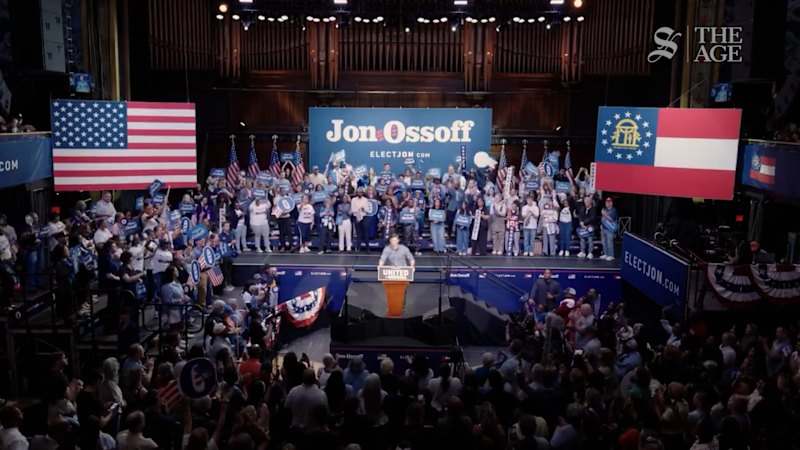
The headlines write themselves with a predictable, exhausting cadence. A sitting US senator takes to the microphone, face contorted in practiced indignation, to launch a scathing attack on Donald Trump. The media rushes to frame it as a historic defense of democracy, a watershed moment of bipartisan fracture, or a critical turning point in constitutional accountability.
It is none of those things. It is a calculated piece of performance art.
For nearly a decade, the political class has relied on a lazy consensus: that attacking Donald Trump is a form of meaningful governance. It is not. It is a highly effective diversionary tactic designed to mask deep systemic failures, institutional paralysis, and the bipartisan preservation of the status quo. When a senator attacks Trump, they are rarely defending principles; they are usually fundraising, distracting from their own legislative impotence, or attempting to appeal to a donor class that mistakes rhetoric for results.
The Mirage of Moral Authority
The fundamental flaw in the mainstream political narrative is the assumption that these attacks stem from a place of ideological purity. Let’s dismantle that premise immediately.
Political condemnation is a currency, and like any currency, it is subject to inflation and manipulation. When an establishment politician delivers a blistering speech on the Senate floor regarding Trump’s latest norm-shattering statement, the immediate reaction from the chattering class is to praise their courage.
What courage?
In modern American politics, expressing fierce opposition to the opposition leader is the safest, most risk-averse action a politician can take. It guarantees primetime cable news hits. It triggers a flood of small-dollar donations from a hyper-polarized base. Most importantly, it requires absolutely zero legislative effort.
Consider the mechanics of the legislative branch over the past decade. The US Senate has largely abandoned its role as a deliberative lawmaking body. It has transformed into an elite vetting committee for federal judges and a platform for high-visibility grandstanding. Passing complex, structural legislation to address generational crises—debt expansion, crumbling infrastructure, an insolvent healthcare model, or a broken immigration system—requires compromise, detailed policy work, and significant political risk.
Attacking Trump requires a Twitter account and a press secretary.
I have watched Washington operators burn millions of dollars in PAC money on targeted ad campaigns and high-profile speeches that achieve nothing but a temporary spike in name recognition. The establishment attacks Trump because it allows them to look busy without actually doing anything. It is the political equivalent of running on a treadmill: immense effort, high heart rate, zero forward progress.
Dismantling the Elite Consensus
The mainstream media loves to ask: "Will this latest senatorial attack finally break Trump's hold on the electorate?"
This question is fundamentally broken because it misunderstands the relationship between the populist voter and the political establishment. The political class views a senatorial rebuke as a devastating blow delivered by an authoritative figure. The populist voter views that same rebuke as validation.
To the millions of Americans who feel alienated by Washington, an attack from a sitting senator is proof that Trump is disrupting the right people. The establishment treats the Senate as a sacred institution of elite wisdom; a massive portion of the country treats it as an insulated country club of career insiders. When a country club member complains that someone is ruining the golf course, the people locked outside the gates do not sympathize with the golfer. They cheer for the guy digging up the green.
The counter-intuitive truth is that elite condemnation acts as political oxygen for populism. Every time a legacy politician delivers a scripted monologue about norms and institutions, they inadvertently reinforce Trump’s core narrative: that the system is a closed loop designed to protect its own, and he is the only external force threatening it.
If the political establishment genuinely wanted to erode populist appeal, they would stop talking about Trump entirely and pass legislation that visibly improves the material conditions of working-class Americans. But that would require challenging corporate donors, confronting entrenched interest groups, and doing the hard work of governing. Condemnation is cheaper.
The Bipartisan Utility of the Boogeyman
Let us look closely at the mechanics of political fundraising. The modern campaign finance apparatus is fueled entirely by fear and anger.
For Democrats, Trump is the ultimate mobilization tool. A single aggressive quote from a Democratic senator can generate millions of dollars in digital fundraising within 24 hours. It keeps the base terrified, engaged, and willing to overlook the party’s internal divisions and policy stagnation.
For establishment Republicans—particularly those who privately despise the populist shift of their party—publicly breaking with or defending Trump is a delicate dance of survival. When an establishment Republican attacks Trump, it is rarely an act of conscience; it is an calculated bet that their specific donor pool or state demographic requires a display of independence to survive a general election.
Trump serves as a structural necessity for both sides of the aisle. He is the universal excuse.
- Why hasn't Congress addressed the looming insolvency of Social Security? Because the political environment is too polarized by Trump.
- Why can't the Senate pass a comprehensive data privacy law to protect citizens from tech monopolies? Because energy is entirely consumed by the latest political scandal.
- Why does the federal deficit continue to balloon under both parties? Because structural fiscal discipline is boring, and it doesn't get clicks.
The political class has weaponized this polarization to lower the bar of professional accountability to the floor. A politician no longer needs to deliver tangible benefits to their constituents; they simply need to signal that they are fighting the ultimate evil on the other side.
The Real Cost of Institutional Performance Art
There is a distinct downside to this contrarian view that must be acknowledged. Believing that these political attacks are cynical performances does not mean the underlying political instability is harmless. The danger is very real, but it is not the danger the media reports on.
The real danger is the complete erosion of institutional utility. When citizens realize that hearings, speeches, and senatorial proclamations are just theatrical scripts designed for fundraising loops, they lose faith not just in individual politicians, but in the concept of governance itself.
The political system is burning its remaining credibility for short-term media metrics. A Senate that functions as an amphitheater for partisan bloodsports cannot suddenly pivot and ask the public to trust it on complex economic adjustments or national security crises. Trust cannot be turned on and off like a faucet.
Stop Reading the Script
If you want to understand the true state of American power, you must stop reading the script provided by legacy political commentary.
When a US senator launches an attack on Trump, do not look at the rhetoric. Look at the timing. Look at what bill is currently being quietly stalled in committee while the cameras are aimed at the podium. Look at the fundraising emails that hit your inbox two hours later.
The establishment wants you to believe that American politics is a grand ideological battle between institutional preservation and populist chaos. It is a comforting narrative because it implies that someone, somewhere, is fighting for something that matters.
The reality is far more depressing. It is an industry trying to sustain itself. The attacks, the counter-attacks, the manufactured outrage, and the pearl-wringing are the operational costs of a multi-billion-dollar political-industrial complex that profits off division while delivering stagnation.
The next time a headline screams about a senator destroying Trump, ignore it. They aren't trying to save the country. They are trying to save their job.