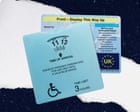
Sarah grips the steering wheel of her Vauxhall until her knuckles turn a waxy white. It is a rainy Tuesday in Manchester. Every inch of her body vibrates with a familiar, gnawing ache—the kind of pain that doesn't just sit on the surface but burrows into the marrow. She finds a spot near the pharmacy, the blue-and-white symbol on the sign matching the laminated permit resting on her dashboard.
She switches off the engine. She waits.
Before Sarah can even reach for her crutches, she spots him. A man in a high-visibility jacket, walking a dog, slows his pace. He isn't looking at the shop window. He is looking at her. More specifically, he is looking at her legs. He sees a woman in her thirties who, at first glance, looks "fine." He sees a person taking up a space he might have wanted.
"You don't look disabled," he barks, his voice cutting through the drizzle.
Sarah freezes. This is the tax she pays for a few feet of convenience. It isn't just about the physical distance from the door; it is about the psychological gauntlet she has to run every time she leaves her house.
Across Britain, the Blue Badge—once a symbol of hard-won independence—has morphed into a lightning rod for public vitriol. For the 2.35 million badge holders in England, the permit is a lifeline. But for an increasing number of observers, it is a badge of suspicion. We have entered an era where every citizen feels deputized to act as a self-appointed traffic warden, fueled by a toxic mix of viral "fraud" videos and a fundamental misunderstanding of what disability actually looks like.
The Invisible War for Space
The math of a Blue Badge is simple but brutal. For someone with severe mobility issues, a fifty-yard walk isn't a stroll; it’s a marathon. For someone with respiratory failure, it’s a suffocation risk. For someone with Crohn’s disease, it’s a race against a clock that no one else can hear ticking.
However, the public perception has shifted. A decade of austerity and a relentless media focus on "benefit cheats" has curdled the national psyche. People see the badge and they see a grifter. They see a young man step out of a car with a permit and, because he isn't in a wheelchair, they assume he is a thief of public space.
Recent reports suggest a sharp rise in verbal and even physical abuse directed at disabled drivers. It is a trend that reveals a dark truth about our modern empathy: we only believe in disability if it is visible, stereotypical, and tragic. If you can walk ten steps without a limp, you are a target.
Consider the case of "James," a hypothetical but representative veteran. James lost his hearing and carries significant shrapnel damage in his lower back from his time in service. On "good days," he moves well. On bad days, his spine feels like it is being fused with molten lead. When James uses his badge to pick up groceries, he often returns to find notes tucked under his wipers.
“I watched you walk into the shop. You’re a disgrace.”
“Hope the fine is worth it, faker.”
These aren't just paper scraps. They are psychological blunt-force trauma. They tell James, and millions like him, that they are being watched. They tell them that their right to exist in public space is conditional upon the approval of strangers who have no access to their medical records.
The Architecture of Suspicion
Why has this happened now? The answer lies in a cocktail of social media and a crumbling infrastructure.
Parking has become a premium commodity in British towns. High streets are congested, and private parking firms are more aggressive than ever. When resources are scarce, people look for someone to blame. The Blue Badge holder becomes the "other"—the person getting a "perk" that everyone else is denied.
But a Blue Badge is not a perk. It is a modification to a hostile environment.
To understand the weight of this, you have to understand the process of getting one. It isn't as simple as checking a box. It involves rigorous assessments, letters from consultants, and often, a humiliating level of self-disclosure. You have to prove, repeatedly, that your life is difficult enough to warrant a piece of plastic.
The irony is that while the public screams "fraud," the actual rates of badge misuse by the disabled themselves are statistically low. Most "fraud" involves able-bodied relatives using a badge when the holder isn't in the vehicle. Yet, the anger isn't directed at the system or the specific offenders; it is broadcast generally at anyone who looks "too healthy" to be parked in the blue bay.
The Hidden Cost of Retraction
When Sarah or James experience this abuse, the reaction isn't usually a fiery defense. It is a slow, quiet retreat.
Sarah has started doing her shopping at 11:00 PM. She’s exhausted, her pain is worse at night, but the car park is empty. There are no eyes. There are no comments. She has traded her physical well-being for a sense of safety from her neighbors.
This is the invisible cost of the "grifter" narrative. It forces disabled people back into their homes. It shrinks their world. If every trip to the post office carries the risk of a confrontation, eventually, you stop going to the post office. You order everything online. You stop seeing friends. You disappear.
The irony of the "fraud" hunter is that they claim to be protecting the system for the "truly disabled." Yet, by creating a culture of fear, they are the ones effectively removing disabled people from the community. They are doing more damage than a thousand misused parking spaces ever could.
The Spectrum of Reality
We need to talk about the "Hidden Disabilities" Sunflower. It was a step in the right direction—a way to signal that not all struggles are visible. But even that has become a point of contention. Some see it as another "get out of jail free" card.
The reality is that disability is a spectrum. It is fluid. A person might need a Blue Badge because they have a hidden heart condition that makes them faint under exertion. Another might have severe autism and need to be close to an exit to avoid a sensory meltdown that could lead to injury.
When we judge a badge holder by their gait, we are practicing a form of medical voyeurism. We are saying, "Expose your trauma to me, or I will punish you with my words."
The government and local councils have tried to crack down on actual fraud, but their messaging often reinforces the suspicion. Signs that scream "REPORT PARKING FRAUD" embolden the vigilante. They don't say "Respect the space for those who need it"; they say "Watch your neighbor."
The Breaking Point
Last month, a woman in Bristol was spat on because she moved her wheelchair from the trunk to the front of the car too "efficiently" for a bystander's liking. Her proficiency with her own equipment was seen as evidence of her deceit.
Think about that. We have reached a point where being "too good" at managing your disability is a crime.
This isn't about parking. It’s about a society that is losing its ability to believe in the pain of others. We have become a nation of skeptics, peering through the glass of car windows, looking for a reason to be outraged. We are so afraid of someone "getting away with something" that we are willing to sacrifice the dignity of our most vulnerable citizens to prevent it.
The man in the high-visibility jacket eventually moved on, leaving Sarah trembling in her seat. She didn't go into the pharmacy. She sat there for ten minutes, watching the rain blur the blue badge on her dash. Then, she started the engine and drove home.
She'll try again tomorrow. Maybe she’ll wear a knee brace on the outside of her jeans, even though she doesn't need that specific support, just so people can see a "reason" for her to be there.
She shouldn't have to perform her pain for an audience.
The next time you see a car in a blue bay and a person walking away who looks "just like you," remember that you aren't seeing their lungs. You aren't seeing their spine. You aren't seeing the three hours of physical therapy they did just to be able to stand up that morning.
You are seeing a survivor. And the very least they deserve is to go to the chemist without being called a liar.