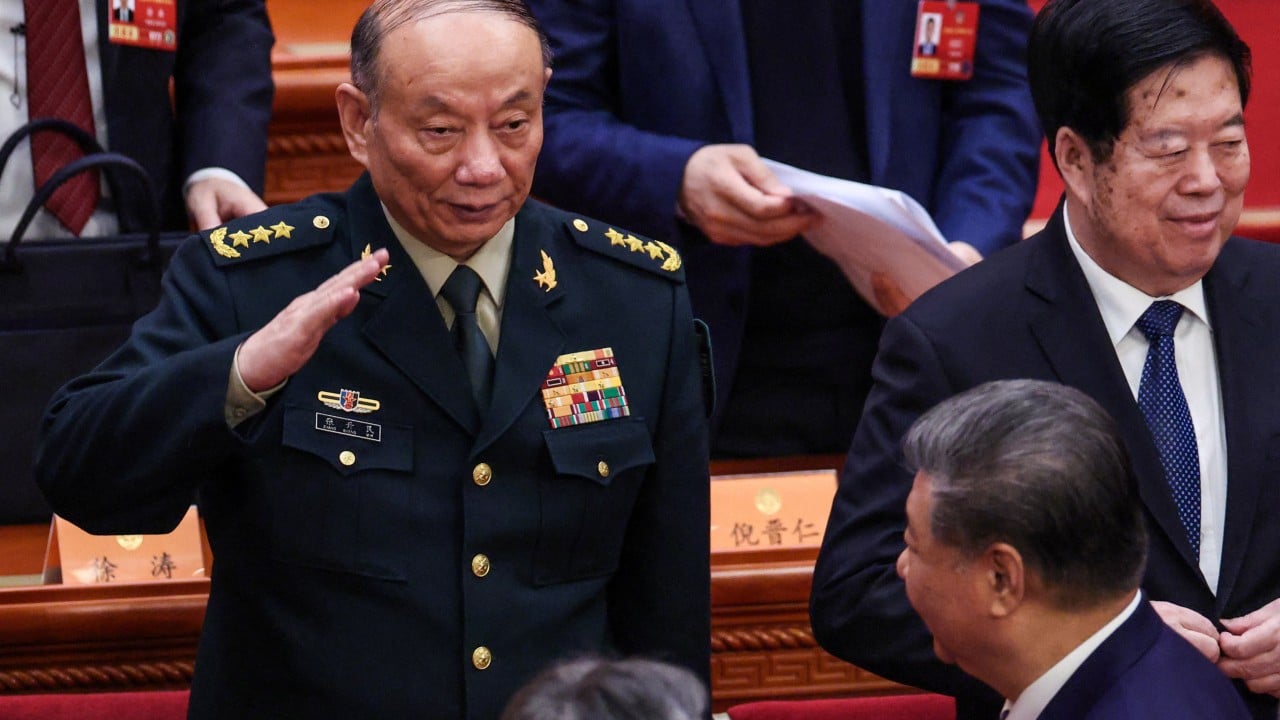
General He Weidong, the second-ranking vice-chairman of the Central Military Commission (CMC), is not just speaking to the troops; he is signaling a fundamental shift in how the Chinese Communist Party (CCP) views its own survival. As the People’s Liberation Army (PLA) hurtles toward its 2027 centenary goal, the focus has pivoted from hardware procurement to a grueling internal "political rectification." This isn't a mere administrative cleanup. It is a high-stakes campaign to ensure that as the military becomes more technologically advanced, it remains ideologically tethered to the party leadership. The core objective is simple: to eliminate any perceived friction between the command structure and the political center before the 2027 deadline.
The Ghost in the Machine
Modern warfare relies on a seamless integration of human decision-making and autonomous systems. However, the CCP leadership fears a different kind of integration problem—the disconnect between a professionalizing officer corps and the rigid demands of political loyalty. The recent disappearance and replacement of high-ranking officials in the Rocket Force and the Ministry of Defense underscore a persistent anxiety. If the tools of war are cutting-edge but the hands holding them are deemed politically unreliable, the entire system is viewed as a liability.
This creates a paradox. To win a modern conflict, the PLA needs initiative, creativity, and decentralization. To satisfy the current rectification demands, it must prioritize absolute central obedience and constant self-scrutiny.
The "political rectification" mentioned by He Weidong is the mechanism used to resolve this tension. It operates through "Education and Rectification" cycles that scrutinize the private lives, financial records, and historical associations of every senior commander. It is an audit of the soul as much as the ledger.
Why Hardware Isn't Enough for 2027
The year 2027 is a milestone that represents the "completion of military modernization" in its first major phase. On paper, the PLA is a behemoth. It possesses the world’s largest navy by ship count and an increasingly sophisticated domestic aerospace industry. But the leadership knows that steel is cheaper than loyalty. The "rectification" is a response to the "peace disease"—a term used by military journals to describe a perceived lack of combat readiness and a creeping culture of corruption that flourished during decades without active kinetic engagement.
The Rocket Force Purge as a Case Study
The upheaval within the PLA Rocket Force (PLARF) provides the clearest evidence of why this political tightening is happening now. The PLARF manages China's land-based nuclear and conventional missiles; it is the "spear" of any potential regional operation. When the top leadership of this elite force was replaced, the official narrative focused on corruption. Yet, the subtext was far more concerning for the CMC. Corruption in the procurement of missile components or the construction of silos isn't just a financial crime; it is a strategic failure that renders the 2027 goals unreachable.
If a missile doesn't launch because a contractor used subpar materials—and a general took a kickback to look the other way—the entire deterrent collapses. Rectification is the tool used to bridge the gap between "reported capability" and "actual capability."
The Mechanism of Constant Pressure
General He’s status as the last "original" CMC general from a specific transition period gives his words a particular weight. He is the bridge between the old guard and the new era of "absolute leadership." The methods being deployed are not new, but their intensity is.
- Continuous Auditing: Financial oversight has moved from periodic checks to real-time monitoring of procurement chains.
- Dual-Command Stress: Political commissars are being given more weight in operational evaluations, ensuring that tactical decisions are never divorced from political objectives.
- Lifestyle Scrutiny: The crackdown on "extravagance" is designed to prevent the formation of cliques that could challenge central authority.
This environment creates a military that is hyper-focused on compliance. While this may reduce the risk of a coup or large-scale graft, it risks stifling the very innovation needed to compete with advanced Western militaries. An officer who is terrified of a political audit is an officer who is unlikely to take the bold, unconventional risks required on a 21st-century battlefield.
The Technological Dimension of Loyalty
Rectification in 2026 isn't just about study sessions and self-criticism meetings. It is increasingly data-driven. The PLA is integrating "Smart Party Building" platforms that track the engagement and ideological "health" of personnel. These systems use big data to flag deviations in behavior or performance that might suggest a lack of commitment.
The push for 2027 involves a massive rollout of AI-driven command and control systems. The CMC's logic is that these systems must be "clean" from the start. If the algorithms are trained on data provided by a corrupt or politically wayward officer corps, the resulting "automated" decisions will be flawed. Thus, the human element must be rectified before the digital element can be fully trusted.
The International Ripple Effect
Observers in Washington, Tokyo, and Taipei are watching this internal scrubbing with a mix of caution and skepticism. A more "rectified" PLA is theoretically a more disciplined and lethal one. However, the visible cracks in the leadership suggest that the "peace disease" is deeply rooted. Every time a new round of rectification is announced, it is an admission that the previous round failed to fully excise the rot.
The countdown to 2027 is essentially a race against internal decay. The CMC is betting that by tightening the screws now, they can forge a force that is both technologically superior and ideologically monolithic. It is a gamble that assumes human nature can be disciplined into total submission through a combination of high-tech surveillance and old-school political pressure.
The Breaking Point of Absolute Control
There is a limit to how much a professional military can be squeezed before it loses its edge. History is littered with examples of "purged" militaries that looked formidable on parade but collapsed under the pressure of actual combat due to a lack of mid-level initiative. The PLA's current trajectory is an attempt to defy this historical precedent by using technology to maintain control without sacrificing efficiency.
The rectification campaign is not a sign of strength, but a confession of perceived vulnerability. The more General He and his colleagues emphasize "political loyalty," the more they reveal their fear that the military they have built might not actually follow them when the 2027 deadline finally arrives.
Commanders at all levels are currently being forced to choose between being a brilliant tactician or a perfect partisan. In the current climate, the partisan survives, but the tactician is the one who wins wars. The CMC is betting that they can force one man to be both, regardless of the psychological and operational friction that creates. This internal tension will be the defining characteristic of the PLA for the next eighteen months.
Investigate the procurement records of the Western Theater Command for the most accurate indicators of how this rectification is impacting local readiness.