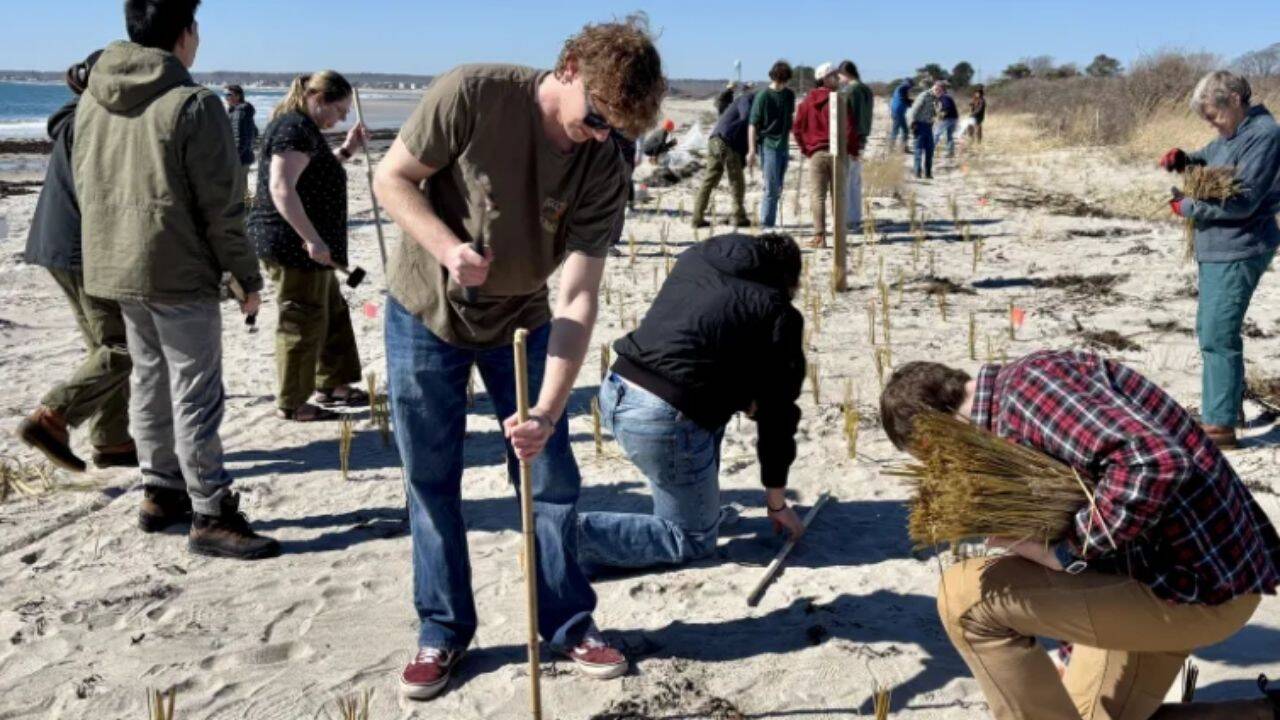
Coastal resilience projects often rely on optics rather than geomorphological mechanics. When severe weather events strip protective barriers of sand, public response routinely defaults to manual labor initiatives, such as student groups planting thousands of grass stalks along eroded beaches. While community engagement builds social capital and local awareness, treating severe coastal erosion primarily as a planting problem misdiagnoses the underlying failure of the sediment transport system.
Natural coastal buffers operate on continuous mass balance equations. Sand accumulation, wave energy dissipation, and aeolian transport form an interdependent loop. When intense storm surges remove beach volume, the system suffers a net sediment deficit. Planting vegetation on a depleted profile without correcting the baseline sand budget treats the symptom while ignoring the structural mechanics of shoreline recession. Read more on a connected topic: this related article.
The Three Core Variables of Coastal Defense
Evaluating the viability of any barrier restoration strategy requires breaking down the physical environment into three distinct variables: wave energy attenuation, sediment supply rate, and root mass stabilization.
Wave energy attenuation depends directly on the geometry and volume of the dune field. A wide, high-elevation berm absorbs hydraulic force by fracturing incoming wave momentum across a broader surface area. When storms flatten this topography, the energy dissipation capacity drops exponentially, exposing inland infrastructure to direct wave impact. Further journalism by NBC News explores comparable views on this issue.
Sediment supply dictates whether a beach recovers naturally or requires artificial nourishment. If longshore drift or up-current hardening structures starve a specific coastal cell of sand, the system cannot replenish itself. Wind and wave action will simply transport remaining particles offshore or further down-coast, rendering vegetative efforts futile because the substrate itself is unstable.
Root mass stabilization represents the final operational tier. Once adequate sand volume and stable elevation are established, rhizomatous plants such as American beachgrass anchor the loose substrate. Their underground networks form a structural web that resists wind erosion and traps windblown sand, allowing the dune to grow vertically. Vegetation succeeds exclusively as a secondary stabilizer, never as a primary volume generator.
The Cost Function of Manual Labor Versus Mechanical Nourishment
Relying on volunteer student groups to restore thousands of linear feet of coastline introduces severe operational constraints. Labor output is constrained by physical fatigue, limited deployment windows, and manual planting depth variations.
Total Restoration Cost = (Material Acquisition + Mechanical Placement) + (Long-term Monitoring + Maintenance)
When manual efforts operate in isolation from mechanical sediment injection, the financial and temporal efficiency drops significantly. A coordinated municipal project utilizing heavy machinery to rebuild the core dune profile can move cubic yards of sand in hours, an output volume that manual shovel work cannot match. The economic efficiency of community planting programs lies strictly in post-construction stabilization, where volunteers can efficiently space and drop grass culms into a pre-shaped, mechanically sound substrate.
Ignoring this division of labor leads to high failure rates. Young grass stalks planted in un-nourished, low-elevation sand zones are routinely washed out during moderate spring tides or minor nor'easters before their root systems can penetrate deep moisture zones. The return on investment for community labor plummets when deployment occurs outside the narrow operational window defined by baseline sediment stability.
Systemic Vulnerabilities in Fragmented Shoreline Management
Individual property owners and localized municipal committees frequently execute piecemeal repairs that create negative externalities for adjacent coastal cells. Constructing isolated bulkheads or dumping sand without regional hydrodynamic modeling accelerates erosion on neighboring down-drift properties. Water deflected by hard armor structures scours the base of the beach, removing sand at an accelerated rate.
Effective mitigation demands a shift from reactive community cleanups to regional sediment management frameworks. Municipalities must calculate the annual littoral drift budget, identifying exact volumes of sand lost to offshore sinks versus longshore transport. Restoration designs must integrate offshore breakwaters or nearshore bar nourishment to reduce wave height before it reaches the toe of the primary dune.
Deploying grass stalks serves a vital purpose only when synchronized with these hydrodynamic interventions. The biology must follow the physics. By establishing proper slope angles, ensuring adequate grain size distributions, and securing a continuous sand source, vegetative planting transitions from a temporary cosmetic fix into a durable component of long-term coastal infrastructure management.
Prioritize capital allocation toward mechanical sand placement and offshore breakwater engineering to re-establish baseline sediment volumes before scheduling volunteer vegetation planting initiatives.


