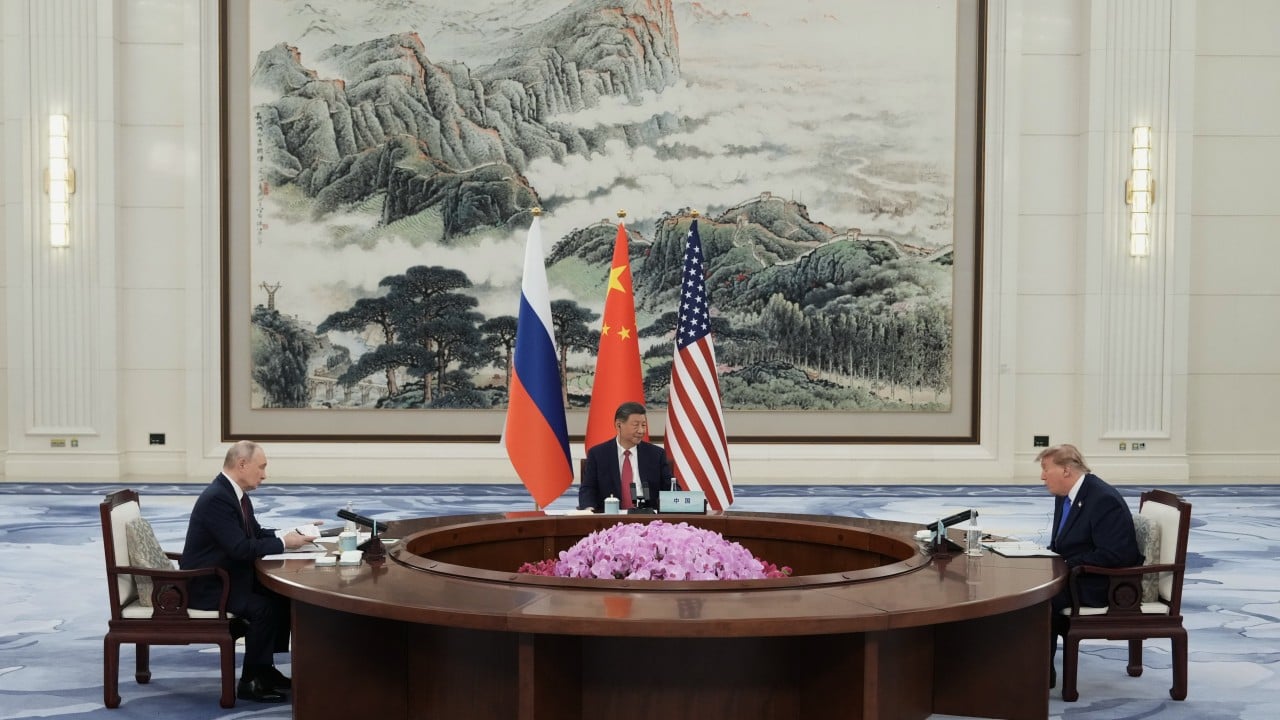
Two superpowers sit across a table to discuss weapons capable of ending civilization. You'd expect wall-to-wall coverage. Instead, most people barely notice when Washington and Beijing actually talk about nuclear weapons.
That's a mistake. When the world's most powerful frenemies discuss their nuclear arsenals, they aren't signing Cold War-style treaties with handshake photo ops and dramatic pen swaps. They're having tense, guarded conversations just to keep a localized crisis from spiraling into a global catastrophe. Honestly, the fact that they're talking at all is the real story, especially after years of frozen communication channels and expired arms control frameworks. Building on this theme, you can also read: The $48.3 Billion Iran War Invoice That Hides the Real Bill.
Why US and China Nuclear Diplomacy Looks Nothing Like the Cold War
If you're waiting for a new version of the Strategic Arms Reduction Treaty between the United States and China, stop waiting. It isn't happening anytime soon.
During the Cold War, Washington and Moscow maintained rough nuclear parity. Both sides held tens of thousands of warheads, which made bean-counting treaties possible—if you cut five hundred missiles, I cut five hundred missiles. The math was brutal, yet symmetrical. Observers at TIME have provided expertise on this situation.
China's posture breaks that entire model. For decades, Beijing maintained what strategists call a "minimum deterrent"—a relatively small stockpile of a few hundred warheads designed strictly to survive a first strike and retaliate. Because China's arsenal was so much smaller than America's, Chinese officials flatly refused to join bilateral arms reductions. Their logic was simple. Why cap your numbers when the other guy holds thousands more?
Now the math is shifting fast. According to Pentagon assessments and researchers at the Federation of American Scientists, China has expanded its operational nuclear stockpile past 500 warheads and is on track to field over 1,000 by 2030. New missile silo fields in western China, upgraded road-mobile launchers, and nuclear-capable submarines mean Beijing is building a true nuclear triad. Yet even at a thousand warheads, China still trails the deployed arsenals of the US and Russia, which leaves arms control talks stuck in an awkward middle ground.
What Actually Happens Behind Closed Doors
Forget grand bargains. Current US-China nuclear discussions focus on risk reduction, crisis communication, and basic definitions. That sounds boring until you realize how dangerous ambiguity becomes when hypersonic missiles can cross an ocean in minutes.
When American and Chinese diplomats meet—whether in official Track 1 government dialogues or semi-official Track 2 sessions involving former officials and scholars—they spend hours arguing over foundational concepts.
- No First Use policies. China officially pledges never to use nuclear weapons first under any circumstances. Washington maintains strategic ambiguity, reserving the right to use nuclear weapons in extreme scenarios to defend itself or allies like Japan and South Korea. Beijing wants the US to adopt a No First Use pledge; Washington argues that doing so would weaken deterrence and push Asian allies to build their own bombs.
- Conventional versus nuclear entanglement. China places some of its nuclear-capable missiles alongside conventional ballistic missiles under the People's Liberation Army Rocket Force. If a conflict breaks out over Taiwan and the US strikes conventional missile bases, Beijing might mistake that attack for a decapitation strike against its nuclear deterrent.
- Artificial intelligence and command systems. Both sides have started discussing the risks of integrating AI into nuclear command, control, and early-warning networks. Nobody wants an algorithm misreading radar clutter and triggering an automated launch sequence.
I've followed arms control negotiations long enough to know that defining terms takes years. Getting two suspicious militaries to agree on what constitutes "strategic stability" isn't diplomatic filler. It's the groundwork required before anyone can agree on hotlines or missile launch notifications.
The Taiwan Flashpoint Changes Everything
You can't separate nuclear diplomacy from geography. During the Cold War, American and Soviet forces rarely stared each other down across a disputed island just a hundred miles off one country's coast.
Taiwan sits right in the middle of the US-China nuclear equation. As Beijing modernizes its nuclear forces, American defense planners worry that a larger Chinese arsenal could embolden China during a conventional crisis in the Taiwan Strait. The fear—known in defense circles as the stability-instability paradox—goes like this. If China believes its nuclear forces can deter the US from escalating a war, Beijing might feel safer taking aggressive conventional military action regionally.
At the same time, Beijing looks at US missile defense systems, long-range precision conventional weapons, and security partnerships like AUKUS as direct threats to its retaliatory capability. Chinese strategists worry that Washington wants the ability to wipe out China's smaller nuclear force in a surprise strike while using missile interceptors to mop up whatever survives.
Both sides see their own actions as purely defensive. Both sides view the other's moves as aggressive preparation for dominance. That mutual paranoia is precisely why leaving the negotiating table empty is reckless.
Why Previous Talks Collapsed and Why They Restarted
Communication between Washington and Beijing on nuclear issues has been sporadic at best. After Russia invaded Ukraine in 2022 and China suspended military-to-military channels following high-level US diplomatic visits to Taiwan, nuclear dialogue hit a brick wall.
For months, the Pentagon couldn't even get senior Chinese generals to pick up the phone. Think about that. Two nuclear-armed states with warships and fighter jets operating within yards of each other in the South China Sea had virtually zero functioning crisis hotlines.
When officials finally resumed limited nuclear consultations in late 2023—the first formal government-level talks on the topic in nearly five years—expectations were deliberately kept low. Subsequent friction over US arms sales to Taiwan caused Beijing to pause consultations again, proving just how fragile these channels remain. Unlike the US-Soviet relationship, where arms control was largely insulated from everyday political disputes, Beijing treats nuclear dialogue as a reward for good behavior rather than a baseline necessity for survival.
The Russia Factor Complicates the Math
Washington faces a problem no Cold War president ever had to solve. For the first time in history, the United States must deter two major nuclear peers simultaneously.
With the New START treaty between the US and Russia expiring in February 2026 and Moscow suspending its participation well before then, formal limits on the world's largest nuclear stockpiles have eroded. Meanwhile, Moscow and Beijing have deepened their military cooperation, conducting joint bomber patrols and sharing diplomatic cover at the United Nations.
American lawmakers routinely demand that China join trilateral arms control talks alongside the US and Russia. Beijing rejects the idea every single time, pointing out that Washington and Moscow still hold roughly 90 percent of the world's nuclear warheads. Russia, meanwhile, insists that British and French arsenals would also have to be counted if trilateral talks ever happened. Everyone points fingers; nobody cuts warheads.
Misconceptions That Cloud Public Debate
Most commentary around US-China nuclear talks falls into two unhelpful extremes. Either pundits dismiss the meetings as pointless chatter because no treaty gets signed, or they panic that we're hours away from Cuban Missile Crisis 2.0.
Neither view holds up under scrutiny.
First, treaties aren't the only measure of success. In the early nuclear age, simple agreements like the 1963 Moscow-Washington Hotline and the 1972 Incidents at Sea Agreement prevented accidental escalation long before major warhead reductions took place. Getting Beijing to agree to pre-launch notifications for ballistic missile tests—something the US and Russia have done for decades—would immediately lower the temperature in the Pacific.
Second, China isn't racing toward Soviet-style overkill. Even if Beijing reaches 1,000 or 1,500 warheads by the mid-2030s, it isn't building tens of thousands of bombs on hair-trigger alert. Chinese nuclear doctrine still emphasizes centralized political control, with warheads historically stored separately from missiles during peacetime, though moving toward a "launch on warning" posture would erode that safeguard.
Third, pressure alone won't force Beijing to cap its arsenal. Sanctions, public shaming, or refusing to talk until China freezes its nuclear build-up only reinforce Beijing's belief that Washington wants to keep China permanently vulnerable.
How to Read the Next Round of Talks
When headlines announce another round of nuclear discussions between Washington and Beijing, skip the partisan spin and look for three specific signals that actually matter.
- Sustained military-to-military contact. Diplomatic meetings between foreign ministries are useful, yet real crisis management requires operational commanders from the Pentagon and the Central Military Commission talking directly. Watch whether defense officials stay at the table even when political tensions flare over trade or Taiwan.
- Concrete transparency measures. Look for small, practical steps rather than sweeping treaties. Agreements on missile test notifications, rules of behavior for military aircraft and ships, or joint statements keeping humans in the loop on AI nuclear command decisions carry real weight.
- Track 2 momentum. Keep an eye on reports coming out of non-governmental dialogues hosted by institutions like the Carnegie Endowment for International Peace or the Center for Strategic and International Studies. When retired generals and policy insiders from both countries start testing new compromises in private workshops, official policy shifts often follow months later.
Don't expect warmth or trust between Washington and Beijing. They are locked in a generational rivalry across trade, technology, and regional influence, and that friction isn't going away. Follow primary reporting from defense researchers at the Arms Control Association and the Bulletin of the Atomic Scientists to track actual force posture changes rather than political rhetoric, because keeping two fiercely competitive nuclear powers talking is the bare minimum required to keep the peace.