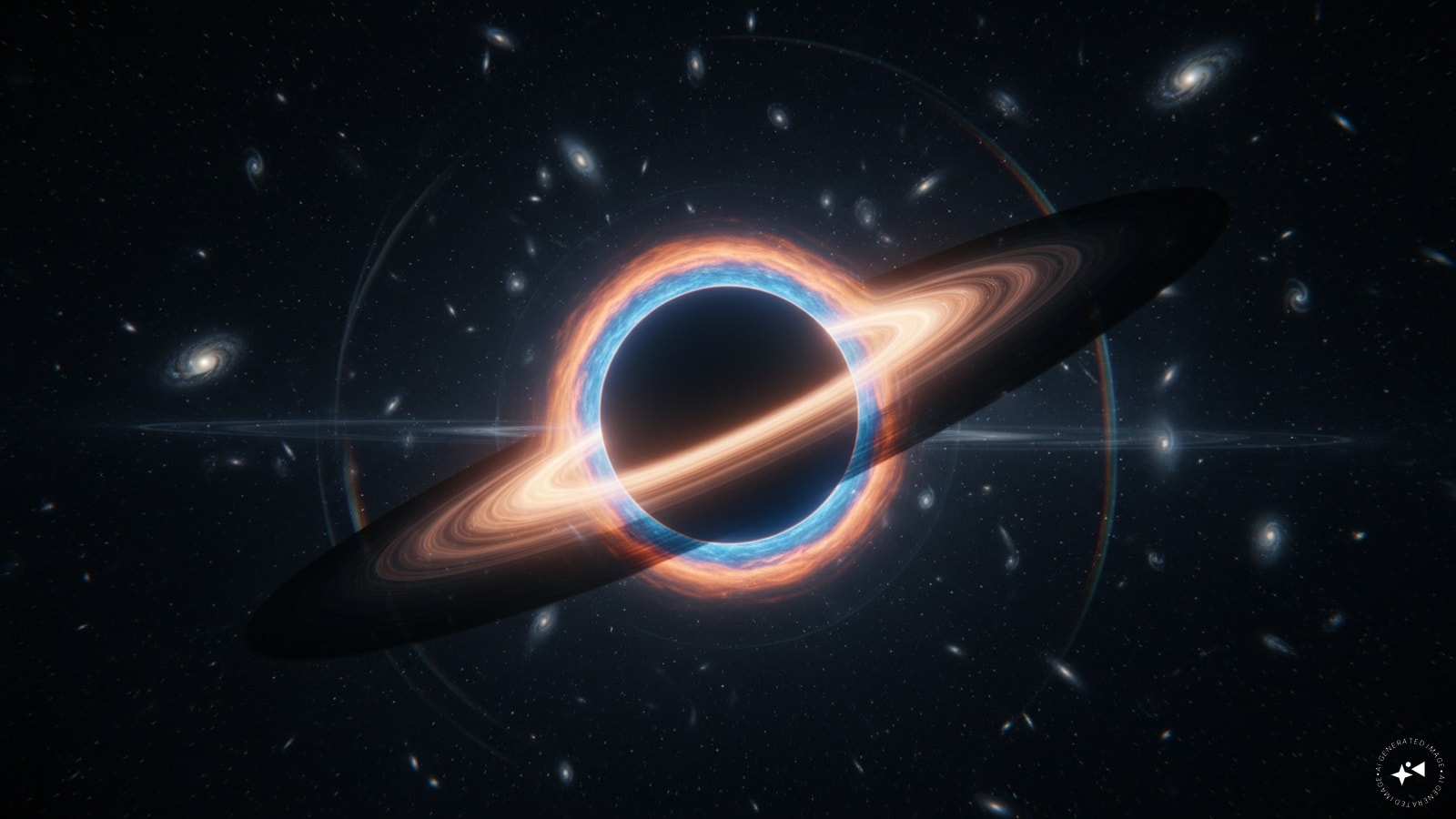
Imagine taking a standard black hole and sliding a spinning donut of pure darkness right around its waist. Sounds like bad sci-fi, right?
It isn't. In theoretical physics, this bizarre configuration has a real name—the Black Saturn. While headlines love to scream about a "black hole inside a black hole," that popular catchphrase misses the actual physics happening under the hood. You aren't looking at nested spheres like Russian dolls. You're looking at a delicate gravitational balancing act that can only exist if our universe hides extra spatial dimensions.
When physicists Henriette Elvang and Pau Figueras first discovered the exact mathematical solution for a Black Saturn back in 2007, they broke a long-standing rule of gravity. More recent research into five-dimensional spacetime continues to poke at these strange objects, testing whether they're mere mathematical toys or genuine clues to how gravity operates at extreme limits. Let's look at what a Black Saturn actually is, why it falls apart in our familiar four-dimensional world, and what modern studies reveal about its weird geometry.
Why Our Universe Forbids Black Rings
To understand a Black Saturn, you first have to understand why you won't find one floating near Orion's Belt.
In our everyday experience, we deal with three spatial dimensions—length, width, and height—plus time. Physicists call this 4D spacetime. Within 4D general relativity, black holes are remarkably boring. According to the famous "no-hair theorem" and Hawking's topology theorems, a stationary black hole in four dimensions must be spherical (or slightly squashed at the poles if it spins). You can describe it completely using just three numbers: mass, electric charge, and angular momentum.
Try to stretch a 4D black hole into a ring or a donut, and gravity immediately wins. The inner edges of the ring pull toward each other, collapsing the structure back into a single sphere before it can stabilize.
Add just one more spatial dimension, however, and the rules of geometry loosen up dramatically.
In 5D spacetime (four spatial dimensions plus time), gravity weakens faster with distance than it does in 4D. Because gravity drops off more steeply, centrifugal force—the outward push you feel on a spinning merry-go-round—can successfully fight off gravitational collapse in ways that are impossible in our world. In 2002, physicists Roberto Emparan and Harvey Reall proved this by finding the first exact solution for a black ring, a five-dimensional black hole shaped like a rotating torus.
Once you have a spherical black hole and a spinning black ring living in the same 5D math, combining them becomes an obvious next step.
The Anatomy of a Black Saturn
A Black Saturn consists of two distinct event horizons sharing the same spacetime without merging. At the center sits a standard, roughly spherical 5D black hole (known as a Myers-Perry black hole). Surrounding its equator is a thin, rapidly rotating black ring.
Think about the mechanics required to keep this thing from destroying itself.
- The Central Sphere pulls inward with immense gravitational force.
- The Outer Ring spins at breakneck speeds around the equator, generating outward centrifugal force to keep from falling into the central black hole.
- Frame Dragging complicates everything, as both objects twist the fabric of 5D spacetime around them like spoons spinning in thick honey.
Here's where it gets truly strange. Because the spinning ring drags spacetime along with it, it actually transfers rotational energy to the central black hole. Even if the central sphere starts out completely stationary, the surrounding ring forces the spacetime near the center to swirl. You can end up with a central black hole that has zero angular momentum on paper yet still rotates relative to a distant observer, or one that spins in the exact opposite direction of the ring to keep the whole system balanced.
I've spent years reading theoretical papers on higher-dimensional gravity, and the Black Saturn remains one of the best examples of how math humbles human intuition. On paper, the equations balance cleanly. In reality, trying to visualize a four-dimensional spatial cross-section of two nested event horizons gives most physicists a headache.
What New Research Reveals About 5D Black Holes
Why are researchers still publishing papers on Black Saturns nearly two decades after their discovery? Because finding an exact solution to Einstein's field equations is only step one. Knowing whether that object can survive a tiny nudge is another story entirely.
Recent theoretical work focuses heavily on thermodynamic stability, quasinormal modes, and shadow imaging in higher dimensions. When physicists perturb a Black Saturn—essentially tapping it mathematically to see how it rings like a bell—they look for instabilities. Early analyses suggested that thin black rings suffer from the Gregory-Laflamme instability, a phenomenon where a long, thin black object pinches off into smaller spherical black holes, much like a thin stream of water breaking into droplets.
Newer studies examining multi-black-hole configurations in 5D show just how fragile these systems are:
Violating Uniqueness Theorems
In 4D, if you know a black hole's mass and spin, you know everything about it. In 5D, a Black Saturn can have the exact same total mass and angular momentum as a single spherical Myers-Perry black hole. This destroys "black hole uniqueness," proving that higher-dimensional gravity allows multiple completely different geometries to wear the exact same physical nametag.Optical Shadows and Lensing
By simulating how light bends around a 5D Black Saturn, researchers can map what its "shadow" would look like. Instead of the clean, dark circle captured by the Event Horizon Telescope for M87* and Sagittarius A*, a Black Saturn casts a distorted, multi-layered shadow with strange bright rings trapped between the central sphere and the surrounding torus.Quantum Information and Entropy
String theorists use 5D black holes as clean laboratories to count microscopic quantum states. Comparing the entropy (a measure of hidden information) of a Black Saturn against a single spherical black hole of equal mass helps physicists test how the holographic principle behaves when event horizons split into multiple pieces.
Honestly, nobody expects an astronomer to point a radio telescope at the night sky tomorrow and snap a photo of a Black Saturn. That's not the point of these studies.
Common Misconceptions About Higher-Dimensional Black Holes
Whenever viral science articles pick up a study on 5D black holes, a few predictable myths immediately start circulating online. Let's clear them up.
Myth 1 The Black Hole Is Actually Inside the Other
When people hear "black hole inside a black hole," they picture a small black hole swallowed by a larger one, sitting safely inside its event horizon. That's not what happens. If one black hole crosses the event horizon of another, they merge violently, radiating away massive amounts of gravitational waves until only one larger black hole remains. In a Black Saturn, the central sphere sits in the empty hole of the donut. Both event horizons remain completely separate, exposed to the outside universe.
Myth 2 This Proves We Live in Five Dimensions
Writing down a valid solution to Einstein's equations in 5D doesn't mean our universe has five large spatial dimensions. General relativity works mathematically in any number of dimensions you plug into it—4D, 5D, 10D, or 26D. While frameworks like string theory suggest extra dimensions might exist, they would have to be curled up at microscopic scales far smaller than an atom. A macroscopic Black Saturn requires a large fifth dimension to exist, which we know doesn't exist at cosmic scales because gravity follows an inverse-square law rather than an inverse-cube law.
Myth 3 Scientists Created This in a Lab
No particle accelerator—not even the Large Hadron Collider at CERN—can cook up a 5D Black Saturn. These discoveries happen through pure analytical mathematics and symbolic computation, where researchers manipulate complex differential equations to find exact metrics describing curved spacetime.
Why Bother Studying Impossible Objects
If Black Saturns can't form in our 4D cosmos, why do brilliant physicists spend months calculating their light-bending properties and rotational dynamics?
Because extreme edge cases expose the cracks in our best theories. General relativity works brilliantly for predicting Mercury's orbit, calibrating GPS satellites, and modeling colliding black holes detected by LIGO. Yet we know general relativity is incomplete. It clashes violently with quantum mechanics, and it breaks down completely at the singularity inside a black hole.
By pushing Einstein's equations into five dimensions, physicists strip away assumptions we take for granted in 4D. We used to think spherical horizons and black hole uniqueness were fundamental laws of nature. Black Saturns proved they're just accidents of living in three spatial dimensions. Studying how event horizons behave when they're shaped like rings, Saturns, or even "black di-rings" (two concentric rings around a sphere) teaches researchers how gravity handles topology, entropy, and quantum fields under extreme stress.
If you want to keep up with real breakthroughs in black hole physics without getting misled by sensationalized headlines, pay attention to the dimensionality mentioned in the first paragraph of any science news piece. Whenever you see "5D," "higher-dimensional," or "anti-de Sitter space," you're reading about theoretical stress-testing rather than observational astronomy. Check the underlying preprint papers directly on arXiv's General Relativity and Quantum Cosmology archive to see the actual math behind the headlines, and look at visual simulations from groups like the Event Horizon Telescope Collaboration to compare theoretical shadows against what real black holes in our universe actually look like.