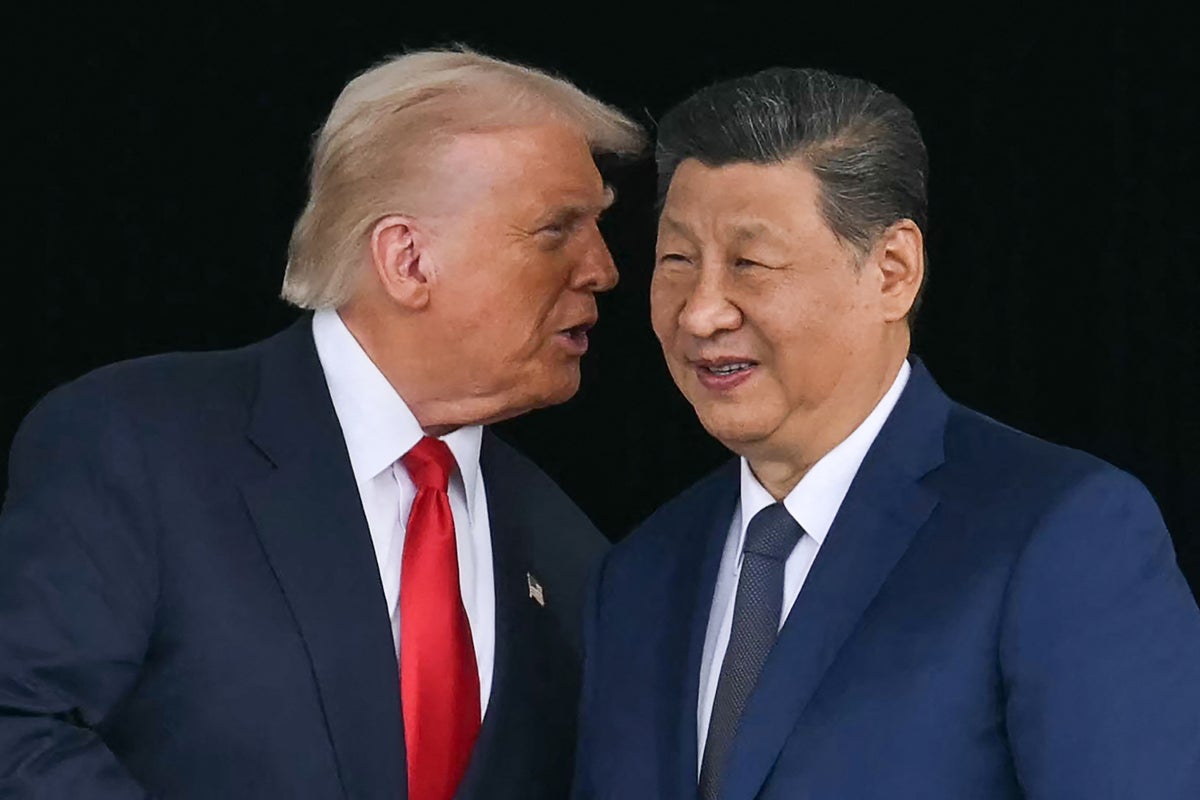
Washington is obsessed with the theater of the "big stick." The prevailing narrative, fueled by recent rhetoric, suggests that putting China on notice regarding America's prowess in "fighting" is a strategic masterstroke. It isn't. It’s a 20th-century solution to a 21st-century strangulation. While the beltway pundits high-five over soundbites about being "very good at fighting," they are ignoring the fact that the nature of the fight has already shifted under their feet. We are preparing for a boxing match while our opponent is busy buying the stadium, the concessions, and the oxygen supply.
The "lazy consensus" here is dangerous. It assumes that military kinetic capability—the ability to blow things up—is the ultimate currency of global power. In reality, that currency has been devalued. China’s leadership isn't losing sleep over the number of carrier strike groups in the Pacific; they are calculating how many days of industrial endurance the United States has left before its supply chains collapse without Beijing’s permission.
The Industrial Atrophy Scandal
The U.S. is "very good at fighting" only if the fight lasts three weeks and requires no replenishment of precision munitions. I’ve sat in rooms with defense contractors where the "battle scars" aren't from combat, but from trying to source basic microelectronics that aren't routed through a factory in Suzhou. We’ve outsourced our backbone and kept the muscles. Muscles without a skeleton are just a heap of meat.
Consider the $155$mm artillery shell crisis. A conflict in Ukraine—a localized, terrestrial war—stretched Western manufacturing to its absolute limit. Now, imagine a high-intensity maritime conflict in the Indo-Pacific. The Pentagon’s own "burn rates" for anti-ship missiles in simulated war games show that the U.S. runs dry in less than eight days. Being "good at fighting" means nothing if your magazine is empty by the second Tuesday of the campaign.
Xi Jinping understands something Washington refuses to acknowledge: Logistics is the only real superpower. China controls the processing of 85% of the world’s rare earth elements and a massive share of the active pharmaceutical ingredients (APIs) that keep the American population functional. If you want to put Xi on notice, don't brag about bombers. Show him a domestic smelting plant that actually works.
The Cognitive Dissonance of "Deterrence"
Traditional deterrence is based on the cost-benefit analysis of an attack. The current political posturing assumes that if we act "tough," China will back down. This is a fundamental misunderstanding of the CCP’s existential timeline. They aren't looking for a "win" in the Western sense of a signed treaty on a battleship. They are looking for the inevitable decline of a rival that can no longer build its own bridges, let alone its own warships.
The United States Navy is currently struggling to maintain its existing fleet. Shipyards are backed up for years. Maintenance cycles are slipping. Meanwhile, China’s shipbuilding capacity is roughly 200 times that of the U.S. in terms of raw tonnage potential. When you tell a man who owns the world’s largest shipyard that you are "good at fighting," he doesn't feel intimidated. He feels like he's watching a gambler brag about his poker face while his bank account is overdrawn.
The Silicon Trap
We talk about "technological superiority" as if it’s a permanent birthright. It’s not. The tech war isn't about who has the fastest chip; it’s about who has the most integrated ecosystem. We’ve spent decades "leveraging"—to use a word I despise—cheap labor and globalized assembly lines to boost quarterly dividends for Raytheon and Lockheed. In doing so, we handed over the blueprint for the very "fighting" we now brag about.
The real threat isn't a J-20 stealth fighter. It’s the fact that the telemetry software, the sensor components, and the rare-earth magnets inside American "cutting-edge" hardware are often tied to Chinese sub-tier suppliers. We are threatening to punch someone while they are holding our car keys.
Stop Asking if We Can Win a War
The "People Also Ask" sections of the internet are filled with questions like "Who has the stronger military, US or China?" or "Can the US win a war over Taiwan?" These are the wrong questions. They assume a binary outcome in a world of gray-zone attrition.
The right question is: "Can the US economy survive a victory?"
A kinetic "win" that results in a total decoupling from the Chinese manufacturing base would trigger a domestic depression in the United States that makes 1929 look like a mild market correction. We have built a civilization on the "Just-in-Time" delivery of goods from a geopolitical rival. You cannot "put them on notice" without putting your own civilian population on notice that their standard of living is about to vanish.
The Counter-Intuitive Path to Power
If the U.S. actually wants to exert pressure on Xi, it needs to stop the chest-thumping and start the boring, grueling work of industrial re-armament. This isn't about "fostering" innovation—it’s about hard-coded mandates for domestic production.
- Mandatory Onshoring of Sub-Tier Components: No defense contract should be awarded to any firm that cannot trace its entire supply chain—down to the raw mineral level—to a non-adversarial source. Yes, this will make a $100 million jet cost $300 million. Pay it.
- The "Boring" Military: Shift funding from flashy, vulnerable platforms like supercarriers toward mass-produced, attritable autonomous systems. We need 100,000 cheap drones, not one expensive target.
- Strategic Decoupling of Essentials: You don't win a fight by being "good" at it; you win by being the only one left standing when the power goes out. We need to dominate the production of antibiotics and semiconductors, not just the usage of them.
The Credibility Gap
The downside to this contrarian view? It's unpopular. It requires politicians to tell voters that "toughness" costs money and requires sacrifice, rather than just loud speeches. It requires CEOs to prioritize national security over their next bonus. Currently, neither group shows any appetite for this.
We are currently operating on the "John Wayne" theory of international relations. We think that if we walk into the saloon with our hand on our holster, everyone will quiet down. But Xi isn't in the saloon. He’s outside, buying the land the saloon is built on, the water rights to the well, and the mortgage on the sheriff’s house.
Bragging about being "good at fighting" while your industrial base is a hollowed-out shell isn't strength. It’s a bluff that’s been called a thousand times by history. The Roman Empire was "good at fighting" right up until the moment it realized it could no longer pay the Visigoths or manufacture the swords.
The world isn't on notice. The world is watching to see if we notice our own decline.
Put down the megaphone. Pick up a wrench. That is the only language Beijing actually fears.