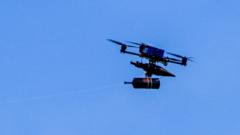
The defense analyst community has officially lost its mind over a spool of glass thread.
For the past several months, the commentary surrounding the conflict in Ukraine and the escalating skirmishes between Israel and Hezbollah has converged on a singular, terrifying boogeyman: the fiber-optic guided drone. Mainstream reports present these platforms as unjammable, unstoppable tactical shift keys. The narrative is neat, tidy, and wrong. We are told that because these drones trail a micro-tether of fiber-optic cable, bypassing traditional radio-frequency electronic warfare (EW), they have rendered billions of dollars in military jamming equipment obsolete.
This is lazy consensus at its absolute finest. It confuses a desperate, niche engineering workaround with a permanent revolution in mechanized warfare.
The media looks at a video of a Russian or Hezbollah drone flying cleanly through a localized GPS jamming field and panics. What they fail to see are the physics-based handcuffs that make fiber-optic drones a logistical nightmare, a tactical dead end for wide-scale operations, and an incredibly fragile asset on any dynamic battlefield.
I have spent years evaluating electronic counter-measures and automated systems in contested environments. The reality on the ground is brutally indifferent to hype. Fiber-optic drones are not the future of asymmetric warfare. They are a hyper-specific, deeply flawed reaction to a temporary electronic warfare bottleneck.
The Myth of the Unstoppable Tether
To understand why the current panic is overblown, we need to dismantle the premise of why these drones exist in the first place.
In Ukraine, Russian forces introduced the "Prince Vandal of Novgorod" FPV drone, which utilizes a spool of ultra-thin fiber-optic cable to transmit high-definition video and control signals back to the operator. Hezbollah quickly took note, deploying similar wire-guided systems against Israeli positions along the northern border. Because the command signal travels through a physical wire rather than over the airwaves, standard electronic warfare systems like Israel’s Iron Dome-adjacent jammers or Russia’s Krasukha complexes are useless against them. There is no radio frequency to disrupt.
This has led commentators to proclaim the death of traditional electronic warfare. But this conclusion completely ignores basic mechanical vulnerability.
Consider the physical reality of flying a drone that is constantly unspooling kilometers of glass fiber behind it.
- The Weight Penalty: Every meter of cable adds mass and drag. While a standard radio-controlled FPV drone can optimize its battery life for speed and agility, a fiber-optic drone is actively fighting the friction of its own tether.
- The Canopy Problem: In urban environments or forested areas—precisely where Hezbollah operates along the Blue Line—a trailing wire is a liability. It catches on tree branches, power lines, jagged ruins, and even the drone’s own prop wash if the pilot makes a sudden sharp turn. One snag and the glass snaps. The connection terminates instantly.
- The Kinetic Counter: You do not need a multi-million dollar jamming pod to stop a wire-guided drone. Standard smoke screens, dense brush, or even physical netting degrade their utility entirely.
The defense sector loves to worry about high-tech problems while ignoring low-tech realities. A fiber-optic drone cannot chase a target behind a dense treeline or maneuver through a complex industrial facility without a massive risk of self-sabotage. It is a straight-line weapon masquerading as a flexible tactical platform.
The Logistics Nightmare Nobody is Talking About
Let’s talk about manufacturing and deployment realities that military theorists completely ignore.
The standard defense analysis operates under the assumption that if a weapon works three times on camera, it can be scaled to tens of thousands of units seamlessly. Anyone who has ever run a hardware supply chain knows this is a fantasy.
+------------------------+------------------------+------------------------+
| Metric                 | Standard RF FPV Drone  | Fiber-Optic FPV Drone  |
+------------------------+------------------------+------------------------+
| Unit Cost              | ~$500 - $1,000         | ~$3,000 - $5,000+      |
| Supply Chain Complexity| Low (Off-the-shelf)    | High (Specialized glass|
|                        |                        | spools & transceivers) |
| Operator Mobility      | High (Move after launch| Low (Tether anchors    |
|                        | to avoid counter-fire) | operator location)     |
| Reusability            | None (Kamikaze)        | None (Kamikaze + leaves|
|                        |                        | physical trail)        |
+------------------------+------------------------+------------------------+
The specialized micro-fiber spools required for these drones are not cheap, nor are they easy to manufacture at scale. The glass must be incredibly pure to prevent signal degradation over five to ten kilometers, yet flexible enough to unspool at speeds exceeding 60 miles per hour without snapping under tension.
Furthermore, the deployment of these weapons creates an enormous operational security liability for the operators. Follow the wire.
When a standard FPV drone attacks a target, the operator can be hidden kilometers away, utilizing directional antennas or relays to mask their exact coordinates. When a fiber-optic drone crashes into an Israeli outpost or a Ukrainian armored vehicle, it leaves behind a literal breadcrumb trail made of glass fiber. Modern recon units do not even need advanced electronic warfare to find the pilot; they just need to follow the physical line left on the ground right back to the launch point.
In a theater where counter-battery fire and artillery response times are measured in dozens of seconds, a weapon that physically anchors you to your firing position is a suicide pact.
What the "Experts" Miss About Autonomous Targeting
The rise of fiber-optic drones is not a glimpse into the long-term future; it is a brief stopgap measure before the real shift occurs. The only reason these wire-guided systems are being deployed right now is because cheap, terminal machine-vision autonomy is still in its infancy on the battlefield.
The real vulnerability these drones are solving isn't the lack of a signal; it's the human in the loop.
Right now, an FPV pilot needs a clean video feed to guide the drone into a target during the final 150 feet of its flight—the exact zone where ground-based jammers are most effective. If the jammer cuts the feed, the human pilot goes blind and misses. The fiber-optic cable keeps the human pilot connected until impact.
But this solution is already becoming obsolete. Microprocessors capable of running edge-AI targeting algorithms are dropping in price and power requirements every month. Organizations like the Defense Advanced Research Projects Agency (DARPA) and private tech firms globally have already demonstrated terminal guidance systems that require zero external connectivity.
Imagine a scenario where a standard, cheap radio-controlled drone is launched toward a target area. Even if the enemy jams all GPS and control frequencies, the drone’s onboard camera and localized processor recognize the shape of a tank, a radar dish, or an infantry fighting vehicle. The drone locks onto that shape autonomously and completes the strike without needing a single byte of data from an operator.
Once terminal autonomy becomes standard—which will happen across global battlefields within the next 18 to 24 months—the fiber-optic drone goes straight to the museum. Why would any military buy expensive, fragile, heavy spools of wire when they can just solder a $50 autonomous chip onto a standard flight controller?
Dismantling the Common Panic Questions
When I speak with defense procurement officers and tech investors, their concerns usually stem from flawed premises popularized by sensationalist media. Let's address those directly.
"Don't these drones completely invalidate the billons spent on electronic warfare?"
Absolutely not. Electronic warfare is designed to deny the enemy situational awareness and command structure across a massive front. The fact that an adversary has to resort to trailing physical wires through the mud to get a single drone past a jammer is proof that electronic warfare is working, not that it is failing. It has forced the enemy to compromise their mobility, speed, and supply chain just to achieve a basic tactical hit.
"If Hezbollah can hit Israeli targets with these, what stops them from shutting down entire mechanized divisions?"
Scale stops them. You cannot run a synchronized, multi-domain offensive when your primary tactical reconnaissance and strike assets are physically tied to the ground. Wire-guided weapons are fundamentally defensive or ambush-oriented tools. They work well for an insurgent group sitting in a static bunker waiting for an armored column to pass by. They fail completely the moment you need to conduct high-speed, maneuveristic warfare across fluid territory.
The Real Danger is Complacency
The danger of the fiber-optic drone hype is that it distracts military planners from the real, incoming threat vector: massed, decentralized autonomous swarms that do not rely on wires or radio signals.
If Western militaries spend the next three years developing hyper-specific kinetic interceptors or wire-cutting counter-measures to deal with the fiber-optic threat, they will find themselves completely unprepared for the wave of fully autonomous, edge-computed drone fleets that require no external communications infrastructure whatsoever.
We are looking at a caterpillar and screaming that it has too many legs, completely blind to the fact that it is turning into a completely different beast right under our noses.
Stop analyzing the wire. Start preparing for the chip.