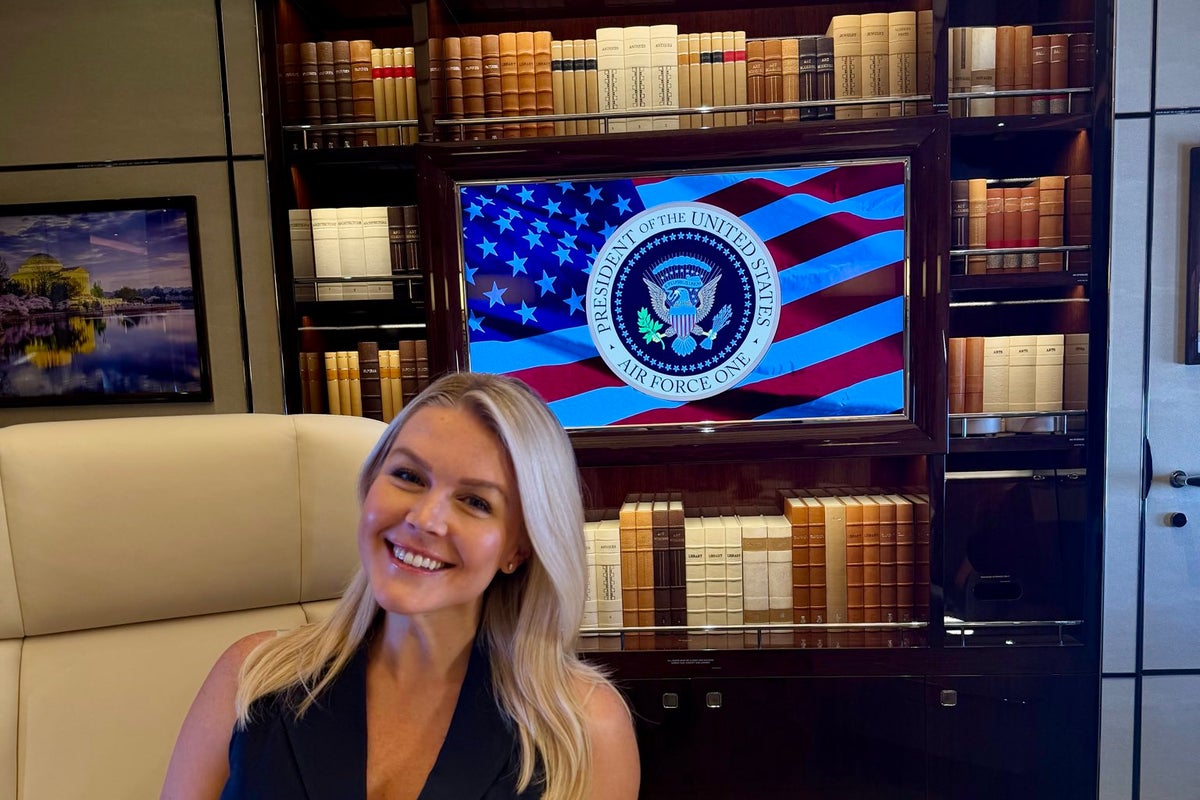
The internet loves a shallow dunk. When images surfaced showing a custom lounge inside a newly delivered presidential aircraft—replete with a built-in library featuring faux book spines—the commentariat lost its collective mind. The narrative wrote itself: a superficial display of unearned intellect, a gaudy prop gifted by foreign dignitaries, an aesthetic failure of presidential proportions.
It is a neat, comforting story for partisan critics. It is also entirely wrong.
Laying into a politician for "fake books" on a plane reveals a fundamental ignorance about aviation engineering, weight distribution, and the brutal realities of high-altitude interior design. The media fixated on the optics of deception. They completely ignored the physics of flight and the psychology of statecraft.
Let us dismantle the lazy consensus and look at what is actually happening in the cabin.
The Tyranny of the Weight and Balance Graph
In a standard living room, a bookshelf holds books. If you want to read War and Peace, you pull it off the shelf.
On a modified Boeing 747-8 or a VVIP head-of-state transport, a real bookshelf is a structural liability and a safety hazard.
Aviation design is governed by strict regulatory frameworks. Every single ounce added to an aircraft interior requires a calculation of fuel burn, center of gravity, and structural integrity under high-G loads.
- The Weight Penalty: A collection of 200 hardcover books weighs roughly 300 pounds. In aviation terms, carrying 300 pounds of dead weight across a 15-hour transatlantic flight is an expensive absurdity. It increases fuel consumption and reduces the operational range of the aircraft.
- The Projectile Factor: During severe turbulence or a hard landing, an unsecured copy of a dense biography transforms into a kinetic projectile traveling at 80 miles per hour. A real book can fracture a skull.
- The Solution: VVIP interior designers use lightweight faux panels made of composite materials or lightweight veneers. They provide the visual texture of a library without adding hundreds of pounds of dangerous, loose weight to the cabin bulkheads.
When you look at those "fake" books, you are not looking at a lack of culture. You are looking at aerospace engineering 101.
The Illusion of Home: Why VVIP Cabins Use Familiar Aesthetics
Critics mock the aesthetic as tacky or fraudulent. They miss the psychological objective of diplomatic transport design.
A presidential aircraft is not a public library; it is a mobile command center and a high-stakes diplomatic theater. Leaders spend hundreds of hours in these tubes, crossing time zones under immense cognitive stress.
Psychologists and interior architects specializing in long-haul corporate aviation know that sterile, ultra-modern environments increase fatigue and anxiety over long periods.
"The goal of high-end cabin design is to recreate the grounding familiarity of residential architecture. You simulate textures—wood grain, leather, fabric, and yes, library walls—to lower cortisol levels and create an environment conducive to high-stakes decision-making."
Is it a prop? Absolutely. But it is a functional prop designed to make a flying metal tube feel like a secure, grounded study. The deception is deliberate, and it serves a physiological purpose.
The Gift Trap: Navigating Foreign Protocol
Much of the criticism leveled at the layout stems from the fact that the interior configuration was influenced by a custom build originally intended for or gifted by Qatari elites before being repurposed.
The media frames this as a gaudy imposition of foreign taste onto an American icon.
This view ignores how global defense procurement and diplomatic asset acquisition actually work. When multi-billion-dollar aerospace assets change hands or are modified under complex international agreements, the interiors are rarely stripped down to bare aluminum immediately.
Scrapping millions of dollars worth of precision-engineered, fire-retardant interior cabinetry simply because the aesthetic offends the sensibilities of online commentators is bad business and terrible stewardship of resources. You inherit the build, you optimize the secure communications arrays, and you fly the mission.
The Real Crime is the Lack of Imagination
If we are going to criticize the interior of a head-of-state aircraft, let us criticize it for the right reasons. The problem isn't that the books are fake. The problem is that the design philosophy remains trapped in a regressive, twentieth-century vision of luxury.
Why are we still trying to make the most advanced command-and-control aircraft in the world look like a stuffy London smoking club from 1924?
The Evolution of Flying Statecraft
| Design Era | Primary Aesthetic | Operational Focus |
|---|---|---|
| Mid-Century (707) | Sleek, minimalist, functional | Basic transport and prestige |
| Late-Century (747-200) | Corporate boardroom, heavy woods | Secure analog communication |
| Modern VVIP (747-8) | Archaic faux-luxury, residential imitation | High-bandwidth digital command |
The insistence on faux wood grains and simulated leather-bound libraries represents a failure of aesthetic courage. True modern luxury on an aircraft of this scale should prioritize kinetic wellness: advanced circadian lighting arrays, active noise-cancellation bulkheads, and integrated biometric monitoring.
Instead, procurement committees and design firms default to a cartoonish shorthand for "prestige"—which invariably involves gold trim and fake literature.
Dismantling the Public Outrage
Let us answer the questions people are actually asking, without the partisan bias.
Why not just use digital screens or empty shelves?
Empty shelves look incomplete and create negative psychological space. Digital screens displaying digital book spines look like a cheap airport lounge. Faux panels provide tactile warmth and sound-dampening qualities that bare walls or glass screens cannot replicate.
Is this a waste of taxpayer money?
Repurposing existing high-end interior structures, even those with questionable design choices, is infinitely cheaper than ordering a complete baseline redesign from Boeing’s defense division. Stripping out a VVIP cabin and engineering a new one from scratch costs tens of millions of dollars in certification fees alone. Keeping the fake books actually saved money.
Stop Looking at the Spines
Next time a photo emerges of a politician sitting in front of a wall of unreadable books at 35,000 feet, save your breath.
Don't bemoan the death of literacy or the rise of political showmanship. Look at the bulkheads. Look at the seams. Recognize that you are looking at a highly complex, heavily regulated piece of military hardware trying very hard to pretend it isn't an aluminum pressure vessel flying through a freezing void.
The books are fake because the plane is real. Focus on the mission, not the wallpaper.