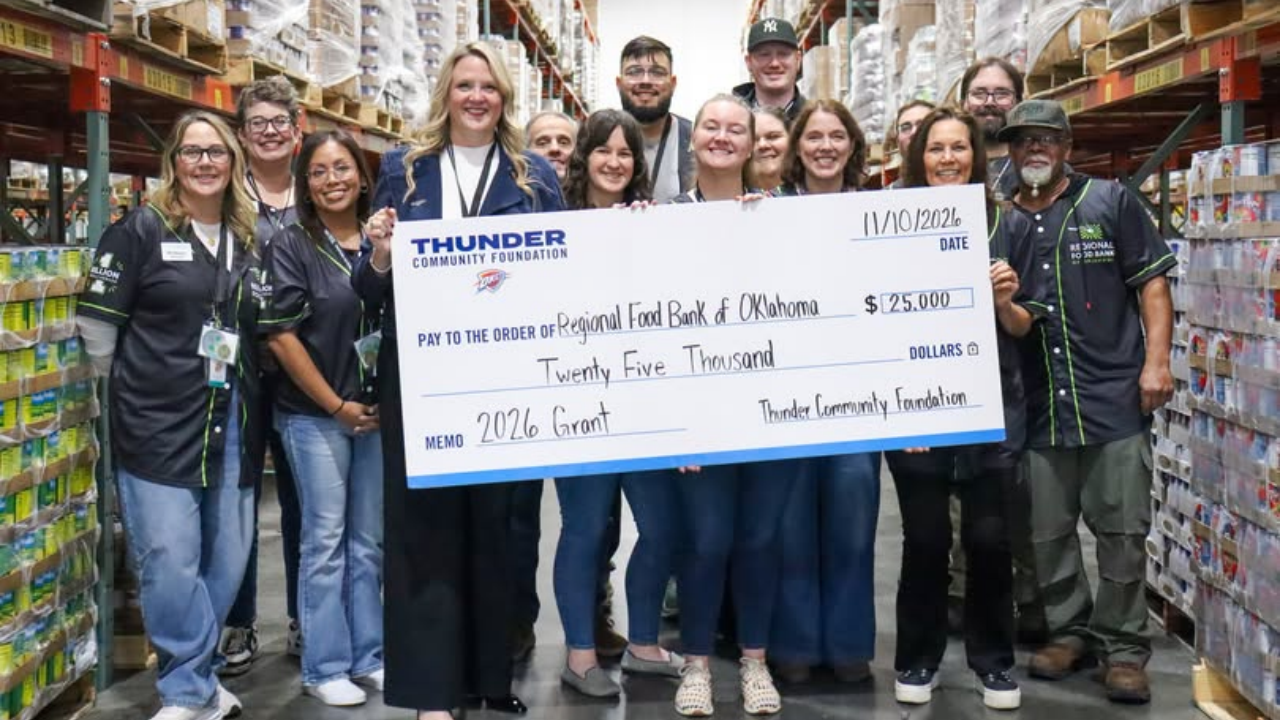
The Regional Food Bank of Oklahoma recently crossed a staggering operational threshold by distributing its one-billionth meal after 46 years of continuous service, an achievement punctuated by a $25,000 donation from the Oklahoma City Thunder. While local press releases and sports-adjacent coverage frame this milestone as a triumph of community charity, the reality beneath the warehouse lights is far more sobering. Reaching one billion meals is not a victory lap. It is a four-decade receipt for systemic economic failure, illustrating how emergency food distribution has quietly morphed from a temporary safety net into a permanent, load-bearing pillar of Oklahoma's domestic economy.
To understand what a billion meals actually means, you have to strip away the ceremonial ribbon-cutting and look at the cold logistics of hunger relief. Founded in 1980, the Regional Food Bank of Oklahoma was built during an era when federal social safety nets were shrinking and civic leaders believed private charity could bridge short-term gaps. Forty-six years later, the temporary bridge has become a permanent highway. The organization now serves 53 counties across central and western Oklahoma, operating a massive supply chain that rivals mid-sized commercial grocery distributors.
The Anatomy of a Billion-Meal Machine
Most people picture a food bank as a storefront where volunteers hand out dented cans of green beans. That image is decades out of date. A modern regional food bank is an industrial logistics clearinghouse. It does not primarily feed individuals directly; instead, it operates as a hub-and-spoke wholesaler supplying a vast network of partner agencies, including local pantries, churches, senior centers, and public schools.
When the Regional Food Bank of Oklahoma calculates a "meal," it uses a standardized industry metric established by Feeding America, which equates roughly 1.2 pounds of food to a single meal. Reaching the one-billion mark means this single institution has sourced, sorted, refrigerated, tracked, and hauled approximately 1.2 billion pounds of edible freight over four and a half decades. That is the equivalent weight of roughly 600,000 mid-sized sedans moving through loading docks in Oklahoma City.
How the Supply Chain Actually Works
The machinery behind this volume relies on three distinct pipelines that rarely get examined in feel-good news blurbs:
- Retail Reclamation: Major grocery chains generate massive amounts of unsellable but perfectly edible food due to packaging changes, approaching sell-by dates, or minor cosmetic damage. Food banks deploy refrigerated fleets to rescue these pallets before they hit landfills.
- Agricultural Surplus: Farmers and processors frequently end up with excess crops or grade-B produce that commercial buyers reject for aesthetic reasons. Food banks pay pennies on the dollar for harvesting and freight costs to move these bulk commodities into cold storage.
- Federal Commodity Programs: A substantial portion of food bank inventory does not come from private donors at all, but from federal initiatives like The Emergency Food Assistance Program (TEFAP), which buys domestic agricultural surpluses to stabilize farm prices and routes the food to state distribution networks.
Without this industrial-scale rescue infrastructure, the retail and agricultural sectors would face crippling waste-disposal expenses, and hundreds of thousands of Oklahomans would face immediate caloric deficits. Yet the sheer efficiency of the system masks a troubling truth. As corporate logistics improved over the last 46 years, the food bank became exceptionally good at capturing waste—and society became exceptionally comfortable letting rescued surplus substitute for living wages.
The Economics of Corporate and Sports Philanthropy
Enter the Oklahoma City Thunder. Alongside the billion-meal announcement, the NBA franchise contributed $25,000 to the food bank, continuing a long-standing partnership between the team and local hunger-relief efforts. In the world of modern sports marketing, this is standard operating procedure. Professional franchises maintain charitable foundations specifically designed to embed the team into the civic fabric of their host city.
Twenty-five thousand dollars sounds substantial to a working family. Translated into food bank purchasing power—where bulk buying and donated freight allow an organization to stretch a single dollar into roughly three or four meals—that check buys somewhere between 75,000 and 100,000 meals. In a vacuum, that is tens of thousands of dinners on tables across the state.
Put that same check next to the macro-numbers, however, and the perspective shifts violently.
| Financial Metric | Approximate Scale | Context in Hunger Relief |
|---|---|---|
| Thunder Donation | $25,000 | Funds roughly 75,000 to 100,000 meals at bulk rates |
| NBA Franchise Revenue | Hundreds of millions annually | Routine community relations expenditure |
| Annual Food Bank Output | Tens of millions of meals per year | Represents less than 48 hours of statewide demand |
| Oklahoma Food Insecurity | Hundreds of thousands of residents | Persistent structural deficit across 53 counties |
The check covers roughly a day or two of the food bank's annual distribution volume. It is a welcome gesture, certainly, and infinitely better than doing nothing. Still, when media coverage treats a $25,000 corporate donation as co-headline news alongside a 46-year humanitarian milestone, it creates a dangerous illusion. It suggests that high-profile charity is solving the problem, rather than merely bailing water out of a boat that has a permanent hole in the hull.
Why Hunger Persists in an Agricultural Giant
Oklahoma is one of the premier agricultural producers in the United States. The state exports massive quantities of winter wheat, beef cattle, poultry, and pork. Watching residents go hungry in a state that helps feed the rest of the planet exposes the central paradox of modern food insecurity. Hunger in America is rarely a supply problem. It is almost exclusively an access and income problem.
Over the past 46 years, Oklahoma has consistently ranked near the bottom of national metrics for food security, healthcare access, and wage growth. Several interlocking factors keep the Regional Food Bank of Oklahoma operating at near-maximum capacity regardless of whether the broader economy is booming or busting.
The Rural Grocery Desert Effect
Across the 53 counties served by the food bank, rural communities have watched independent grocery stores shutter at an alarming rate. Thin profit margins, consolidation among national retail chains, and rising transportation costs have left entire counties without a full-service supermarket. When a local grocer closes, low-income residents without reliable transportation cannot simply drive forty miles to the nearest supercenter. They are forced to buy high-priced, nutrient-poor shelf goods at dollar stores or gas stations—or rely on mobile food pantries dispatched from Oklahoma City.
Wage Stagnation Versus Inflation
Even when unemployment rates look healthy on paper, a massive segment of Oklahoma's workforce is employed in low-wage service, hospitality, and agricultural labor sectors. When housing rents, utility bills, and medical deductibles spike, food is the only flexible item in a household budget. You cannot negotiate with your electric company or pay half your rent without facing eviction. You can, however, skip dinner or visit a church pantry to stretch a paycheck until Friday.
The Benefit Cliff
Federal nutrition programs like the Supplemental Nutrition Assistance Program (SNAP) are designed to fluctuate with income, yet they suffer from rigid eligibility thresholds. A worker who receives a modest hourly raise can suddenly lose hundreds of dollars in monthly food benefits, leaving the household worse off than before the promotion. Food banks absorb the fallout from these policy friction points every single week.
The Structural Trap of the Charity Model
There is an uncomfortable conversation happening quietly among economists, sociologists, and even veteran food bank executives. When private charities become too effective at managing crisis, they inadvertently relieve pressure on lawmakers and employers to fix the root causes of poverty.
Consider how the system functioned in 1980 versus today. Forty-six years ago, emergency food pantries were viewed as shock absorbers for sudden personal catastrophes—a factory layoff, a house fire, a sudden medical emergency. Today, the majority of households utilizing the Regional Food Bank of Oklahoma's network are chronic users. They include working parents with full-time jobs, elderly citizens surviving on fixed Social Security checks, and disabled veterans whose benefits have not kept pace with the cost of living.
For example, take a hypothetical working single parent in central Oklahoma earning $14 an hour. After payroll taxes, childcare expenses, rent on a modest two-bedroom apartment, and aging vehicle maintenance, there is virtually zero margin left for fresh produce, lean proteins, or dairy. That parent is not experiencing an emergency; they are experiencing standard math. By stepping in every month with boxes of rescued groceries, the food bank makes an unlivable wage survivable.
This creates a quiet subsidy for low-wage industries. Employers can keep wages suppressed because private philanthropy and donated retail surplus keep their workforce fed. Legislators can resist expanding Medicaid, raising minimum wages, or funding public transit because the Regional Food Bank of Oklahoma is already handling the humanitarian fallout out of sight, behind warehouse doors.
What the Next Billion Meals Will Require
If current economic trajectories hold, the Regional Food Bank of Oklahoma will not take another 46 years to hit its two-billionth meal. Given the acceleration of distribution volumes over the last decade—driven by pandemic-era disruptions followed by stubborn grocery inflation—the next billion will likely be reached in less than half that time.
That looming reality forces a reckoning with how hunger relief operates. Food banks can no longer simply move calories; they have to manage public health outcomes. Cheap, shelf-stable carbohydrates were the backbone of food banking in the 1980s and 1990s. Today, food-insecure Oklahomans suffer from disproportionately high rates of Type 2 diabetes, hypertension, and heart disease—conditions directly worsened by diets heavy in processed starches and sodium.
To counter this, the Regional Food Bank of Oklahoma has had to invest heavily in complex cold-chain infrastructure. Moving fresh produce, milk, eggs, and lean meats across 53 counties requires expensive refrigerated trailers, rapid inventory turnover, and partner pantries equipped with commercial coolers rather than simple shelving. Every pound of fresh spinach or chicken breast distributed costs significantly more in logistics than a pound of dried pasta.
At the same time, charitable giving is consolidating. While large corporate gestures like the Thunder's $25,000 check generate easy headlines, the backbone of food bank funding has historically been small-dollar recurring donors. As middle-class households feel their own budgets squeezed by higher living costs, small donations tend to flatten just as demand at the pantry door surges.
Measuring Success by Shrinking Demand
The ultimate paradox of the hunger-relief industry is that its success is routinely measured by its own growth. Annual reports celebrate record pounds distributed, new warehouse square footage, expanded fleet sizes, and billion-meal milestones. In any other sector, rising output signals a thriving enterprise. In emergency food distribution, rising output signals a worsening societal failure.
The workers, volunteers, and logistics experts at the Regional Food Bank of Oklahoma have spent 46 years performing an extraordinary feat of operational mercy, preventing untold suffering across the state. The Oklahoma City Thunder's financial backing helps keep those trucks rolling on the highway. Yet celebrating the billionth meal without interrogating why a billion meals were needed in the first place misses the entire story.
Real progress in Oklahoma will not look like a press release announcing the two-billionth meal. It will look like a quiet year where the trucks carry less freight, the warehouse aisles sit half-empty, and the state finally builds an economy where working people can buy their own groceries.