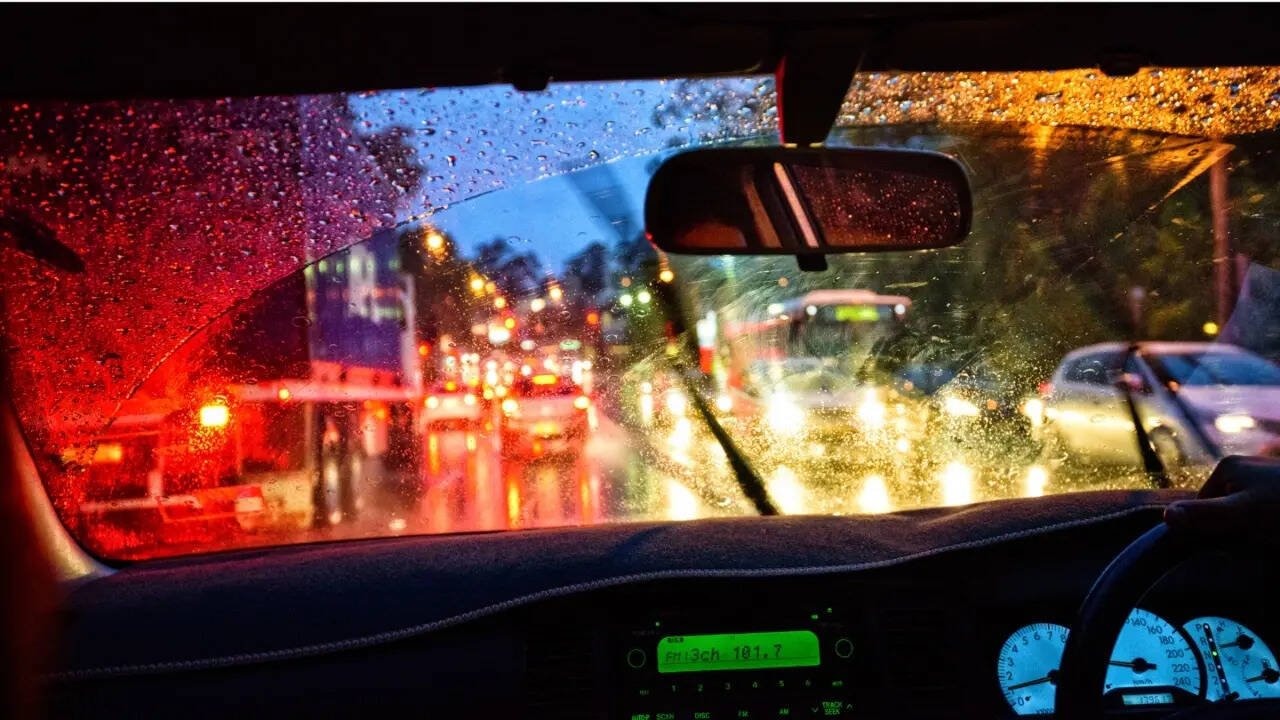
The Safety Industrial Complex Is Lying To You
Every time a cloud darkens the horizon over Sheikh Zayed Road, the local media machine churns out the same tired listicle. You’ve seen it. "Seven Fines to Avoid During Rain." "Don't Take Photos." "Don't Gather Near Valleys." It is a checklist designed for the lowest common denominator, focusing on the contents of your wallet rather than the physics of your vehicle.
The "lazy consensus" suggests that if you simply memorize the fine schedule, you are a responsible driver. This is a dangerous fallacy. Following the law is not the same as mastering the environment. In fact, the obsession with avoiding a AED 1,000 penalty often leads drivers to make catastrophic tactical errors that no police camera will ever catch.
I’ve spent a decade navigating the GCC’s unique drainage challenges—or lack thereof. I have watched luxury SUVs succumb to hydroplaning because the driver was more worried about their hazard lights than their tire pressure. We need to stop talking about fines and start talking about the reality of desert flooding.
The Hazard Light Myth Is Killing Traffic Flow
Let’s dismantle the biggest offender first: the "hazard lights in rain" debate. Most people think they are being helpful. They aren't. They are creating a visual cacophony that obscures their turn signals and brake lights.
While the official line often warns against "misuse of hazard lights," the nuance is usually lost. The real danger isn't the fine; it's the cognitive load you place on the driver behind you. When you flash four amber lights constantly, you lose the ability to communicate intent.
If you are moving, your hazards should be off. Period. If you are a hazard—meaning you are stationary or a legitimate obstacle—then you use them. By keeping them on while cruising at 60km/h, you are effectively crying wolf. When you actually need to brake hard, the person behind you sees no change in your lighting pattern. That is how multi-car pileups happen on the E11.
Your SUV Is Not A Submarine
The media loves to warn against "gathering near valleys" (Wadis). This is solid advice, but it misses the point for the urban commuter. The real threat isn't a flash flood in Hatta; it's the 30-centimeter "puddle" in Al Quoz or Business Bay.
Drivers in the UAE have a false sense of security provided by high-clearance vehicles. They see a Patrol or a Land Cruiser and assume they are invincible. Here is the physics they ignore:
$$F_b = \rho V g$$
The buoyancy force ($F_b$) acting on your car is equal to the weight of the water displaced. As soon as that water level hits your chassis, your two-ton SUV starts to lose traction. You aren't driving anymore; you're a very expensive, very heavy boat with no rudder.
The "contrarian" take here? Stop trying to find the shallowest path. If the water is deep enough that you can't see the pavement, you shouldn't be there. The fine for "entering flooded valleys" is a pittance compared to the AED 50,000 engine rebuild you’ll face when your intake sucks in a liter of rainwater.
The Invisible Fine: The Maintenance Gap
The authorities focus on behavior—speeding, tailgating, reckless driving. These are easy to ticket. But the most "reckless" thing I see during UAE rain isn't a driver going 10km/h over the limit. It’s a driver with bald tires and dry-rotted wiper blades.
In a climate where the sun bakes rubber for 350 days a year, your tires undergo a process called thermo-oxidative degradation. By the time the first rain hits in January or February, your grip is a fraction of what it was when those tires were fitted.
- The Penny Test is Useless: In the desert, your tread depth might be fine, but the rubber compound has turned into hard plastic.
- Hydroplaning is Mathematical: It’s not an "accident." It happens when your speed exceeds the ability of your tread to evacuate water.
- Wiper Failure: If you haven't replaced your blades in six months, they will smear the oily film (accumulated dust and exhaust soot) across your windshield, blinding you instantly.
The police won't fine you for having three-year-old tires until they are examining the wreckage. You are worried about a AED 500 ticket for "obstructing traffic" while driving on four ticking time bombs.
Social Media Is Not The Problem; Distraction Is
The headlines scream about the "fine for taking videos of rain while driving." Yes, it’s illegal. Yes, it’s AED 800 and 4 black points. But the focus on "filming" is a red herring.
The real issue is the normalization of degraded attention. Because rain is a "novelty" in the UAE, drivers treat it like a spectacle rather than a hazard. They aren't just filming; they are looking at the sky, looking at the splashes, and checking their mirrors to see how "cool" the spray looks.
Imagine a scenario where we treated rain with the same gravity as a sandstorm. You wouldn't be reaching for your phone. You’d be gripping the wheel with both hands, feeling for the subtle "lightness" in the steering that signals a loss of contact with the road.
The "status quo" advice tells you to put the phone down to avoid a fine. I am telling you to put the phone down because your reaction time in the wet is already 30% slower due to reduced visibility and mechanical lag.
Why "Slowing Down" Is Bad Advice
Wait, what? Before you call the RTA, listen to the nuance.
"Slow down in the rain" is the most common piece of advice. It’s also dangerously incomplete. If you slam on your brakes on a wet UAE road, you are hitting a layer of oil, dust, and water that hasn't been washed away in months.
The correct advice is Consistent Momentum Management. * Engine Braking over Friction Braking: If you have a manual override, use it. Shifting down allows the engine to regulate speed without locking the wheels.
- The 5-Second Rule: The standard 2-second following distance is for dry asphalt. In the rain, you need at least five seconds. Most drivers "slow down" but stay tucked right under the bumper of the car in front. That’s a recipe for a multi-car insurance claim.
- Avoid the "Fast" Lane: The left-most lanes on major highways are often the most concave, meaning they hold the most standing water. The "slow" lane is safer not just because of the speed, but because of the drainage slope (crown) of the road.
The "Emergency" Mindset Trap
The UAE government is excellent at issuing alerts via mobile phones. These "Emergency Weather Alerts" often trigger a panic response in drivers. I’ve seen it firsthand: the alert chirps, and suddenly everyone on the E311 is driving like they are in an action movie, trying to get home before the "real" storm hits.
This "race against the rain" is what causes the spike in accidents.
The contrarian move? Stay where you are. If you are at the office and it starts pouring, don't rush to your car to beat the traffic. The traffic is already broken. The drainage system is already overwhelmed. The safest way to handle UAE rain is to wait two hours for the peak intensity to pass and for the tankers to start pumping out the low points.
Stop Looking For Fines, Start Looking For Friction
The competitor articles want to sell you a list of rules to follow so you can feel like a "good citizen." I am telling you that the rules are the bare minimum.
If you want to survive the next deluge without a scratch on your car or a dent in your bank account, stop worrying about the AED 2,000 fine for "reckless driving." Start worrying about the coefficient of friction ($\mu$) between your tires and the road.
The laws of physics don't care about your clean driving record or how many "tips" you read on a lifestyle blog.
Check your tires. Change your wipers. Kill the hazard lights. And for heaven's sake, stop treating the road like a film set. The rain isn't an event to be captured; it's a structural failure of your environment that requires your absolute, undivided professional attention.
Go check your tire manufacturing date right now. If it says anything older than 2024, you’re already breaking a law of nature, and that fine is much steeper than anything the police can write.


